Eyelid asymmetry is often first noticed in a photograph.
One eye may appear more open than the other, or one upper eyelid may seem to sit lower. This can lead to the assumption that the difference can be understood simply by comparing eyelid height.
But eyelids are not static structures.
They move every time we open our eyes, change our gaze, or use the brow and forehead to assist eye opening. In patients with ptosis, facial nerve paralysis, or complex eyelid asymmetry, these movements can reveal functional differences that are difficult to recognize in a resting photograph alone.
For this reason, eyelid evaluation should consider not only where the eyelids are positioned, but how they move.
A Resting Photograph Shows Only One Moment
A frontal photograph taken with the eyes naturally open is an important part of eyelid evaluation.
It can show differences in eyelid height, crease position, brow position, and overall symmetry.
However, it represents only one moment.
Two eyelids that appear relatively balanced at rest may behave differently when the patient attempts to open the eyes more widely. Conversely, an apparent difference at rest may partly reflect brow position or compensatory forehead activity rather than the eyelid-opening mechanism alone.
This is why a static photograph should not be the only basis for deciding whether ptosis correction is appropriate.
What Active Eye Opening Can Reveal
During evaluation, it is useful to observe the eyes both during natural opening and during wider active eye opening.
This can make certain functional differences easier to recognize.
For example, active opening may reveal that one eyelid does not elevate as effectively as the other, that the brow is being recruited differently between the two sides, or that asymmetry becomes more pronounced with increased effort.
The important point is not simply whether one eye becomes larger.
It is how the eyelids, brows, and surrounding structures behave as the patient attempts to open the eyes.
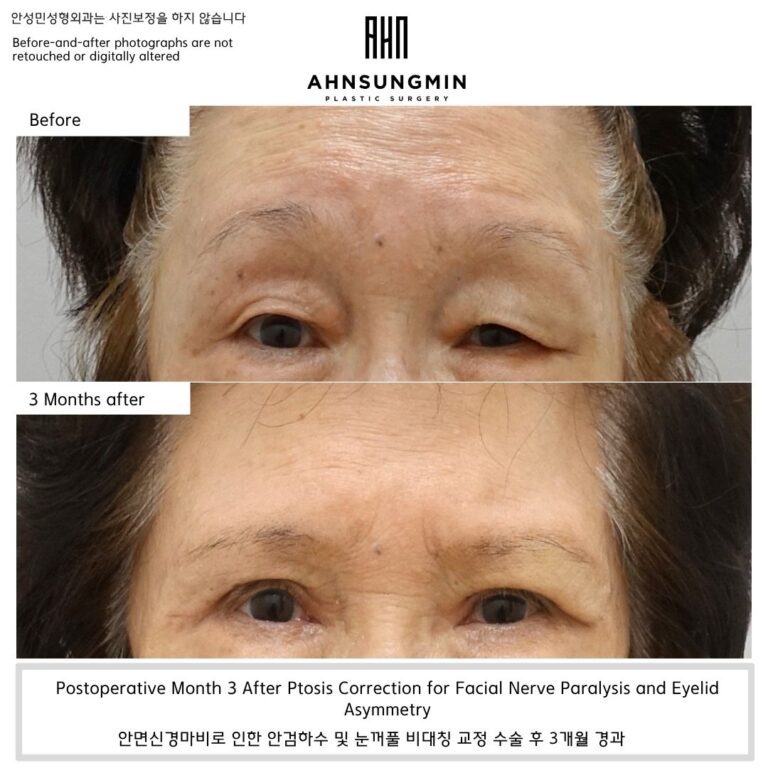
Eyelid asymmetry may become more apparent during active eye opening. Comparing movement before and after treatment provides additional information beyond resting eyelid height.
View the Primary Clinical Case →
Brow Compensation Can Mask the Underlying Difference
The upper eyelid does not function independently from the brow and forehead.
When eyelid opening is reduced, some patients unconsciously elevate the brow or activate the forehead in an attempt to open the eye more widely.
This compensation can change the apparent position of the upper eyelid.
As a result, an eyelid may appear more open in a photograph even though additional effort is being used to maintain that position.
If brow compensation is not recognized, the degree or cause of eyelid asymmetry may be misinterpreted.
This is why evaluation should consider eyelid opening and brow movement together.
Facial Nerve Paralysis Makes Dynamic Evaluation Especially Important
In patients with facial nerve paralysis, the functional relationship between the two sides may already be different.
Changes in facial muscle activity, brow position, forehead compensation, and movement around the eye can influence how the eyelids appear at different moments.
True ptosis may also be present, but it should not be assumed simply because one eye appears smaller or more closed.
Observing eyelid movement helps distinguish between different contributing factors and provides a more complete understanding of the asymmetry.
For a broader explanation of how these factors are assessed, see our Facial Nerve Paralysis Eyelid Surgery in Korea guide.
Previous Surgery Can Change Eyelid Movement
Dynamic evaluation is also important in revision cases.
Previous ptosis correction or eyelid surgery may create scar tissue, adhesions, tissue deficiency, or changes in eyelid mechanics.
An eyelid may therefore look acceptable at rest while demonstrating an abnormal relationship with the opposite side during active opening.
Before considering another operation, the surgeon should determine whether the remaining asymmetry is related primarily to the underlying eyelid function, previous surgical changes, neuromuscular differences, or a combination of these factors.
This is one reason revision surgery should not begin simply by deciding that an eyelid needs “more correction.”
Movement Also Matters After Surgery
Functional evaluation does not end when surgery is completed.
Postoperative photographs at rest are useful, but they do not provide the entire picture.
As swelling decreases and eyelid movement becomes more natural, the relationship between the two sides should also be observed during active eye opening.
This is particularly important in patients with pre-existing functional asymmetry or facial nerve dysfunction.
A good result should remain reasonably balanced not only in a single photograph, but during natural eyelid movement.
Why More Eye Opening Is Not Always Better
It can be tempting to judge ptosis surgery by how much larger the eye becomes.
But greater eyelid height does not automatically mean better function.
If correction exceeds what the eyelid can naturally support, the result may appear unnatural or create a new imbalance between the two sides.
The appropriate amount of correction depends on the functional condition of each eyelid and the relationship between them.
This is why surgical planning should prioritize functional balance rather than maximum eye opening.
Eyelid Position and Eyelid Function Should Be Evaluated Together
Eyelid height is important—but it is only part of the evaluation.
Natural eye opening, wider active opening, brow compensation, previous surgery, and underlying neuromuscular function can all influence the appearance of asymmetry.
Looking at movement helps explain why the two eyes are different, not simply how different they appear in one photograph.
For patients with complex ptosis or eyelid asymmetry, this distinction can influence whether surgery is appropriate, what type of correction should be considered, and how much correction is reasonable.
A balanced eyelid should not only look natural at rest. It should also move naturally.
Related Clinical Cases
Ptosis Correction for Facial Nerve Paralysis and Eyelid Asymmetry
A primary case showing how active eye opening can reveal functional asymmetry that may not be fully understood from resting eyelid position alone.
Revision Ptosis Correction for Facial Nerve Paralysis and Eyelid Asymmetry
A revision case demonstrating why eyelid movement should be evaluated together with previous surgical changes and underlying neuromuscular function.
Related Insights
Ptosis and Facial Nerve Paralysis: Why Eyelid Asymmetry Requires Functional Evaluation
Why eyelid height alone cannot fully explain asymmetry when underlying facial nerve function is different between the two sides.
Why Perfect Eyelid Symmetry May Not Be Possible With Facial Nerve Paralysis
Understanding why functional balance and natural movement may be more important than forcing identical eyelid height.
Revision Ptosis Surgery: Why Previous Eyelid Surgery Changes the Surgical Plan
Scar tissue, adhesions, and altered eyelid mechanics can make revision ptosis correction fundamentally different from primary surgery.
Why Overcorrection Can Be a Problem in Revision Ptosis Surgery
More correction does not always create better function, particularly when previous surgery or underlying neuromuscular imbalance is present.
AHNSUNGMIN Surgical Philosophy
We do not evaluate eyelid surgery from a single static measurement.
Eyelid position, active movement, brow compensation, previous surgical changes, and the functional relationship between the two sides are considered together before determining whether correction is appropriate.
The goal is not maximum eyelid height, but natural movement, functional balance, and long-term stability.
