Facial Nerve Paralysis Eyelid Surgery in Korea
Facial nerve paralysis can affect eyelid position, eye opening, and the balance between the two eyes. Treatment should begin by understanding how each eyelid functions—not simply by trying to make both eyes look identical.
AHNSUNGMIN Plastic Surgery specializes exclusively in eyelid surgery, including complex eyelid asymmetry, ptosis correction, and revision eyelid surgery. Each treatment plan is based on functional evaluation, individual eyelid mechanics, natural movement, and long-term stability.
20+ Years
Specializing in Eyelid Surgery
Maximum 2
Surgeries Per Day
One Surgeon
Complete Care
International Patient Program
How Can Facial Nerve Paralysis Affect the Eyes?
Facial nerve paralysis can affect the muscles that control facial expression, brow position, and movement around the eyes. When muscle function becomes different between the two sides of the face, the eyes may appear asymmetric even when the eyelids themselves are not the only cause.
Patients may develop differences in eyelid position, eye opening, brow position, or compensatory forehead movement. In some cases, ptosis or pre-existing eyelid asymmetry may further contribute to the imbalance.
For this reason, eyelid surgery in patients with facial nerve paralysis should begin with a functional evaluation of the entire eye and brow region—not simply a comparison of eyelid height.
The goal is not to make both eyes mechanically identical. It is to understand the cause of the asymmetry and determine whether surgery can improve functional balance, natural eyelid movement, and long-term stability.
Facial Nerve Paralysis Does Not Always Mean Ptosis
Facial nerve paralysis can affect the eye region in different ways, and not every patient develops true ptosis.
Changes in brow position, eyelid closure, lower eyelid position, facial muscle activity, or compensatory forehead movement may also affect how the eyes appear and function.
For this reason, the first step is not deciding how much ptosis correction is needed. It is determining which structure or functional difference is actually responsible for the patient’s symptoms and asymmetry.
Not every patient with facial nerve paralysis needs ptosis correction—or eyelid surgery at all.
Why Eyelid Surgery for Facial Nerve Paralysis Is Different
Eyelid asymmetry associated with facial nerve paralysis is different from ordinary cosmetic eyelid asymmetry.
The two sides of the face may not have the same underlying muscle function. As a result, simply adjusting eyelid height or trying to make both eyes look identical at rest may not create a natural or stable result.
Surgical planning should consider not only how the eyes look, but how they function and move.
01. Functional Differences Between the Two Sides
The underlying neuromuscular condition may affect each side differently. Treatment should be individualized according to the function of each eyelid.
02. Eyelid Movement Matters
Symmetry at rest does not tell the whole story. The eyelids should also be evaluated during natural and wider eye opening.
03. Previous Surgery Changes the Plan
Previous ptosis or eyelid surgery may leave scar tissue, adhesions, or altered eyelid mechanics that require a different surgical approach.
For patients with facial nerve paralysis, the goal of eyelid surgery is therefore not maximum correction or perfect anatomical symmetry.
The priority is to achieve the best possible functional balance while preserving natural eyelid movement and long-term stability.
What Eyelid Problems Can Be Associated With Facial Nerve Paralysis?
Facial nerve paralysis does not affect every patient in the same way. The pattern of eyelid and brow imbalance depends on the underlying nerve function, muscle activity, previous surgery, and the condition of each eyelid.
For this reason, treatment should be based on the specific functional problem present in each patient, rather than on facial asymmetry alone.
Asymmetric Eye Opening
One eye may appear more open or more closed than the other, particularly during active eye opening. The degree of asymmetry may also change between resting and active facial movement.
Ptosis
Drooping of the upper eyelid may contribute to reduced eye opening. When ptosis is present, the eyelid-opening mechanism should be evaluated independently on each side before considering correction.
Brow and Forehead Imbalance
Differences in brow position or compensatory forehead use can change the apparent position of the eyelids. What appears to be an eyelid problem may therefore involve the brow and forehead as well.
Asymmetry After Previous Eyelid Surgery
Patients who have already undergone ptosis correction, upper blepharoplasty, or other eyelid surgery require additional evaluation. Scar tissue, adhesions, and altered eyelid mechanics may contribute to persistent or recurrent asymmetry.
The same visible asymmetry can have different underlying causes. Identifying the cause is therefore more important than simply correcting the difference in eyelid height.
How We Evaluate Eyelid Asymmetry Before Surgery
Before considering eyelid surgery for facial nerve paralysis, we first determine why the two eyes appear and function differently.
A single resting photograph is not enough. Eyelid position can change with eye-opening effort, brow movement, forehead compensation, and the underlying neuromuscular difference between the two sides.
For this reason, evaluation includes both static appearance and dynamic eyelid function.
01. Eyelid Position at Rest
We first evaluate eyelid height, crease position, brow position, and the overall relationship between the two eyes without excessive effort.
02. Active Eye Opening
The patient is asked to open the eyes naturally and then more widely. Some functional differences become much more apparent during movement than they are at rest.
03. Brow & Forehead Compensation
We assess whether the brow or forehead is being used to compensate for reduced eyelid opening. This can make an eyelid appear more functional than it actually is.
04. Previous Surgery & Tissue Condition
For patients who have undergone previous eyelid or ptosis surgery, scar tissue, adhesions, tissue deficiency, and altered eyelid mechanics must also be considered.
05. Realistic Surgical Limits
Finally, we determine what surgery can reasonably improve—and what differences may remain because of the underlying facial nerve dysfunction.
Accurate evaluation comes before correction. The goal is not to operate on every visible difference, but to identify which part of the asymmetry can be improved safely and meaningfully.
Real Clinical Cases
CASE 1
Revision Ptosis Correction in a Patient With Facial Nerve Paralysis
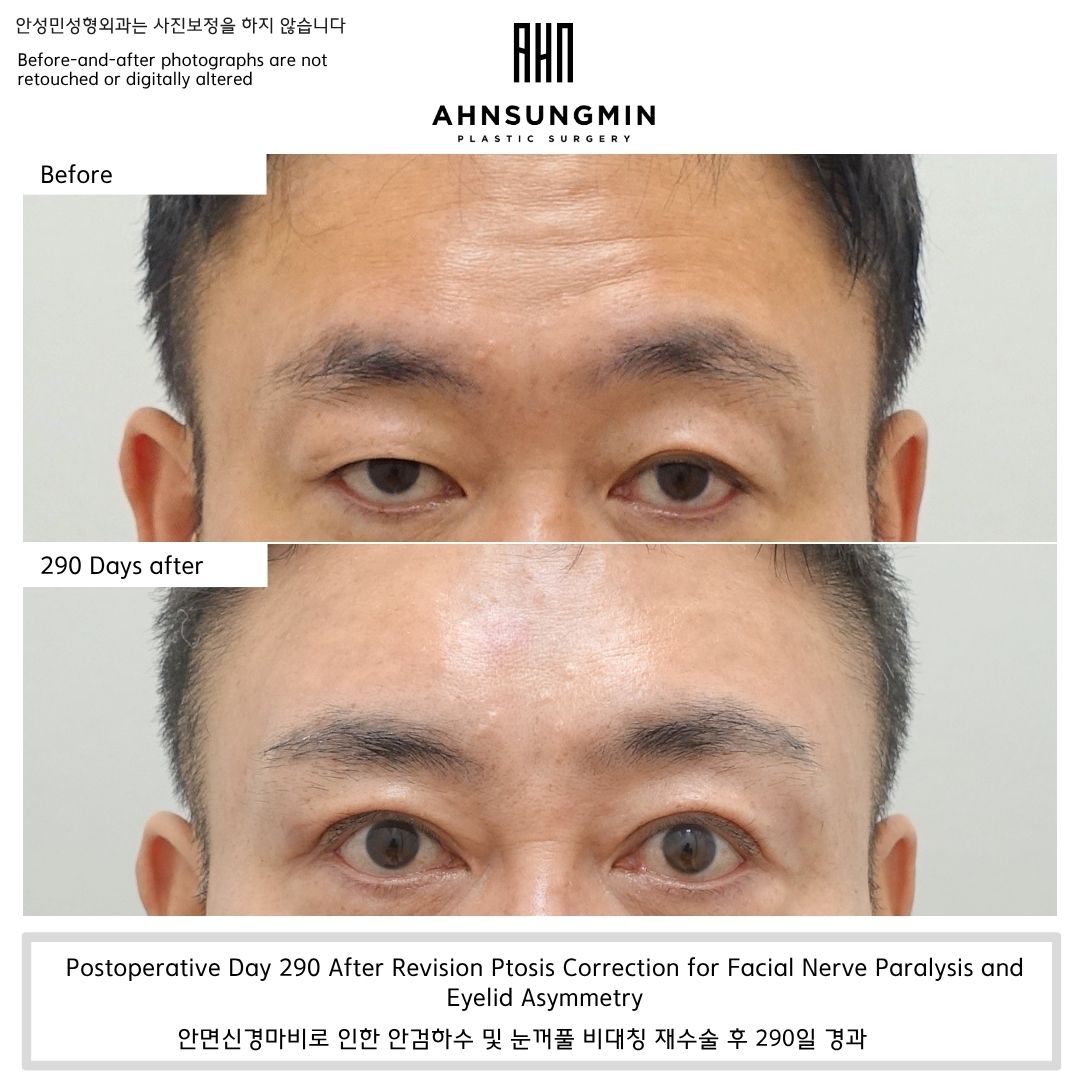
This patient presented with facial nerve paralysis and persistent eyelid asymmetry after previous eyelid surgery.
Because facial nerve function was already asymmetric, the two eyelids needed to be evaluated according to their individual movement and function rather than attempting to make both eyes mechanically identical.
Revision ptosis correction was planned to improve functional balance while avoiding excessive correction.
Restoring Eyelid Balance
Before revision surgery, there was a visible difference in eyelid opening between the two sides.
At postoperative day 290, eyelid position appears more balanced at rest. The goal was not maximum enlargement, but improved functional balance and stability.
Functional Balance With Wider Eye Opening
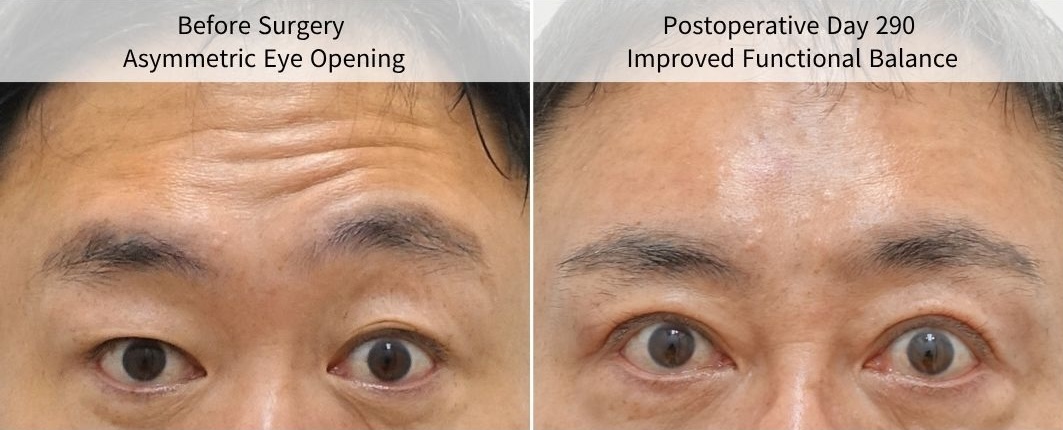
The asymmetry became more apparent when the patient opened his eyes widely.
At postoperative day 290, wider eye opening demonstrates improved balance between the two sides, providing an additional way to evaluate functional improvement beyond the resting position.
Why This Case Required a Conservative Approach
Facial nerve paralysis creates an underlying functional difference between the two sides, while previous surgery may add scar tissue, adhesion, and altered eyelid mechanics.
For this reason, revision ptosis correction should not pursue forced symmetry. The priority is to achieve the best possible functional balance while preserving natural eyelid movement and avoiding overcorrection.
In complex ptosis revision, a better result does not necessarily mean a larger eye. It means more balanced function that remains stable over time.
CASE 2
Ptosis Correction for Facial Nerve Paralysis

Facial nerve paralysis can affect eyelid position and create significant asymmetry in eye opening.
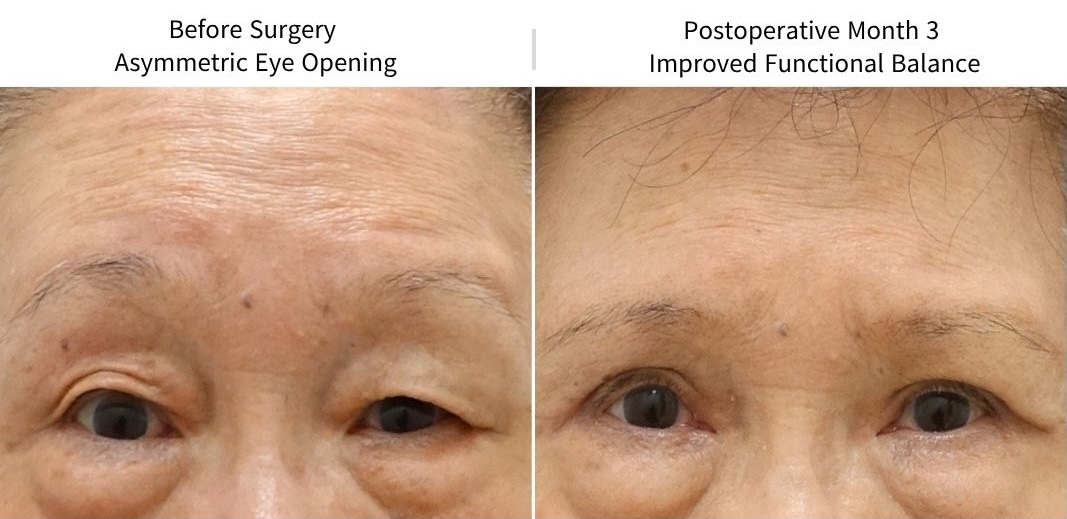
In this patient in her 60s, the two eyes did not open evenly. The goal of ptosis correction was not to make the eyes larger, but to improve functional balance while respecting the underlying facial nerve condition.
Before Surgery
Before surgery, there was a clear difference in eyelid opening between the two eyes. The asymmetry became more noticeable when the patient attempted to open her eyes widely.
This required evaluation of eyelid function rather than eye size or crease shape alone.
Postoperative Month 3
Three months after ptosis correction, eyelid opening appears more balanced while maintaining a natural appearance.
The improvement is particularly important during active eye opening, where functional asymmetry can be evaluated more clearly.
Restoring Functional Balance
In patients with facial nerve paralysis, complete anatomical symmetry may not always be achievable.
The goal is therefore not forced symmetry or maximum enlargement, but to restore the best possible functional balance within the limitations of the underlying neuromuscular condition.
Can Eyelid Surgery Restore Perfect Symmetry After Facial Nerve Paralysis?
Not always.
Facial nerve paralysis can create different neuromuscular conditions on each side of the face. Even when eyelid position improves after surgery, the two sides may continue to move differently because the underlying nerve and muscle function is not identical.
For this reason, perfect symmetry should not be the primary goal of surgery.
Attempting to force both eyelids into exactly the same position may require excessive correction and can sometimes create unnatural movement, overcorrection, or a new functional imbalance.
Instead, treatment should focus on what can be improved safely and meaningfully for each patient.
What Surgery May Improve
Eyelid Opening
Ptosis correction may improve reduced eyelid opening when eyelid-opening function contributes to the asymmetry.
Visible Asymmetry
Differences in eyelid position may be reduced when the underlying cause can be surgically addressed.
Functional Balance
The relationship between the two eyelids may become more balanced both at rest and during active eye opening.
Natural Eyelid Movement
Correction should preserve natural movement rather than pursuing maximum eyelid height.
What Surgery Cannot Change
Eyelid surgery does not restore the underlying facial nerve itself.
Some differences in facial movement, brow position, muscle activity, or dynamic symmetry may therefore remain even after successful eyelid correction.
Understanding these limitations before surgery is an important part of determining whether treatment is appropriate.
A successful result does not necessarily mean two perfectly identical eyes. It means achieving the best possible functional balance while respecting the underlying neuromuscular condition.
Primary vs. Revision Eyelid Surgery After Facial Nerve Paralysis
Eyelid surgery for facial nerve paralysis requires individualized planning whether the patient has never undergone eyelid surgery before or is seeking correction after a previous procedure.
However, revision surgery introduces additional structural considerations.
Previous ptosis correction or eyelid surgery may leave scar tissue, adhesions, tissue deficiency, or altered eyelid mechanics. These changes must be evaluated together with the underlying neuromuscular imbalance before another operation is considered.
Primary Eyelid Surgery
In patients without previous eyelid surgery, evaluation focuses on the existing eyelid function, degree of asymmetry, brow and forehead compensation, and how the two eyelids move during active eye opening.
The surgical plan is based on the functional condition of each side rather than a predetermined amount of correction.
Revision Eyelid Surgery
Revision surgery requires an additional layer of analysis.
The surgeon must distinguish between asymmetry related to facial nerve dysfunction and problems created or altered by previous surgery.
Scar tissue, adhesions, previous overcorrection or undercorrection, and changes in eyelid mechanics may all influence what can safely be improved.
Why More Correction Is Not Always Better
When persistent asymmetry remains after previous surgery, repeating or strengthening the same correction is not necessarily the answer.
Further surgery should only be considered after identifying why the imbalance remains and whether another procedure can provide meaningful functional improvement without creating additional instability.
In revision surgery, understanding what has already been changed is just as important as deciding what should be changed next.
Learn more about our approach to Revision Eyelid Surgery in Korea
When Is Eyelid Surgery Appropriate—and When Is It Not?
Not every eyelid asymmetry associated with facial nerve paralysis requires surgery.
The decision depends on what is causing the visible imbalance, how the eyelids function, whether the condition is stable, and whether surgery can realistically improve the problem.
In some patients, ptosis correction or structural eyelid surgery may improve functional balance. In others, the asymmetry may be driven primarily by underlying nerve dysfunction or facial movement that eyelid surgery alone cannot correct.
Surgery May Be Considered When
Eyelid Opening Is Functionally Reduced
When ptosis or impaired eyelid opening contributes meaningfully to the asymmetry, correction may help restore a more balanced eyelid position.
Asymmetry Has a Surgically Correctable Component
A visible difference may involve eyelid position or mechanics that can be improved without requiring excessive correction.
The Condition Is Sufficiently Stable
Surgical planning becomes more reliable when the underlying condition and previous surgical changes can be evaluated consistently.
The Patient Understands the Limitations
A realistic goal is improved function and balance—not guaranteed perfect symmetry.
Surgery May Not Be the Right Choice When
The Asymmetry Is Primarily Caused by Ongoing Nerve Dysfunction
Eyelid surgery cannot restore the facial nerve itself or correct every difference in facial movement.
The Condition Is Still Changing
If eyelid or facial function is continuing to change, additional observation may provide a more reliable basis for treatment planning.
Revision Is Being Considered Too Early
After previous eyelid surgery, swelling, scar maturation, and tissue remodeling may continue for months. Operating before these changes stabilize can make accurate evaluation more difficult.
Meaningful Improvement Would Require Excessive Correction
When the expected benefit is limited but achieving symmetry would require aggressive intervention, further surgery may create more problems than it solves.
Sometimes the Right Decision Is to Wait
For complex eyelid asymmetry, timing is part of treatment.
Especially after previous surgery or when neuromuscular function is changing, allowing sufficient time for the eyelids and surrounding tissues to stabilize can make the eventual evaluation more accurate.
The decision not to operate—or not to operate yet—can be just as important as choosing the correct surgical procedure.
Learn more about our approach to Revision Eyelid Surgery in Korea
Eyelid Surgery Options for Facial Nerve Paralysis
There is no single eyelid procedure that is appropriate for every patient with facial nerve paralysis.
The appropriate treatment depends on which part of the eyelid system is contributing to the functional problem, whether previous surgery has altered the anatomy, and what degree of improvement can realistically be achieved.
Ptosis Correction
When true ptosis contributes to reduced eyelid opening, ptosis correction may be considered to improve eyelid position and functional opening.
The amount of correction should be determined according to the function of each eyelid rather than simply trying to make both eyes the same height.
Upper Eyelid Surgery
When excess upper eyelid skin, structural changes, or the effects of previous surgery contribute to heaviness or asymmetry, upper eyelid surgery may be considered as part of the treatment plan.
The objective is to address the contributing structural problem while preserving natural eyelid movement.
Brow Lift
When brow descent or significant brow asymmetry contributes to upper eyelid heaviness or imbalance, a brow lift may be considered in selected patients.
Because brow position can influence the apparent height and shape of the upper eyelid, the brow and eyelid should be evaluated together rather than treating the eyelid alone.
The goal is not simply to raise the brow, but to improve the relationship between brow position, eyelid opening, and overall functional balance.
Asymmetry Correction
When several factors contribute to eyelid asymmetry, the two sides may require different surgical adjustments.
Rather than performing the same correction on both eyes, treatment is individualized according to the functional and structural condition of each side.
Revision Eyelid Surgery
Previous ptosis correction or eyelid surgery can leave scar tissue, adhesions, tissue deficiency, or altered eyelid mechanics.
In revision cases, these changes must be evaluated together with the underlying facial nerve dysfunction before determining whether further correction is appropriate.
The procedure is chosen after identifying the cause of the eyelid dysfunction—not simply from the appearance of asymmetry.
Recovery After Eyelid Surgery for Facial Nerve Paralysis
Recovery after eyelid surgery for facial nerve paralysis should be evaluated over time.
Early swelling, stiffness, and temporary differences between the two eyes can affect eyelid position during the first stages of healing. In patients with pre-existing neuromuscular asymmetry, these early differences may be even more noticeable.
For this reason, the result should not be judged by early symmetry alone. We evaluate how eyelid position, movement, and functional balance develop as healing progresses.
What to Expect During Recovery
Immediately After Surgery
Swelling and temporary asymmetry are expected. Eyelid movement may also feel different while the tissues begin to heal.
Around 7 Days
Early swelling begins to improve, and sutures may be removed when appropriate. The eyelid position is still not considered final.
1–3 Months
As swelling and stiffness decrease, eyelid movement and the relationship between the two sides become easier to evaluate.
6 Months and Beyond
Long-term eyelid position and functional balance become more meaningful as healing and tissue remodeling progress.
Why Long-Term Follow-Up Matters
For patients with facial nerve paralysis, recovery is not simply about waiting for swelling to disappear.
The more important question is whether the eyelids maintain a natural and stable relationship both at rest and during active eye opening.
This is particularly important after revision surgery, where scar tissue and previous surgical changes may make recovery less predictable.
A good early appearance is encouraging, but long-term functional stability is the more important measure of success.
Why Dr. Ahnsungmin for Complex Eyelid Surgery?
Eyelid surgery in patients with facial nerve paralysis requires more than correcting a visible difference between the two eyes.
The surgeon must evaluate eyelid function, dynamic movement, previous surgical changes, and the realistic limits of correction before deciding whether—and how—surgery should be performed.
Dr. Ahnsungmin has focused his clinical practice exclusively on eyelid surgery for more than 20 years, with particular experience in complex eyelid asymmetry, ptosis correction, and revision eyelid surgery.
Eyelid Surgery as a Specialized Focus
Because the eyelids function as part of a connected system, treatment is planned by considering the relationship between eyelid opening, brow position, muscle function, tissue condition, and previous surgery.
The objective is not simply to change eyelid height, but to determine which part of the imbalance can be safely and meaningfully improved.
One Surgeon From Evaluation Through Follow-Up
Every consultation, surgical plan, procedure, and postoperative evaluation is personally directed by Dr. Ahnsungmin.
For complex functional asymmetry, this continuity matters. The surgeon evaluating eyelid movement before surgery is the same surgeon making intraoperative decisions and assessing how that function changes during recovery.
Experience With Primary and Revision Eyelid Surgery
Some patients seek treatment without previous eyelid surgery, while others present after one or multiple previous procedures.
Revision cases may involve scar tissue, adhesions, tissue deficiency, altered eyelid mechanics, or previous overcorrection. These structural changes must be considered together with the underlying functional asymmetry.
Restraint Is Part of Surgical Judgment
Not every visible difference should be corrected aggressively.
When perfect symmetry would require excessive intervention, a more conservative plan—or sometimes no immediate surgery—may provide a safer and more stable approach.
The goal is not the greatest possible correction. It is the most appropriate correction for the function and anatomy of each patient.
Facial Nerve Paralysis Eyelid Surgery in Korea for International Patients
International patients considering eyelid surgery for facial nerve paralysis can begin the evaluation process before traveling to Korea.
Because these cases may involve complex functional asymmetry, previous eyelid surgery, or differences in eyelid movement, we recommend reviewing photographs, surgical history, and current concerns before planning your visit.
Your Evaluation Can Begin Online
Before traveling to Korea, patients can submit photographs and describe their symptoms, previous procedures, and concerns.
This initial review helps determine whether an in-person functional evaluation may be appropriate and what additional information should be prepared before visiting Seoul.
In-Person Functional Evaluation in Korea
After arriving in Korea, Dr. Ahnsungmin evaluates the eyelids directly at rest and during movement.
Eyelid opening, brow and forehead compensation, previous surgical changes, and differences between the two sides are assessed before a final treatment plan is determined.
Planning Your Stay in Seoul
The recommended length of stay depends on the procedure and individual recovery.
For eyelid surgery generally, the clinic currently advises many international patients to plan approximately 7–10 days in Korea, allowing time for consultation, surgery, early postoperative evaluation, and suture removal when appropriate.
Follow-Up After You Return Home
After returning home, international patients can continue postoperative communication through scheduled online follow-up and photographic evaluation. Because the same surgeon directs the consultation, surgery, and follow-up, recovery can be assessed in the context of the original surgical plan.
Your Treatment Journey in Korea
Online Photo Evaluation
Begin your evaluation before traveling to Korea.
Personalized Surgical Planning
Treatment is planned according to your individual eyelid function and anatomy.
One-Surgeon Care
The same surgeon evaluates, operates, and follows your recovery.
Long-Term Follow-Up
Postoperative communication can continue after you return home.
For complex facial nerve paralysis cases, the journey begins with determining whether eyelid surgery can meaningfully improve the problem—not simply scheduling an operation.
Treatment Overview
| Treatment Information | Details |
|---|---|
| Surgery Time | Approximately 1.5–2 hours, depending on the eyelid condition and surgical plan. |
| Anesthesia | Local anesthesia. Patients remain awake, allowing eyelid opening and movement to be evaluated during surgery when necessary. |
| Suture Removal | Usually 5–7 days after surgery, depending on the procedure and healing condition. |
| Postoperative Visits | Early postoperative evaluation is scheduled according to the procedure and individual recovery. |
| Follow-Up | Long-term follow-up may include evaluation at 1 month, 3 months, and 6 months to assess eyelid position, movement, and functional balance. |
| Same-Day Discharge | Most patients can typically return home on the same day after postoperative observation. |
| Return to Daily Activities | Light daily activities can usually be resumed gradually. Recovery varies depending on the procedure and individual condition. |
Frequently Asked Questions
Answers to common questions about facial nerve paralysis,
eyelid asymmetry, ptosis correction, revision surgery, and treatment in Korea.
Yes. Facial nerve paralysis can create differences in muscle function and movement between the two sides of the face, which may affect brow position, eyelid appearance, and the overall balance around the eyes.
However, not every visible eyelid difference is caused by the facial nerve alone. Ptosis, brow compensation, previous eyelid surgery, and other structural factors may also contribute, which is why functional evaluation is important.
In selected patients, surgery may improve eyelid opening and reduce meaningful asymmetry when there is a surgically correctable eyelid component.
The goal is not necessarily perfect symmetry. Treatment should focus on achieving the best possible functional balance while respecting differences in underlying nerve and muscle function.
No. Eyelid surgery does not restore or repair the underlying facial nerve.
It addresses specific eyelid problems that may contribute to functional or visible imbalance. Differences caused directly by the underlying nerve dysfunction may remain even after successful eyelid surgery.
No. Facial nerve paralysis does not automatically mean that ptosis correction is needed.
Surgery should only be considered when careful evaluation identifies an eyelid-opening problem that can reasonably be improved. In some patients, observation or treatment of another contributing factor may be more appropriate.
Eyelid asymmetry may look different at rest and during movement.
Observing natural and wider eye opening can reveal differences in eyelid function, brow compensation, and movement that may not be apparent in a static photograph. This helps determine what is actually contributing to the asymmetry.
Not always.
When underlying neuromuscular function differs between the two sides, some difference in movement or position may remain even after surgery. Aggressive correction in pursuit of perfect symmetry may create overcorrection or unnatural eyelid movement.
The more appropriate goal is often improved functional balance rather than identical eyelid height.
Possibly. Revision surgery may be considered when previous eyelid surgery has left persistent ptosis, asymmetry, or functional imbalance.
However, scar tissue, adhesions, tissue condition, previous correction, and the underlying facial nerve dysfunction must all be evaluated before determining whether another operation is appropriate. This fits the clinic’s existing revision approach of evaluating previous structural changes before further surgery.
Revision surgery should generally be considered only after the previous operation has healed sufficiently for the eyelid position, scar tissue, and function to be evaluated reliably.
If the condition is still changing, waiting may provide a more accurate basis for deciding whether additional surgery is necessary.
Early swelling and temporary asymmetry usually improve gradually, but functional balance should be evaluated over a longer period.
Eyelid position and movement may continue to change over several months, particularly in revision cases. The final result should therefore not be judged by early postoperative appearance alone.
Yes. International patients can begin with an online photo evaluation before traveling. Photographs, current concerns, and previous surgical history can be reviewed first, followed by a detailed in-person functional evaluation after arrival in Korea. The clinic also provides postoperative communication after patients return home.
The appropriate stay depends on the procedure and individual recovery. The clinic currently recommends that many international eyelid surgery patients plan approximately 7–10 days in Korea, allowing time for consultation, surgery, early postoperative evaluation, and suture removal when appropriate.
The first step is determining what is actually causing the asymmetry.
Evaluation should consider eyelid opening, movement, brow and forehead compensation, previous surgery, tissue condition, and the underlying functional difference between the two sides. Surgery is considered only when meaningful improvement appears realistically achievable.
FACIAL NERVE PARALYSIS EYELID SURGERY IN KOREA
Request a Facial Nerve Paralysis Eyelid Evaluation
Every facial nerve paralysis case is different.
Our evaluation begins by understanding how facial nerve dysfunction affects eyelid position,
eye opening, and movement between the two sides.
We also assess ptosis, eyelid asymmetry, previous surgical changes, and tissue condition before determining whether eyelid surgery can provide meaningful functional improvement.
The goal is not perfect symmetry, but the most appropriate balance possible while respecting the underlying neuromuscular condition.
Online Consultation Available for International Patients
Ahnsungmin Surgical Philosophy
Eyelid surgery for facial nerve paralysis begins with understanding the cause of the asymmetry—not simply comparing eyelid height.
Treatment is individualized according to eyelid function, movement, previous surgery, and the underlying neuromuscular condition.
Our goal is to improve functional balance while preserving natural eyelid movement and long-term stability.
Request a Facial Nerve Paralysis Eyelid Evaluation
Share your photos and concerns for an initial assessment.
