When Eyelid Asymmetry Reflects a Functional Difference
Eyelid asymmetry is not always a cosmetic difference between the two eyes.
In patients with facial nerve paralysis, differences in neuromuscular function can affect how the eyelids and surrounding facial structures move. This means that simply comparing eyelid height at rest may not fully explain the underlying problem.
This patient in her 60s presented with significant asymmetry in eyelid opening associated with facial nerve paralysis.
The goal of treatment was not to make both eyes mechanically identical. It was to determine how much functional balance could be restored while respecting the underlying difference between the two sides.
Evaluating More Than Eyelid Height
Before surgery, there was a clear difference in eyelid opening between the two eyes.
However, the evaluation did not focus only on how the eyes appeared in a resting photograph.
Eyelid movement, opening strength, asymmetry during active eye opening, and the underlying facial nerve condition were considered together when determining the appropriate degree of correction.
This is particularly important in patients with facial nerve dysfunction, where the appearance of asymmetry may change depending on facial movement and effort.
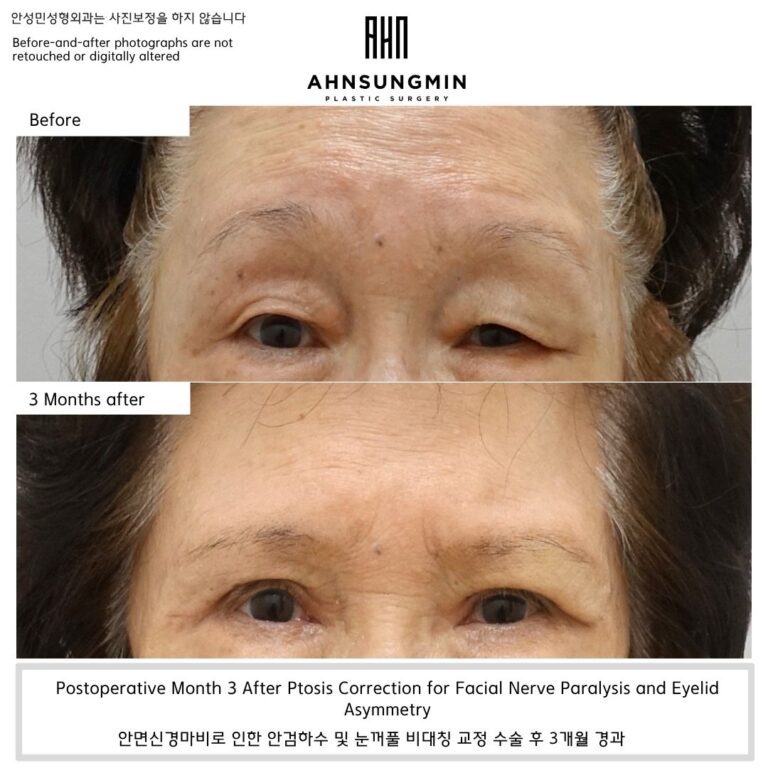
Postoperative Month 3 After Ptosis Correction for Facial Nerve Paralysis and Eyelid Asymmetry
Improving Balance Without Pursuing Maximum Eye Opening
The objective of ptosis correction was not maximum enlargement.
Attempting to force both eyelids into identical positions despite different underlying function can create another imbalance.
Instead, correction was planned according to the functional condition of each side, with the aim of improving eyelid opening while maintaining natural movement.
At postoperative month 3, the difference in eyelid opening has been reduced and the eyes demonstrate a more balanced appearance.
Why Active Eye Opening Matters
A resting photograph provides only one part of the evaluation.
Before surgery, the functional difference between the two sides became more apparent when the patient attempted to open her eyes widely.
For this reason, we also compared eyelid movement during active eye opening after surgery.
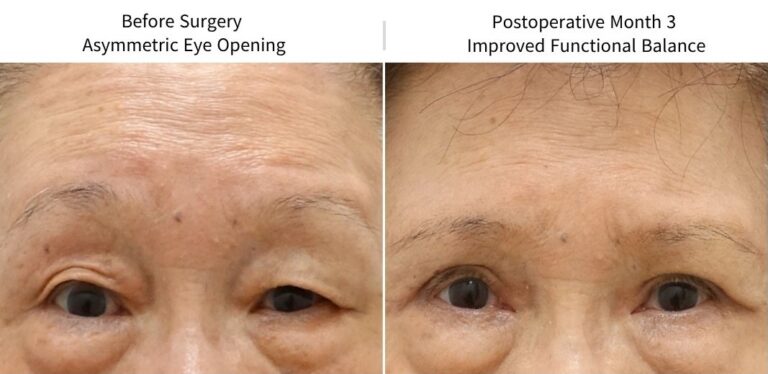
Functional eye opening before and three months after ptosis correction for facial nerve paralysis.
At postoperative month 3, the comparison demonstrates improved balance during active eye opening as well as at rest.
This does not mean that the underlying facial nerve dysfunction has disappeared. Rather, it demonstrates how eyelid balance can improve within the limitations created by the pre-existing neuromuscular condition.
Why Perfect Symmetry Is Not Always the Goal
In patients with facial nerve paralysis, the two sides may continue to function differently even after successful eyelid surgery.
For this reason, perfect anatomical or dynamic symmetry may not always be a realistic goal.
Aggressive correction simply to make the eyelid heights identical can potentially compromise natural movement or create overcorrection.
The surgical objective should instead be individualized: improve function where possible, reduce meaningful asymmetry, and preserve a natural relationship between the two eyes.
What This Case Demonstrates
Ptosis correction should not be judged simply by whether the eyes become larger.
This case demonstrates the importance of evaluating eyelid movement and underlying function when significant asymmetry is associated with facial nerve paralysis.
The goal is not forced symmetry, but the most natural and stable functional balance possible for each patient.
Learn more about Facial Nerve Paralysis Eyelid Surgery in Korea →
Related Insights
Ptosis and Facial Nerve Paralysis: Why Eyelid Asymmetry Requires Functional Evaluation
Why eyelid height alone cannot fully explain asymmetry when underlying facial nerve function is different between the two sides.
Why Perfect Eyelid Symmetry May Not Be Possible With Facial Nerve Paralysis
Understanding why functional balance and natural movement may be more important than forcing identical eyelid height.
Why Eyelid Movement Matters When Evaluating Ptosis and Asymmetry
A functional evaluation should consider how the eyelids move during active eye opening—not only how they appear at rest.
Revision Ptosis Surgery: Why Previous Eyelid Surgery Changes the Surgical Plan
Scar tissue, adhesions, and altered eyelid mechanics can make revision ptosis correction fundamentally different from primary surgery.
Why Overcorrection Can Be a Problem in Revision Ptosis Surgery
More correction does not always create better function, particularly when previous surgery or underlying neuromuscular imbalance is present.
Related Clinical Case
Revision Ptosis Correction for Facial Nerve Paralysis and Eyelid Asymmetry
A revision case demonstrating long-term improvement in eyelid balance and active eye opening after previous eyelid surgery.
