When the Eyelid Fold Looks Too High
High fold correction is not simply about lowering the crease. It begins with understanding why the fold appears too high and restoring a natural balance between the eyelid fold, eye opening, and surrounding tissues for natural, long-term results.
✓ High Fold
✓ Multiple Creases
✓ Thick Fold
✓ Puffy Appearance
✓ Residual Ptosis
✓ Asymmetry
20+ Years
Focused on
Eyelid Surgery
Revision
Specialist
Focus
Patients
from 30+
Countries
One
Surgeon
Care
High Fold Correction
At Ahnsungmin Plastic Surgery, we specialize in high fold revision surgery for eyelids that appear overly high, tense, hollow, or structurally unbalanced after previous surgery.
Many patients come to us after procedures that focused primarily on creating a higher crease under the misconception that a larger fold automatically creates brighter or more attractive eyes.
In reality, natural eye balance depends on proportion, structural support, and functional harmony – not excessive crease height alone.
Whether the high fold developed after previous surgery or occurred naturally, our approach focuses on restoring a more balanced and natural-looking eyelid through careful structural analysis and conservative planning.
At AHNSUNGMIN, high fold revision surgery is approached with long-term stability in mind – not simply lowering the crease aggressively.
Common Problems Seen in High Fold Revision
Many patients who seek high fold revision surgery describe concerns such as:
- My eyelid crease looks too high.
- My eyes appear smaller after surgery.
- My eyelids look thick or puffy.
- I developed multiple folds after surgery.
- My eyelids look hollow over time.
- My eyes still appear sleepy despite previous surgery.
- My eyelids feel tight when opening or closing.
These concerns often reflect underlying structural issues rather than crease height alone.
At AHNSUNGMIN, revision surgery focuses on identifying the cause of these symptoms before determining whether crease lowering is appropriate.
Our Surgical Philosophy
Successful high fold correction should restore a natural relationship between the eyelid crease, eyelid opening, soft tissue volume, and surrounding structures while maintaining long-term stability.
Every high fold is different.
Crease height, residual ptosis, scar tissue, soft tissue thickness, eyelid volume, and previous surgical changes are carefully evaluated to determine the most appropriate revision strategy.
Revision surgery often involves limited remaining tissue.
Whenever possible, healthy tissue is preserved while scar tissue and structural imbalance are carefully addressed to reduce the risk of additional hollowing or instability.
The goal is not simply to create a lower crease.
Successful high fold correction should restore a natural relationship between the eyelid crease, eyelid opening, and surrounding structures while maintaining long-term stability.
BEFORE & AFTER
Real Results.
Naturally Restored.
High fold revision is not about lowering the crease —
it’s about restoring balance, function, and natural movement.
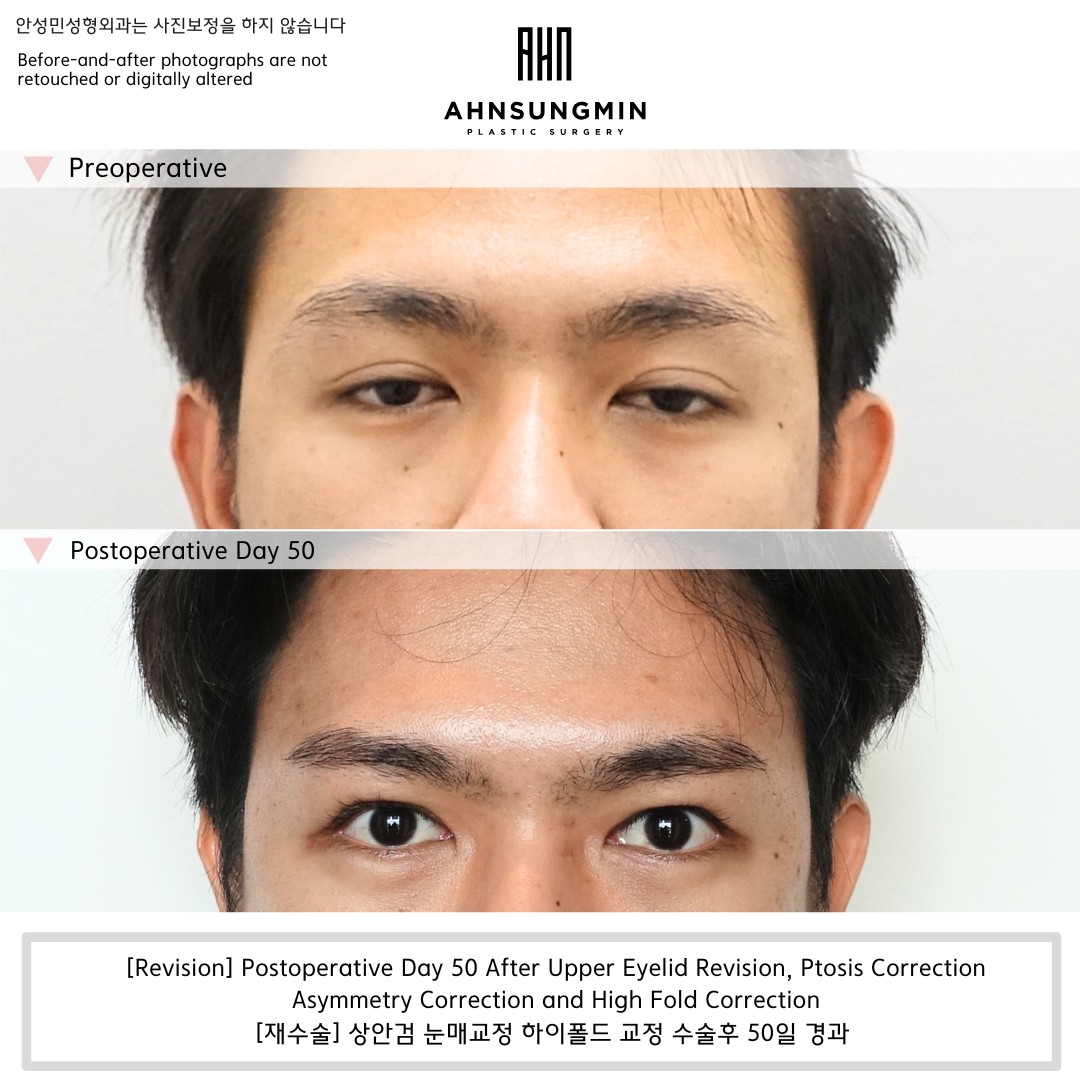
CASE 1
EYE DETAIL
Restoring Natural Balance
High fold revision is not simply about lowering the crease.
The goal is to create a softer, more stable, and naturally balanced eye appearance.
Careful adjustment of crease height, eyelid tension, and structural support can help restore more natural eye opening and long-term balance over time.
CASE 2
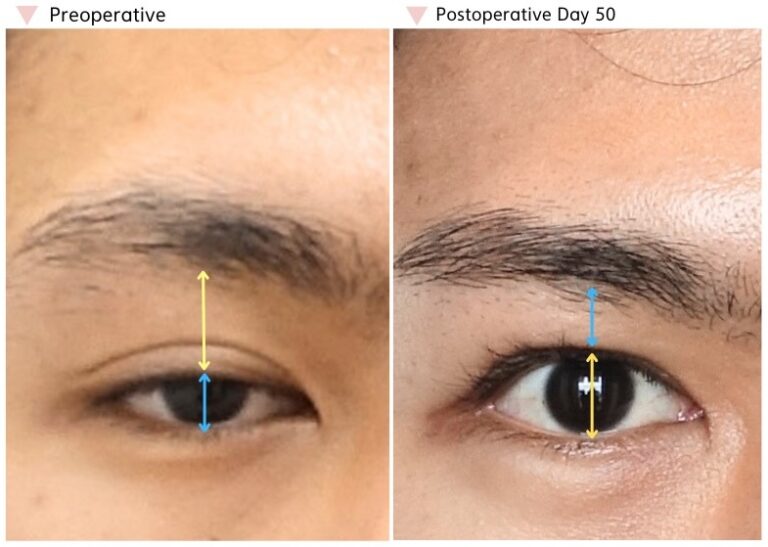
EYE DETAIL
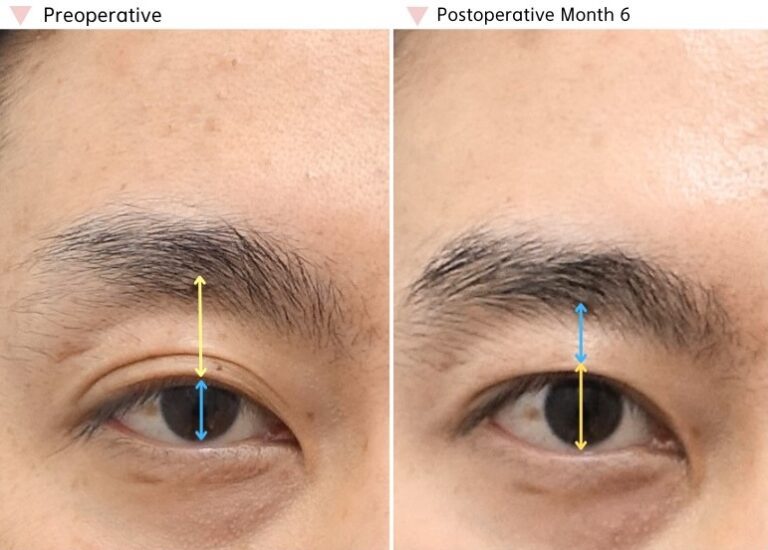
Restoring Functional Eye Opening
In some patients, an excessively high fold may visually narrow the eye opening and create an unbalanced appearance over time.
High fold revision surgery can help restore a more natural relationship between the eyelid crease, brow position, and visible eye opening while maintaining long-term structural stability.
This case demonstrates improved eye balance and softer eyelid tension following conservative high fold revision.
CASE 3
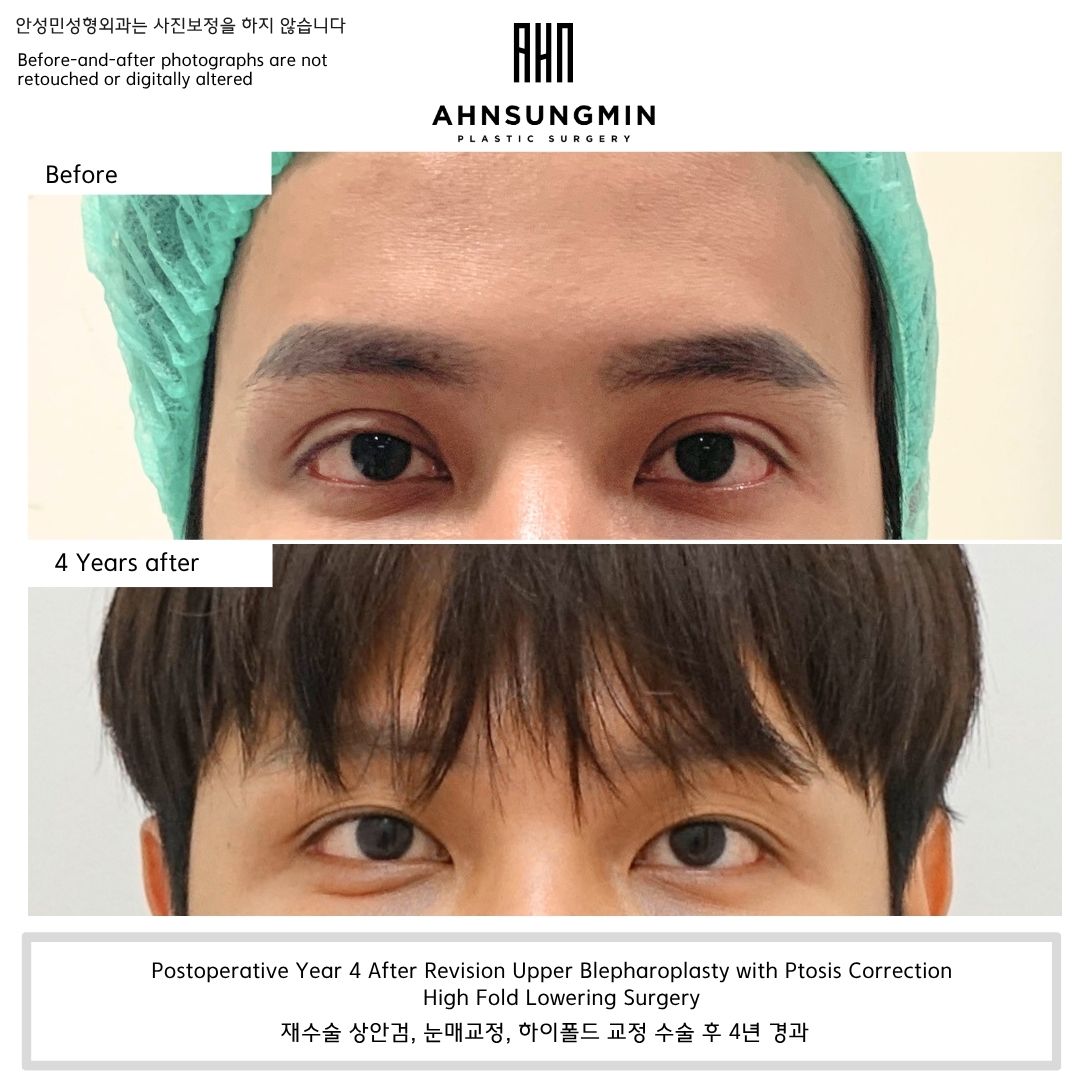
A Lower Fold Creates a More Natural Appearance
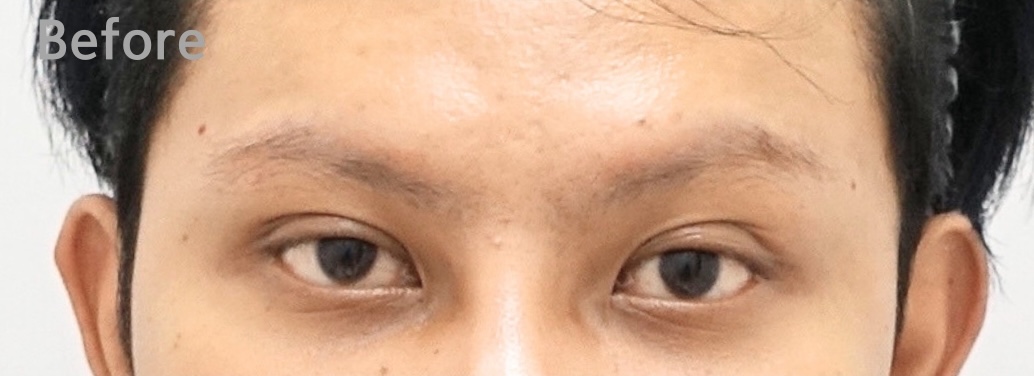
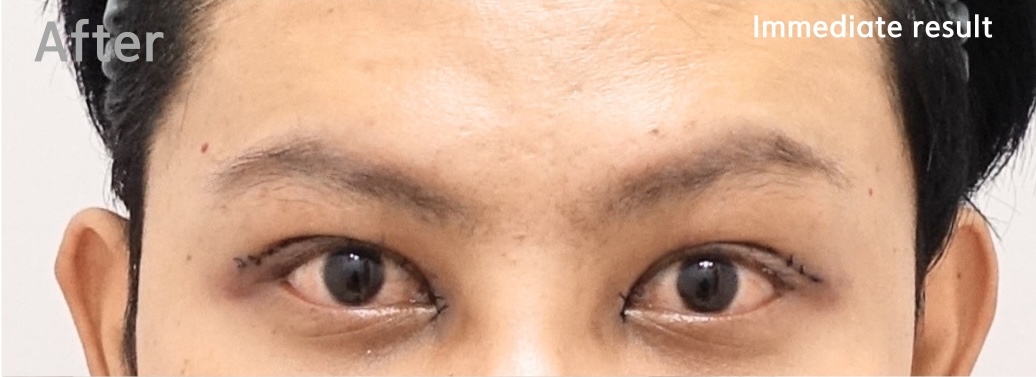
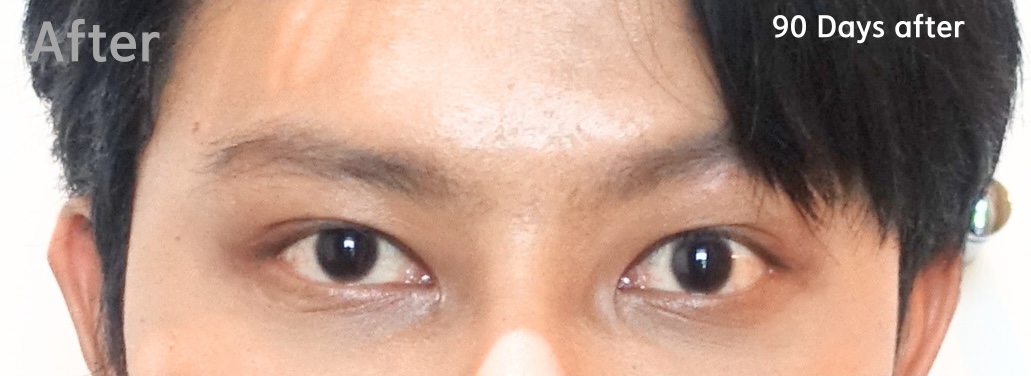
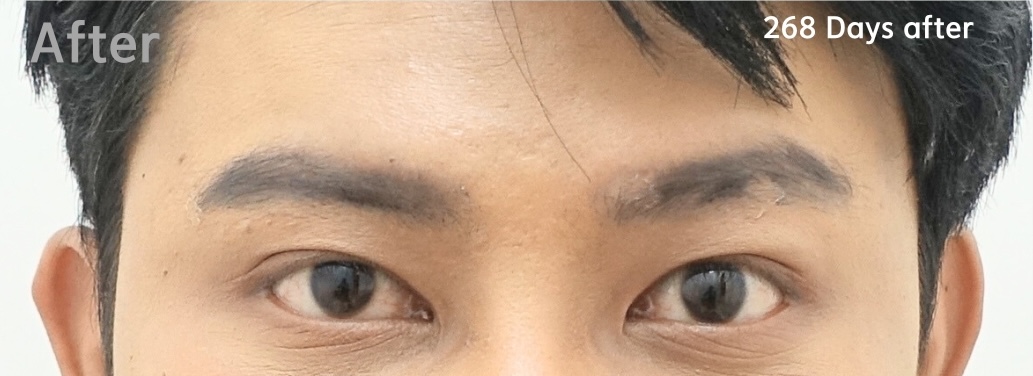
This patient had an overly high eyelid crease that made the eyes appear more defined than desired. The goal of surgery was not simply to lower the crease, but to restore a more natural balance between the eyelids and the rest of the face.
Revision surgery combined high fold correction with ptosis correction to create a lower, softer eyelid crease while improving eye opening. Four years after surgery, the result remains stable, with a more masculine, natural appearance and improved facial harmony.
Our Goals in High Fold Revision
- A more balanced and naturally positioned eyelid crease
- Reduction of excessive tension and overly defined fold appearance
- Improvement of hollow or structurally imbalanced eyelids
- Preservation of natural eye movement and expression
- Long-term stability through conservative surgical planning
- Results that respect the patient’s natural facial characteristics
When Additional Structural Support Is Needed
In some patients, high fold revision surgery may also involve correction of hollowing, volume imbalance, or weakened eyelid support structures.
Depending on the condition of the eyelid, supportive procedures such as fat repositioning or selective volume restoration may be considered to improve structural balance rather than simply increasing fullness.
The goal is not to create dramatic change, but to restore a more stable, natural, and less tense eyelid appearance over time.
Why High Fold Eyelids Often Become More Noticeable Over Time
Many high fold eyelids become more noticeable over time as swelling decreases and the tissues settle.
Excessively high folds may gradually appear more tense, hollow, overly defined, or structurally unbalanced, sometimes accompanied by forehead compensation or multiple folds.
For this reason, high fold revision surgery should not be approached simply by lowering the crease alone.
At AHNSUNGMIN, revision surgery focuses on structural balance, conservative planning, and long-term stability rather than aggressive correction.
When High Fold Revision Requires More Than Lowering the Crease
In some patients, an excessively high fold is not caused by crease height alone.
Underlying issues such as ptosis compensation, hollowing, scar adhesion, multiple folds, or structural tension may also contribute to an unnatural appearance over time.
For this reason, high fold revision surgery often requires careful evaluation of the entire eyelid structure rather than simply lowering the crease aggressively.
At AHNSUNGMIN, revision surgery is approached with a focus on structural balance, natural movement, and long-term stability.
Why Conservative Revision Planning Matters
Overly aggressive high fold revision surgery can sometimes create additional tension, hollowing, skin shortage, or long-term instability.
For this reason, not every high fold should be lowered dramatically.
At AHNSUNGMIN, revision surgery is planned conservatively with careful consideration of tissue condition, eyelid balance, natural movement, and long-term structural stability.

Approximately 1.5–2 hours

Revision design based on existing crease position, scar tissue, and structural imbalance

Not required

Typically 5-7 days after surgery
Initial recovery generally occurs within 1–2 weeks, while crease settling continues over several months.
Local anesthesia with real-time functional evaluation
BEFORE & AFTER
CASE 3
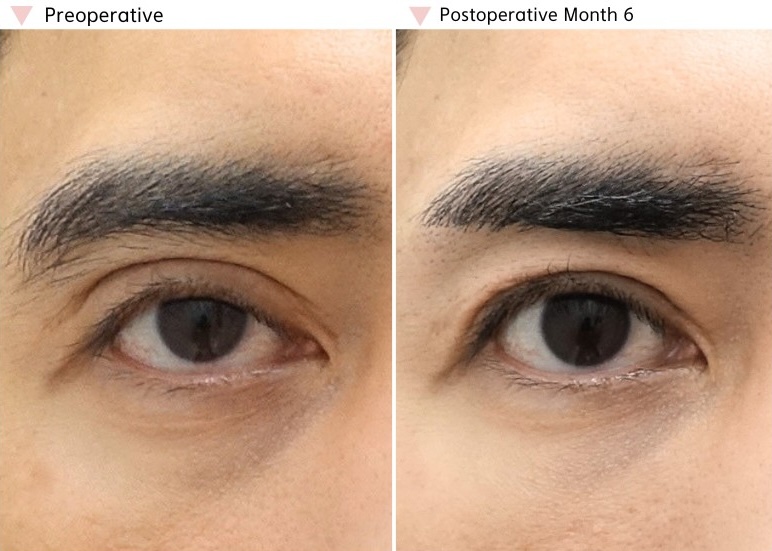
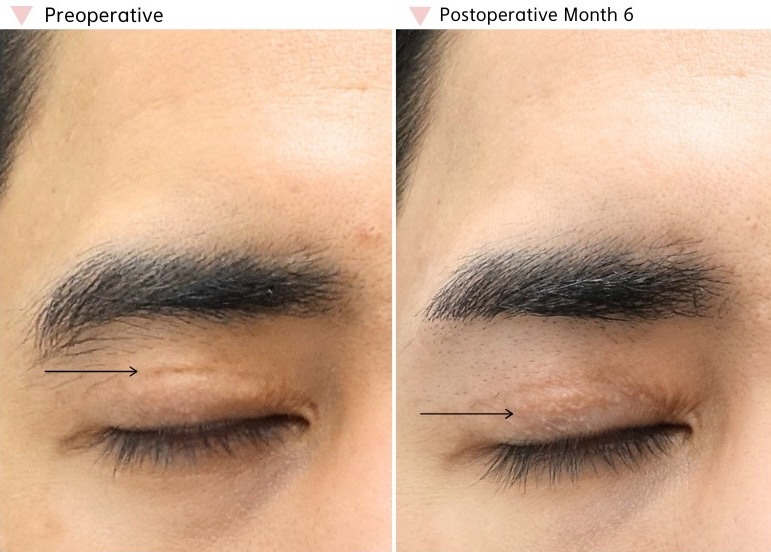
When Skin Shortage Becomes the Main Limitation
One of the most important factors in high fold revision surgery is the condition of the remaining eyelid skin.
In this case, the patient had already undergone three previous surgeries, resulting in severe skin shortage, excessive tension, and incomplete eye closure before revision surgery.
Because there was not enough remaining skin, removing the existing high fold itself was not possible. Instead, the revision was approached conservatively by minimizing additional skin excision, improving eyelid opening strength through ptosis correction, and carefully releasing the adhesions created by the previous high fold.
Rather than aggressively lowering the crease, the goal was to restore a more natural, stable, and less tense eyelid while preserving long-term eyelid function.
Related Insight
Patients with high fold revision often have significant scar tissue and adhesion from previous surgery. Learn how these tissue changes affect eyelid movement, surgical planning, and long-term stability in “Ptosis Surgery: When Scar and Adhesion Define the Outcome.”
CASE 4
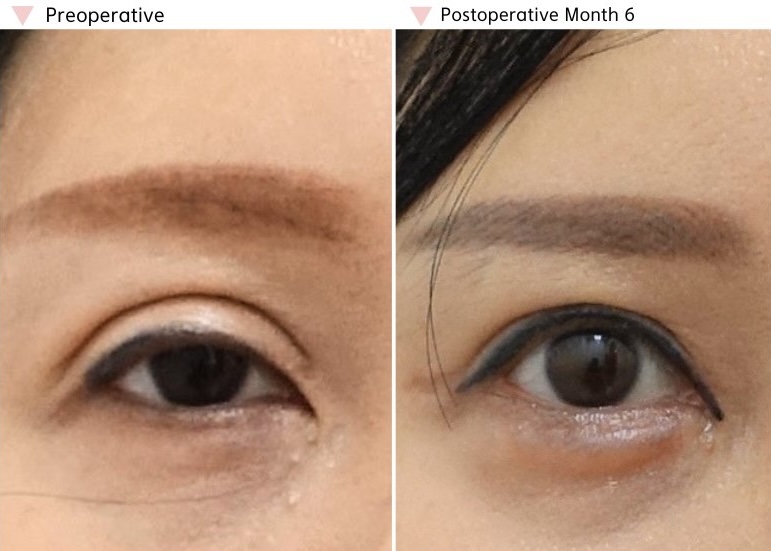
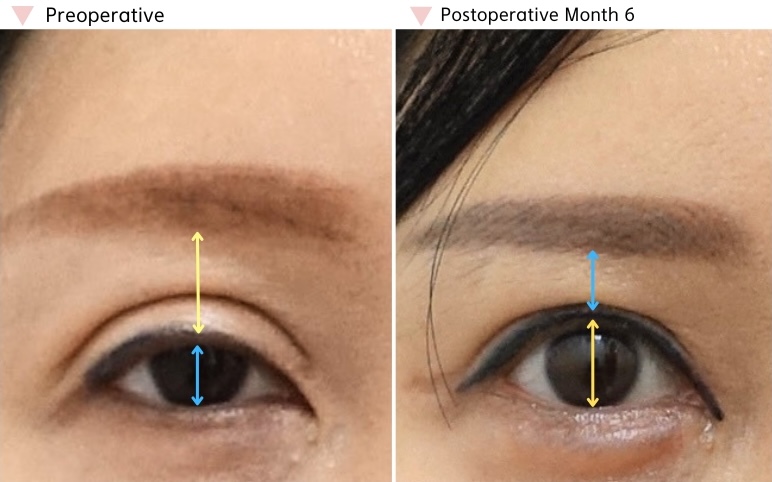
When Residual Ptosis Creates a Thick High Fold.
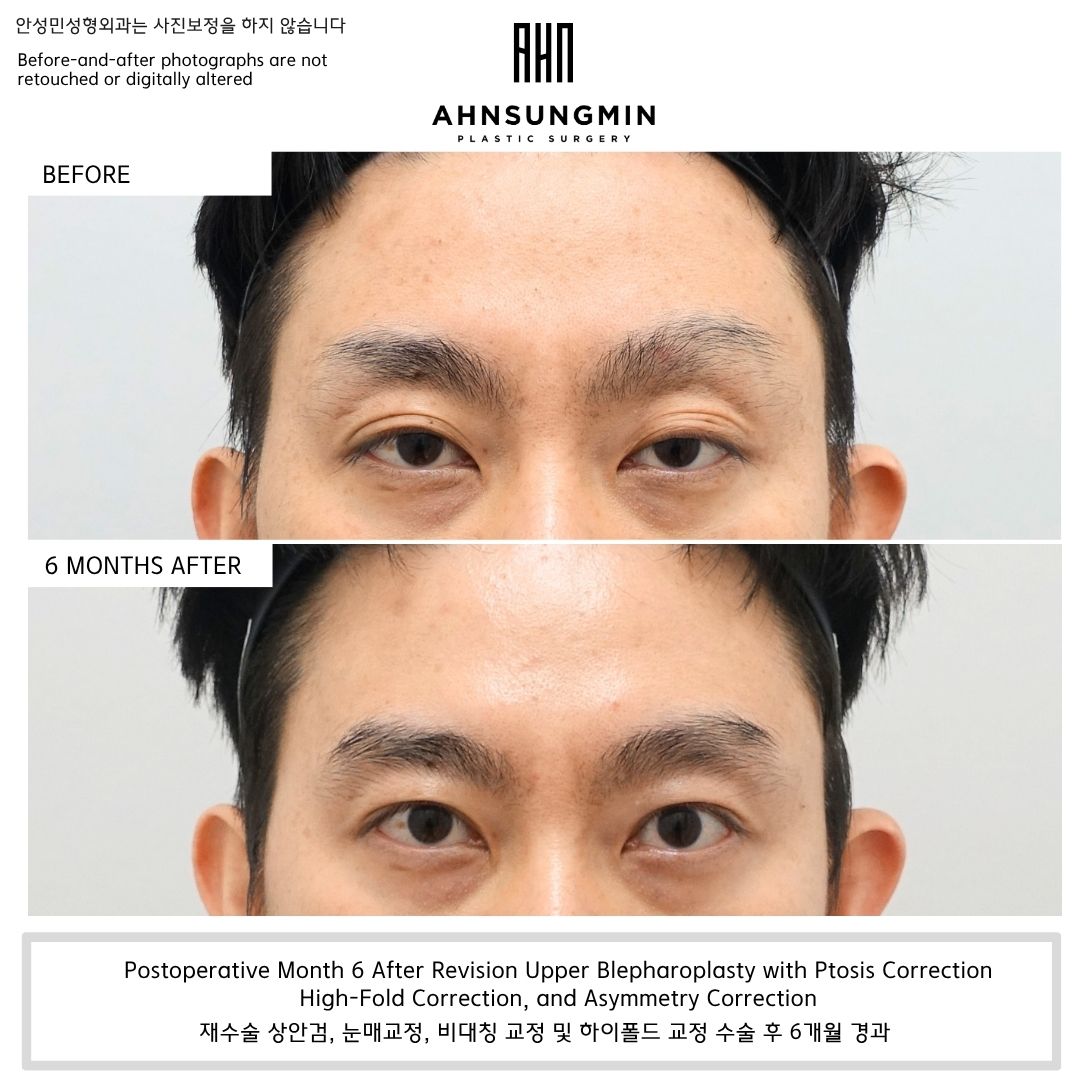
This patient had undergone a third revision surgery and presented with a very deep, thick, and excessively high double eyelid crease, commonly referred to as a “sausage eyelid,” creating a very unnatural appearance.
Despite multiple previous surgeries, the patient still appeared sleepy, and the underlying ptosis had never been fully corrected. Ptosis is one of the fundamental causes of high folds, and in cases like this, the underlying eye-opening weakness must first be addressed.
Because of the persistent ptosis and the excessively high crease, the eyelids had gradually become more tense, thick, and structurally unnatural over time.
In this revision surgery, ptosis correction was performed to restore more natural eye opening, while the adhesions created by the previous high fold were carefully released. Due to the limited remaining eyelid skin, the crease was conservatively lowered with minimal additional skin excision.
The goal of surgery was not simply to lower the crease aggressively, but to restore a more natural, balanced, and functionally stable eyelid appearance.
CASE 5
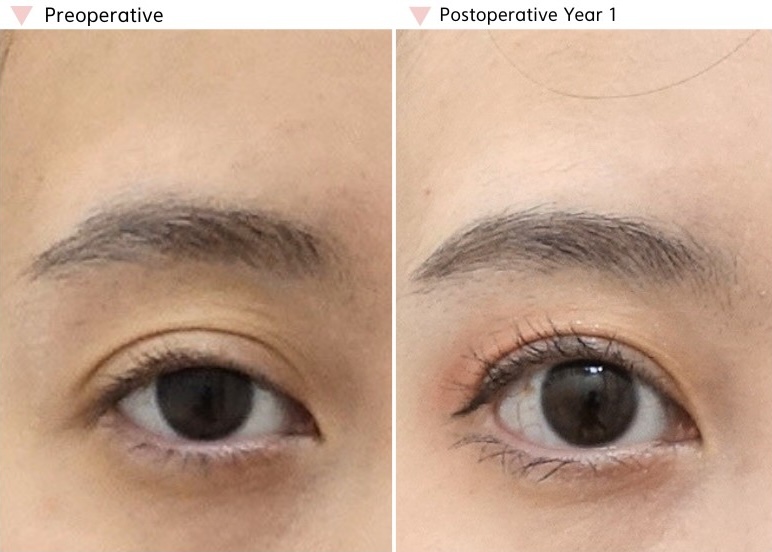
CASE 6
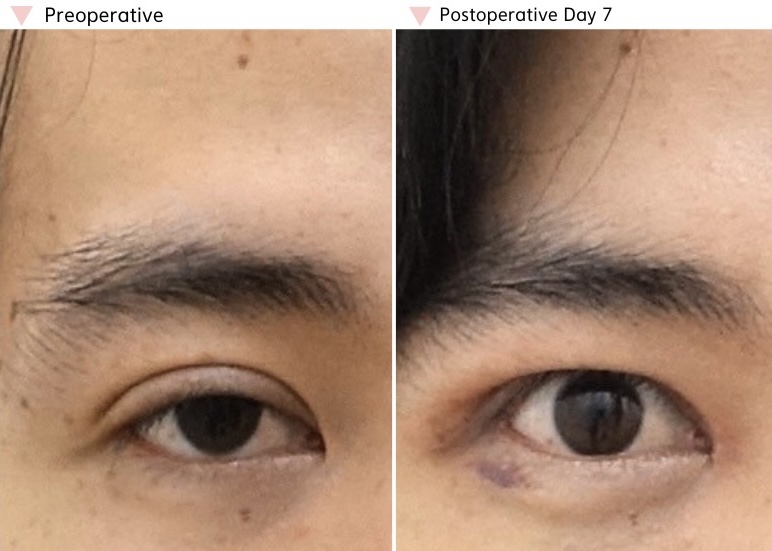
CASE 7
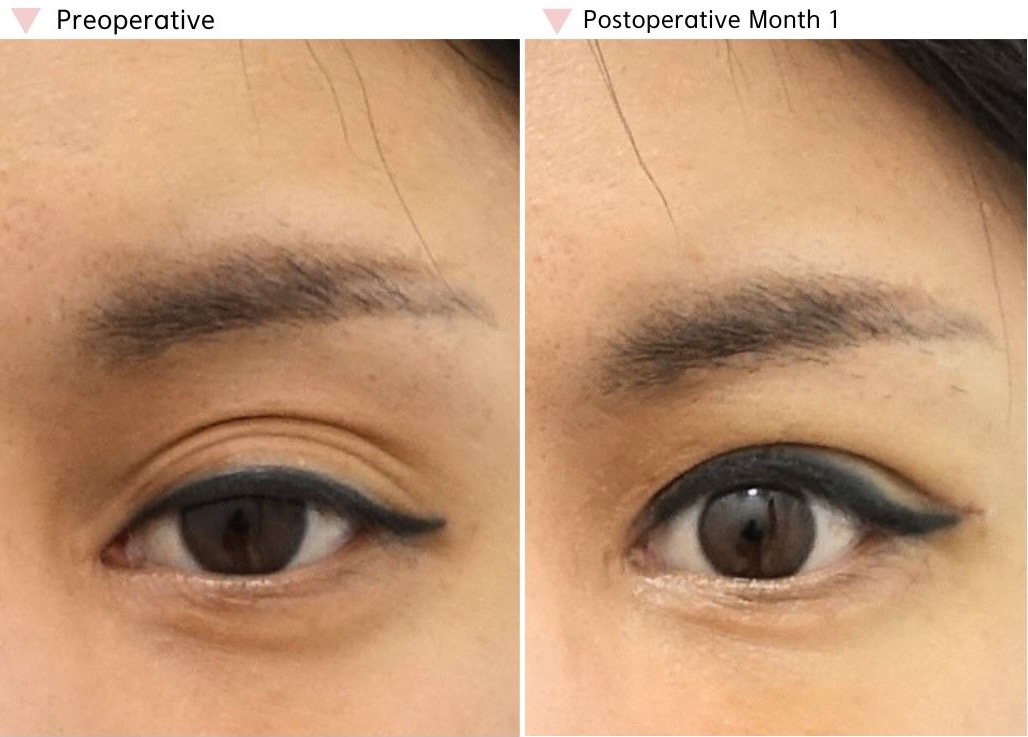
CASE 8

HIGH FOLD RECOVERY TIMELINE
Natural Results
Take Time
High fold correction is not simply about lowering the crease.
As swelling subsides and the eyelid tissues gradually settle, the fold becomes softer, more natural, and better balanced.
For this reason, the final outcome should be evaluated over several months rather than immediately after surgery.
REVISION RECOVERY TIMELINE
CASE 1
The eyelid fold gradually softens and becomes more balanced over the months following high fold correction.
• 1–2 weeks: Swelling, tightness, and bruising are most noticeable
• 1 month: The crease begins settling and daily appearance becomes more natural
• 3 months: Residual swelling continues improving and the fold appears softer
• 6 months: Structural balance and crease stability become more noticeable
• 9–12 months: Scar maturation and long-term tissue stabilization continue gradually
Learn more about High Fold Revision Recovery →
See more High Fold Revision Cases →
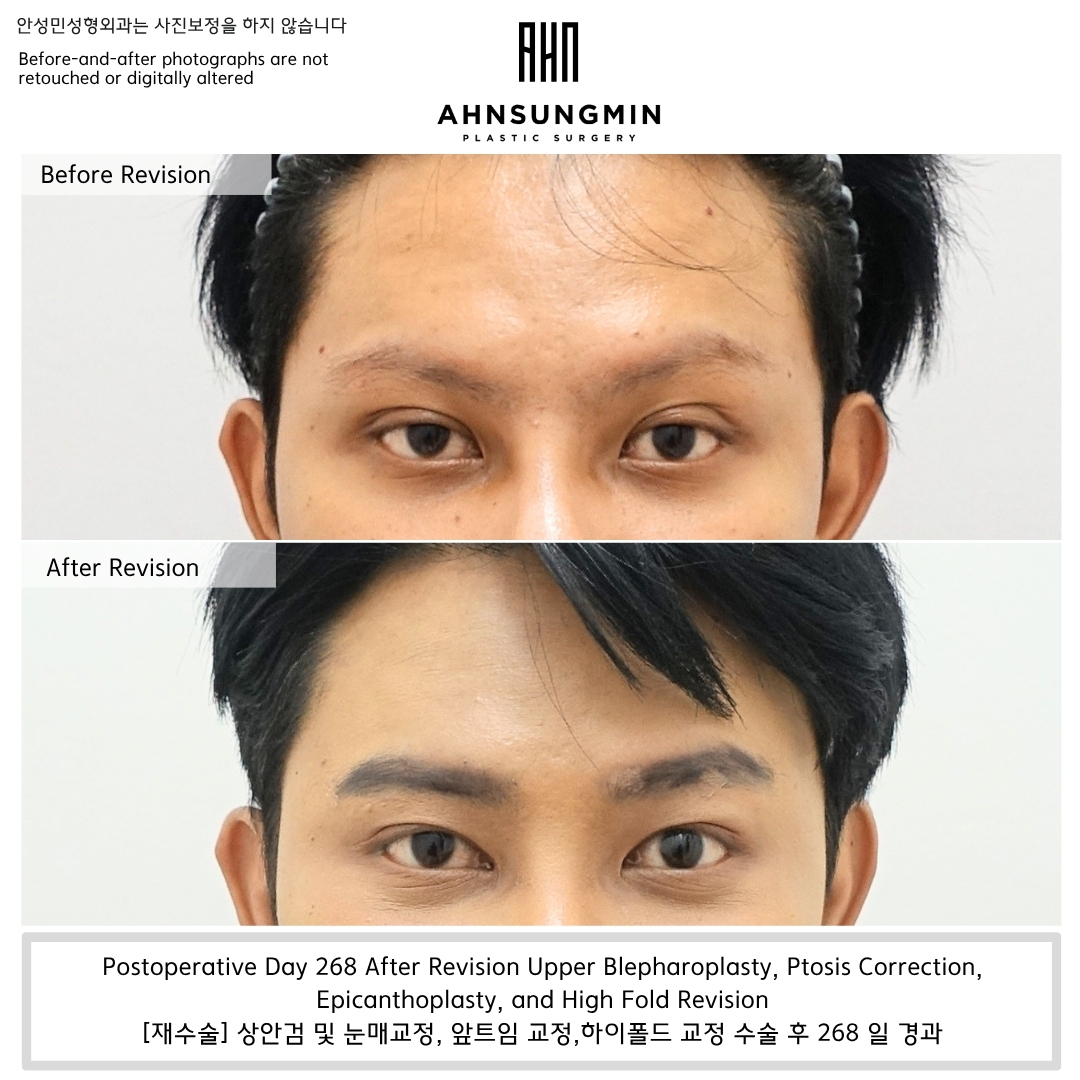
CASE 2
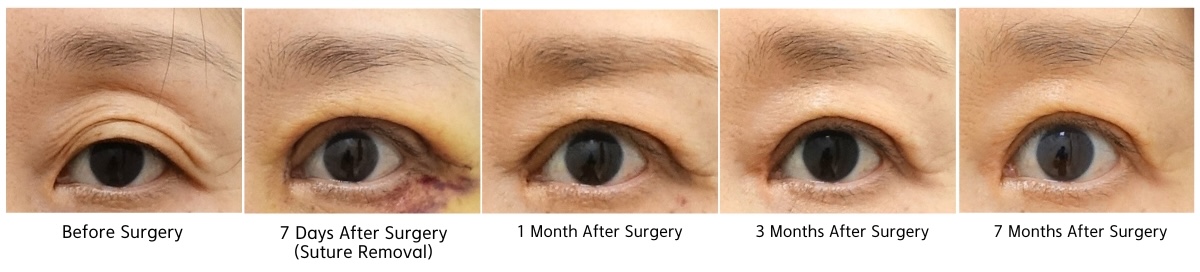
Recovery Timeline After High Fold Revision Surgery in a Woman in Her 50s
This case demonstrates the gradual recovery process after high fold revision surgery in a woman in her 50s, showing progressive improvement in eyelid balance, crease stability, and natural eye opening over time.
Our Approach to High Fold Revision
- Structural analysis of the existing crease and surrounding eyelid support
- Conservative adjustment of excessively high or unstable folds
- Evaluation of hollowing, tension, and multiple fold formation
- Careful consideration of brow position, eye opening, and facial balance
- Long-term planning focused on stability rather than aggressive change
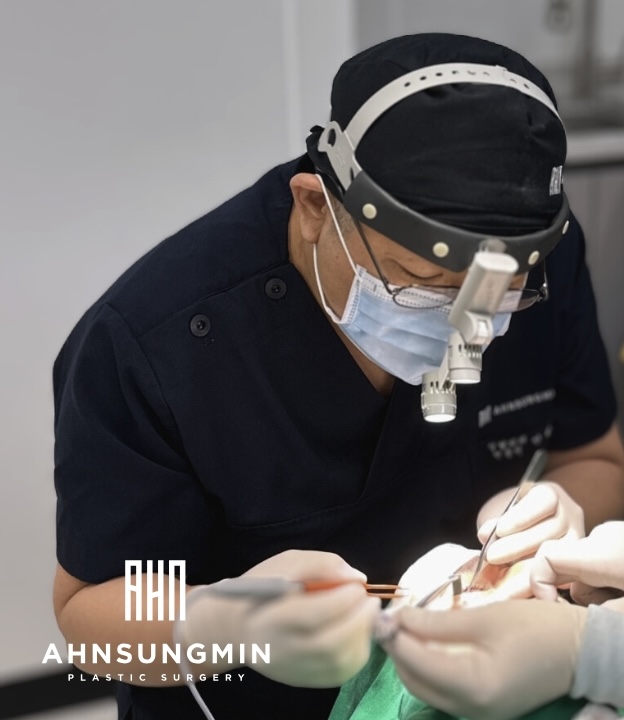
The AHNSUNGMIN Difference
High fold revision surgery is not approached simply by lowering the crease.
Many patients with high folds also experience underlying structural imbalance, excessive tension, hollowing, or functional compensation involving the forehead and eyelid opening muscles.
At AHNSUNGMIN, each revision plan is based on careful structural evaluation of the eyelid rather than a standardized crease height.
Our goal is to create a more balanced and natural-looking eyelid while preserving long-term stability and avoiding excessive correction.
Many international patients visit Korea for revision eyelid surgery after unsuccessful high fold procedures performed elsewhere, often seeking a more structurally balanced and natural-looking result.
HIGH FOLD REVISION SURGERY IN KOREA
Frequently Asked Questions
About High Fold Revision Surgery
Answers to the most common questions about high fold
revision surgery, recovery, and results.
FAQ
Frequently Asked Questions
01. Why do some high fold eyelids look unnatural?
Excessively high eyelid folds may create increased tension within the upper eyelid structure, causing the eyes to appear hollow, overly defined, fatigued, or structurally unbalanced over time.
02. Can high fold eyelids become more noticeable over time?
Yes. As swelling decreases and the tissues settle after surgery, high folds may gradually appear sharper, deeper, or more tense, especially when structural imbalance or excessive fixation is present.
03. Is lowering the crease alone always enough?
Not always. Some patients also have ptosis compensation, hollowing, scar adhesion, or multiple fold formation that contribute to the unnatural appearance. In these cases, revision surgery requires broader structural evaluation.
04. Why do multiple folds happen after eyelid surgery?
Multiple folds may develop when the crease becomes unstable due to excessive tension, scar adhesion, or imbalance between the eyelid opening muscles and surrounding tissues.
05. Why is conservative revision planning important?
Overly aggressive revision surgery may increase the risk of hollowing, skin shortage, or long-term instability. Conservative planning helps preserve natural eyelid movement and structural balance over time.
06. How long should I wait before revision surgery?
In many cases, sufficient healing time is important before considering revision surgery. Tissue swelling, scar maturation, and crease stability often continue changing for months after surgery.
07. What is the goal of high fold revision surgery?
The goal is not simply to create a lower crease, but to restore a more natural, stable, and structurally balanced eyelid appearance.
08. Can high fold revision improve sleepy eyes?
In some patients, yes. When sleepy-looking eyes are related to residual ptosis or excessive eyelid tension, high fold revision combined with ptosis correction may help restore clearer and more natural eye opening.
09. Why do sausage eyelids happen?
Sausage eyelids often develop when a double eyelid crease is created excessively high or with excessive fixation in patients with underlying ptosis or structural imbalance. Over time, the eyelids may become thicker, more tense, and less natural in appearance.
10. Can ptosis cause high folds?
Yes. In some patients, underlying ptosis contributes to the development of excessively high or unstable folds because the eye-opening muscles cannot properly support the crease over time.
11. Why do high folds become more noticeable over time?
As postoperative swelling decreases and tissue tension changes over time, excessively high folds may gradually appear deeper, thicker, more hollow, or structurally unbalanced.
High Fold Revision Insights
High fold problems are not always caused by the crease itself.
In many revision cases, scar adhesion, ptosis imbalance, structural tension, and unstable eyelid movement must be carefully evaluated before correction.
The following insights explain why successful high fold revision often requires structural analysis rather than simple crease lowering alone.
Why Lowering the Crease Alone Often Fails in Revision Surgery.
Why Bigger Creases Do Not Create Bigger Eyes.
Why We Lowered the Line Instead of Making It Bigger.
Why High Fold Correction Required Structural Adjustment—Not Just Lowering the Crease.
Why We Corrected Function Before Lowering the Fold.
Why a High Fold Eyelid May Actually Be Ptosis.
Some high fold revision cases involve deeper structural problems such as scar adhesion, ptosis imbalance, tissue limitation, or unstable eyelid support created by previous surgery.
Explore how revision eyelid surgery is approached through structural analysis, functional evaluation, tissue preservation, and long-term stability.
→ Revision Eyelid Surgery Specialist
Eyelid Revision Surgery in Korea
Understanding Functional Ptosis in High Fold Revision
In many patients, excessively high or unstable folds are closely related to weakened eyelid opening function and compensatory muscle use rather than crease height alone.
Understanding how ptosis influences eyelid balance is often an important part of successful high fold revision surgery.
→ Ptosis Correction Surgery
Ptosis Correction Surgery in Korea
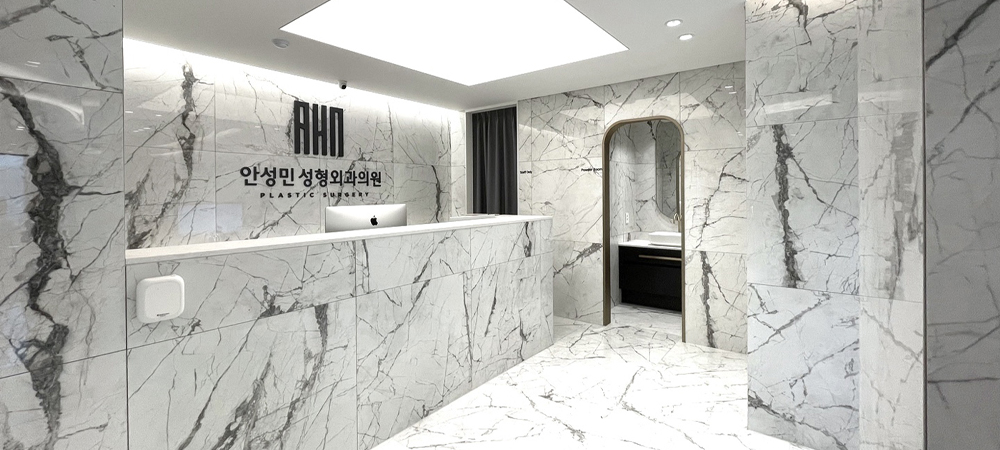
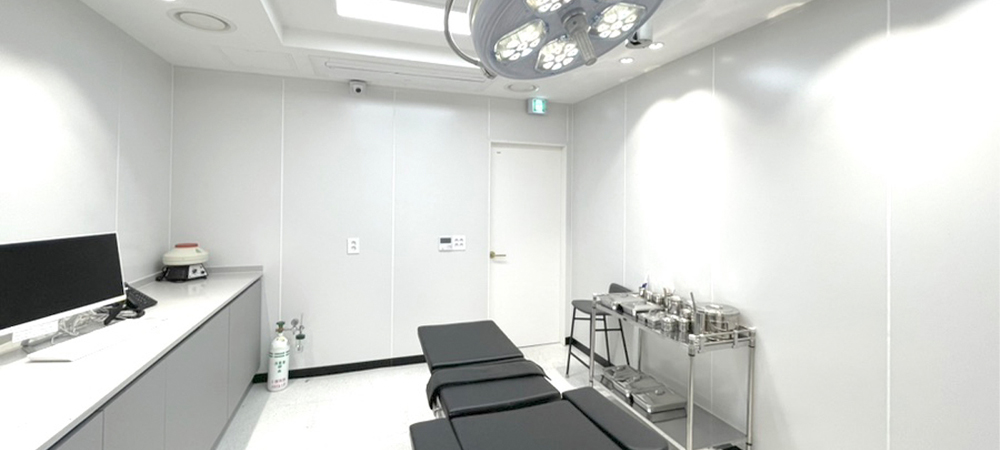
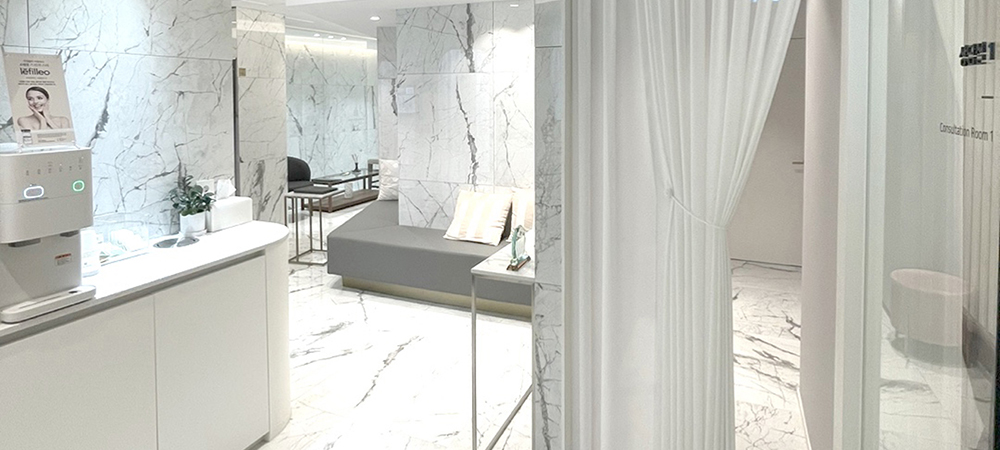
Ahnsungmin Surgical Philosophy
At Ahnsungmin Plastic Surgery, eyelid surgery is approached through careful structural analysis rather than simply focusing on cosmetic change.
Many eyelid conditions such as ptosis, eyelid hollowing, lower eyelid bags, or postoperative imbalance are closely related to the underlying anatomy of the eyelid.
Our surgical philosophy focuses on restoring natural balance while preserving healthy tissue and achieving long-term structural stability.
What Our Patients Say?

“From consultation to results, my experience at Ahnsungmin Plastic Surgery was incredible. Dr. Ahn truly listened and delivered exactly what I wanted – natural, beautiful eyes. Best decision I ever made!”
“I’m so grateful I chose Ahnsungmin Plastic Surgery. Dr. Ahn’s expertise and caring approach made the whole process comfortable, and my results are perfectly natural. Thank you for making my dream come true!”
Contact Us Today
Seoul, Republic of Korea
