Before and After
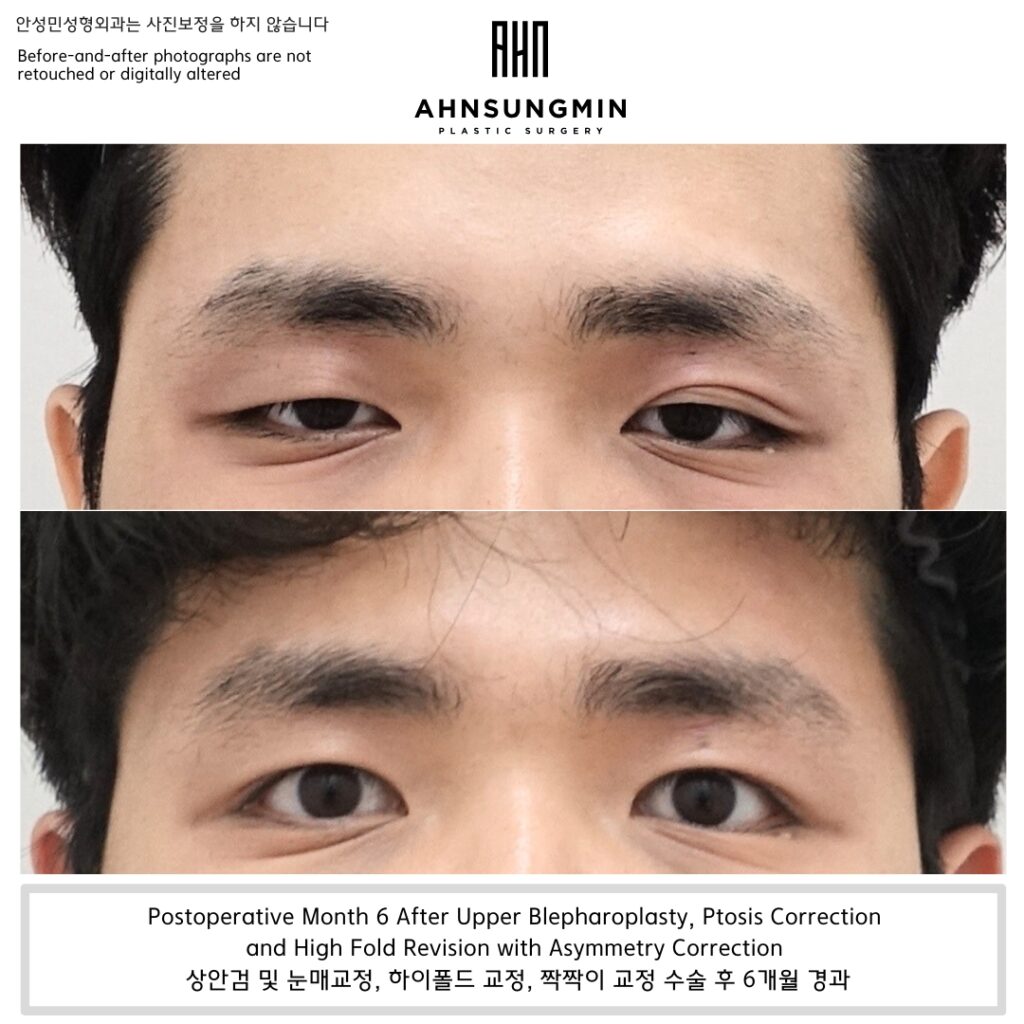
A Functional Problem Hidden Behind a High Fold
At first glance, this case appeared to be a simple issue of a high eyelid crease.
The fold looked elevated, thick, and somewhat unnatural.
However, what mattered was not the height of the crease itself—but the underlying cause.
The patient showed signs of ptosis, with reduced eyelid opening strength and asymmetrical muscle function.
As a result, the crease appeared higher and more defined than intended.
This was not a design problem.
It was a functional imbalance.
This type of unstable eyelid opening is also commonly seen in patients with residual ptosis after previous eyelid surgery, where persistent forehead compensation and incomplete functional correction gradually affect long-term crease stability and eye balance over time.
→ Revision Ptosis Surgery Case: Correcting Residual Ptosis and Restoring Clearer Eyelid Opening.
Why We Did Not Simply Lower the Crease
Lowering the crease alone may improve the appearance temporarily.
But if the underlying ptosis is not addressed, the same forces remain.
In these cases, the eyelid continues to rely on compensatory mechanisms—
including increased tension and abnormal crease formation.
This often leads to recurrence of the same problem over time.
The goal, therefore, was not to lower the crease.
The goal was to correct the structure that created it.
Structural Correction
The procedure included:
- Upper blepharoplasty
- Ptosis correction
- High fold revision
- Asymmetry correction
Instead of focusing on crease position alone, the surgery addressed the balance between eyelid opening function and crease formation.
By restoring proper muscle function and reducing compensatory tension,
the crease was naturally repositioned to a more stable and appropriate level.
Results
At 6 months postoperative:
- Eyelid opening is more balanced
- The crease appears lower and more natural
- Asymmetry has improved
- The overall impression is softer and more stable
Most importantly, the result is not dependent on force or compensation.
It reflects a corrected structure.
Surgical Approach
In high fold cases, the visible problem is often misleading.
What appears to be excessive height is frequently the result of underlying ptosis or imbalance in eyelid mechanics.
Without addressing these structural causes,
even technically accurate crease adjustments can lead to unstable outcomes.
A stable result is not created by lowering the crease.
It is created by restoring function.
When Evaluation Becomes Necessary
If your eyelid appears too high, thick, or increasingly unnatural over time—
especially if your eyes feel heavy or require effort to open—
a structural evaluation is necessary.
→Request a High Fold & Ptosis Evaluation
Seeing the Eye as a Whole, Not in Parts
A Clinic Dedicated to Eyelid Revision Surgery in Korea
Ahnsungmin Plastic Surgery
Internal References
Why your double eyelid looks too high over time
Why thickness—not height—often determines how unnatural a fold looks
When a high fold should be lowered—and when it should not
Why volume loss is often misdiagnosed in eyelid surgery
Why your double eyelid looks too high over time
