Not Every High Fold Should Be Lowered
A high eyelid crease often appears unnatural, heavy, or overly defined.
Because of this, many patients assume that lowering the crease is the solution.
But this assumption is not always correct.
To understand how these decisions are made in a structured way, it is important to look at how high fold eyelid revision is evaluated as a whole.
The key is not how high the crease looks.
The key is why it looks that way.
A High Fold That Is Not Truly a “Height Problem”

At first glance, this appears to be a high fold.
The crease looks elevated, and the eye appears smaller.
But the problem is not simply the position of the crease.
The eye is not opening fully.
What Makes a Fold Look Higher Than It Actually Is

When the eyelid cannot open properly, the visible portion of the eye is reduced.
As a result:
- The crease appears thicker
- The eye looks more closed
- The fold appears higher than it actually is
This is not just a crease problem.
It is a functional problem.
What Changes When the Structure Is Corrected
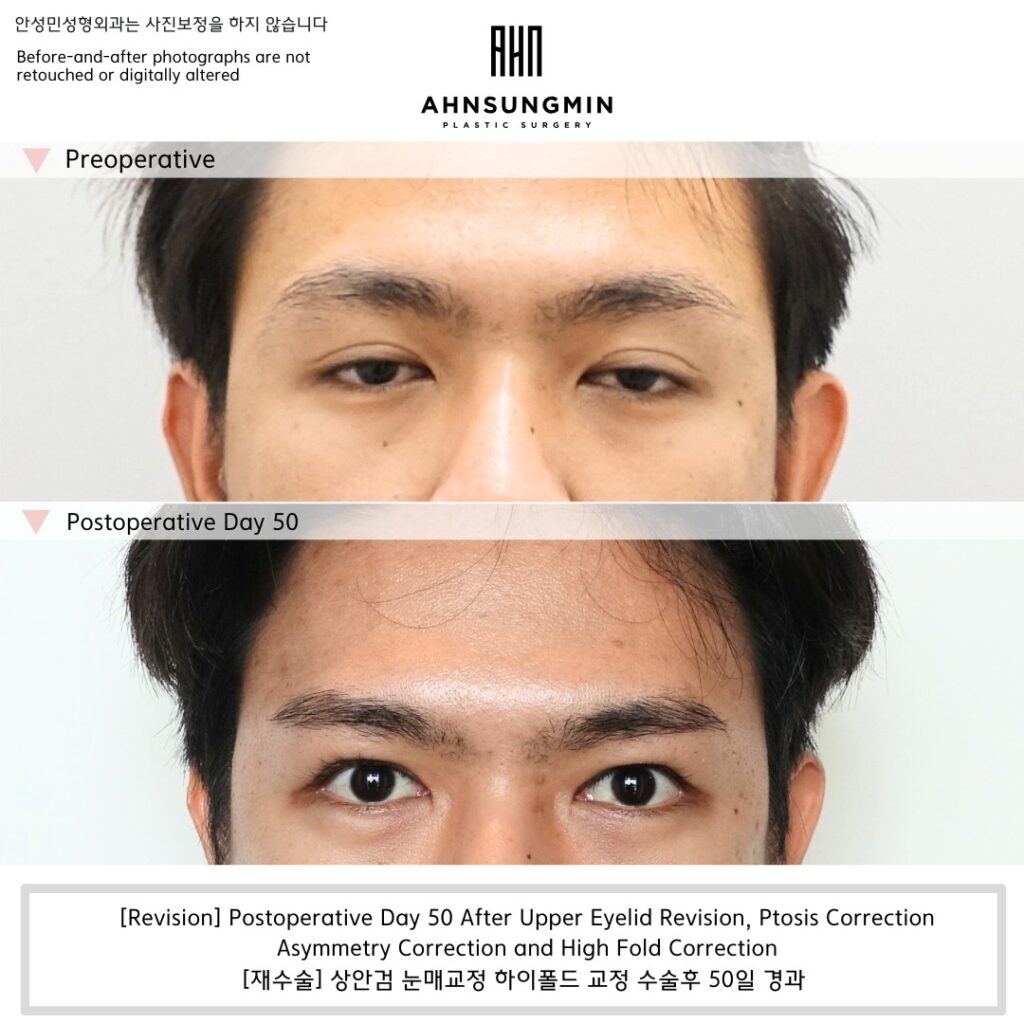
After correcting ptosis and restoring eyelid function, the change becomes clear.
The eye opens more naturally.
The visible eye height increases.
The crease appears softer and more balanced.
The key point is this:
The crease was not simply lowered.
It changed because the structure was corrected.
When Lowering the Crease Is Appropriate
Lowering the crease may be appropriate when:
- The crease is anatomically positioned too high
- The fold remains clearly visible even when the eye is closed
- The issue is structural positioning—not function
When Lowering the Crease Alone Is Not the Right Approach
In the following situations,
simply lowering the crease is not the right approach:
- When ptosis is present
- When the eye does not open fully
- When the crease appears thick due to compensatory tension
In these cases,
lowering the crease alone will not solve the problem.
What matters first is
understanding the underlying structural and functional cause.
The Most Important Principle
A high fold should not be lowered simply because it looks high.
It should only be lowered when the underlying structure has been properly evaluated and addressed.
Internal References
→ Learn why a high fold and a sausage eyelid are fundamentally different problems
→ Learn when a high fold should be lowered—and when it should not
→ Learn how eyelid structure affects long-term results
→ Learn Best Male Eyelid Surgeon in Korea
If your eyelid appears high, thick, or unnatural—and you are unsure whether lowering the crease is the right approach—a structural evaluation is necessary to determine the correct direction.
Frequently Asked Questions About High Fold Eyelids and Ptosis
What causes a double eyelid to look too high?
A double eyelid may appear too high not because of the crease itself, but due to underlying structural issues such as ptosis. When the eye does not open fully, the crease can look higher as a compensatory effect.
Is lowering the eyelid crease always the right solution?
No. Simply lowering the crease does not address the root cause if the problem is related to eyelid function. In many cases, correcting ptosis is necessary before considering any adjustment to crease height.
How can you tell if a high fold is actually ptosis?
If your eyes do not open fully, or if you notice that you are using your forehead muscles to lift your eyelids, the issue may be functional rather than purely aesthetic. A structural evaluation is required to determine the exact cause.
Why does a high fold sometimes look unnatural?
The unnatural appearance is often due to thickness, tension, or imbalance in eyelid structure—not just the height of the crease. Addressing these factors leads to more natural results.
Can revision surgery fix both high fold and ptosis at the same time?
Yes, but only when the underlying causes are properly identified. Revision surgery should focus on structural correction, functional restoration, and long-term stability rather than simply changing the appearance.
Request a Consultation for Ptosis and Eyelid Structure Evaluation
Insights
Why Does My Double Eyelid Look Too High Over Time?
→ What appears to be a high fold is often a structural or functional issue—not just a matter of height.
A High Fold Is Not Always the Same as a Sausage Eyelid
→ They may look similar, but the underlying causes are completely different—and require different approaches.
Why Thickness Matters More Than Height in Eyelid Revision
→ In many cases, thickness and tension—not height—determine how unnatural a crease appears.
