UPPER EYELID FAT REPOSITION SURGERY IN KOREA
Hollow Upper Eyelids After Surgery or Aging?
Upper Eyelid Fat Repositioning Focused on Structural Balance, Not Simply Adding Volume
Many patients seek treatment because their eyes look hollow, sunken, or tired. However, hollow upper eyelids are not always caused by volume loss alone. In reality, hollowing may result from previous surgery, ptosis, brow compensation, fat displacement, or structural imbalance. Our approach focuses on understanding the cause before deciding how to restore natural contour and long-term stability.
✓ Hollow Upper Eyelids
✓ Sunken Appearance
✓ Volume Loss After Surgery
✓ Hollowing Related To Ptosis
✓ Previous Fat Removal
✓ Structural Imbalance
20+ Years
Focused on
Eyelid Surgery
Revision
Specialist
Focus
Patients
from 30+
Countries
One
Surgeon
Care
UNDERSTANDING THE CAUSE
Why Do Upper Eyelids Become Hollow?
Many patients assume that hollow upper eyelids develop because fat has disappeared.
In reality, hollowing is often more complex than simple volume loss.
A hollow appearance may develop after previous eyelid surgery, age-related tissue changes, ptosis, compensatory brow elevation, orbital fat displacement, or structural imbalance around the eyelid.
Because several different factors can produce a similar appearance, treatment should begin with understanding the cause rather than simply adding volume.
In some patients, restoring eyelid function or repositioning existing tissue may be more important than adding additional volume.
Successful treatment begins with identifying why the eyelid looks hollow in the first place.
UPPER EYELID FAT REPOSITION SURGERY IN KOREA
Common Causes of Upper Eyelid Hollowing.
✓ Previous Eyelid Surgery
✓ Excessive Fat Removal
✓ Ptosis and Brow Compensation
✓ Orbital Fat Displacement
✓ Age-Related Structural Changes
✓ Functional Imbalance of the Eyelid
Who May Benefit From Upper Eyelid Fat Repositioning?
□ Hollow upper eyelids after surgery
□ Sunken upper eyelids from aging
□ High fold with hollow appearance
□ Hollowing associated with ptosis
Not every hollow upper eyelid requires more volume.
Understanding the cause is often more important than deciding how to restore volume.
Our treatment philosophy focuses on structural balance, tissue preservation, and long-term stability rather than simply making the eyelid look fuller.
Our Surgical Philosophy
Upper eyelid hollowing is often not simply a volume problem.
Our approach focuses on restoring structural balance between orbital fat, eyelid support, muscle function, and eyelid contour.
Every hollow eyelid is different.
Orbital fat distribution, eyelid support, brow position, muscle balance, previous surgery, and ptosis-related compensation are carefully evaluated before treatment planning.
Healthy tissue should be preserved whenever possible.
Excessive fat removal is one of the most common causes of upper eyelid hollowing and revision surgery.
The goal is not to create a fuller eyelid.
Successful treatment should restore natural contour, stable structure, and long-term balance while preserving natural eyelid movement.
REAL CLINICAL CASES
Real Clinical Cases of Upper Eyelid Fat Reposition
Every hollow upper eyelid has a different cause.
The following cases demonstrate how treatment decisions vary depending on previous surgery, tissue condition, eyelid function, and structural balance.
CASE 1
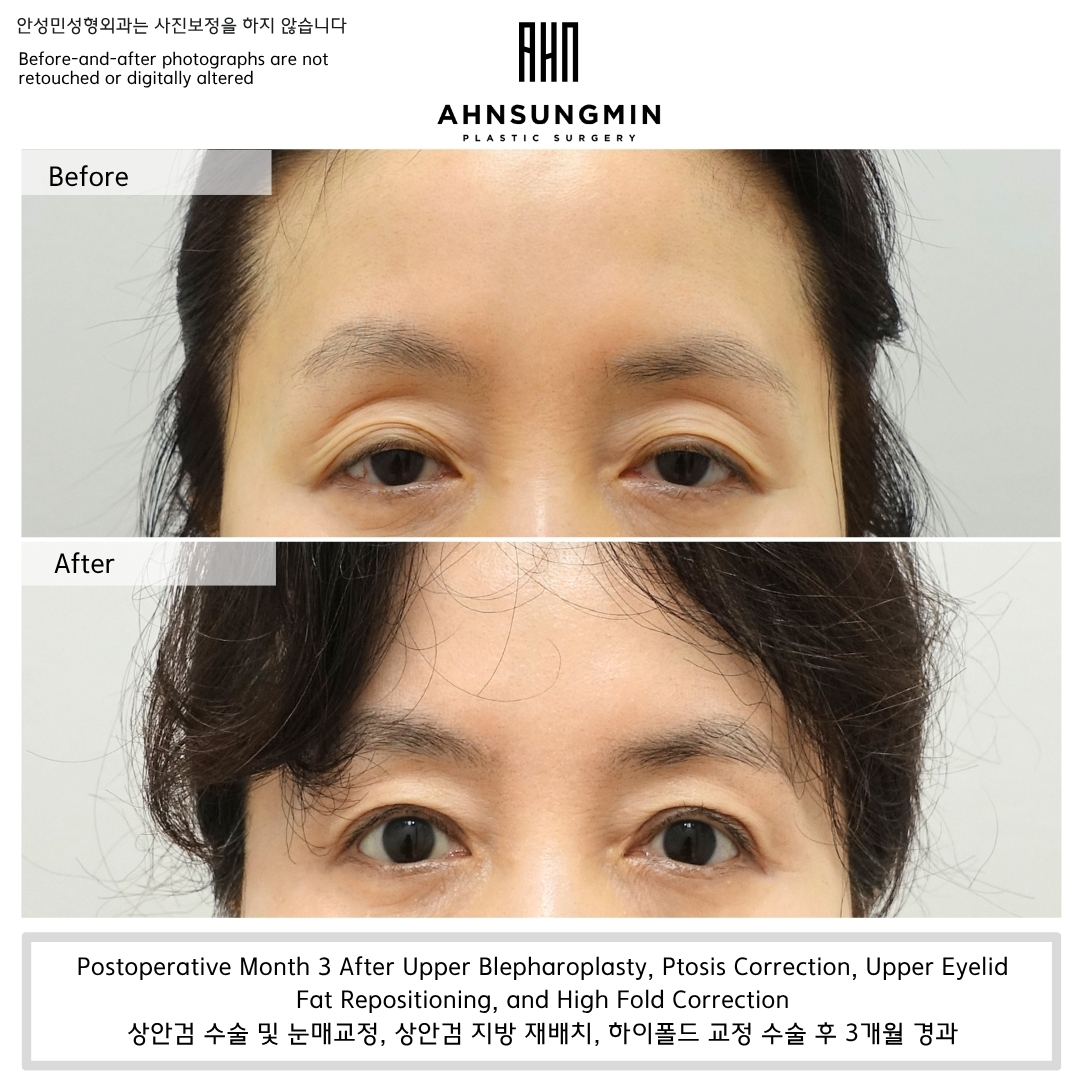
A Hollow Upper Eyelid Corrected Through Structural Repositioning
Upper Eyelid Fat Repositioning Combined With Ptosis Correction
This patient presented with a hollow upper eyelid appearance, a high eyelid fold, and signs of ptosis-related imbalance.
The hollow appearance was not caused by volume loss alone. Previous tissue changes, eyelid support, and functional imbalance all contributed to the overall appearance of the upper eyelid.
Rather than simply adding volume, treatment focused on repositioning existing tissue, improving eyelid function, and restoring a more natural upper eyelid contour.
Upper eyelid fat repositioning was performed together with ptosis correction and high fold correction to achieve structural balance and long-term stability.
Successful treatment of hollow upper eyelids begins with understanding the cause, not simply increasing volume.
When Repeated Surgery Fails to Address the Cause
This patient had undergone four previous eyelid surgeries.
The hollow appearance was not caused by volume loss alone. Structural imbalance, ptosis, and changes in the position of existing orbital fat all contributed to the problem.
Successful correction begins with understanding the cause before planning treatment.
CASE 2
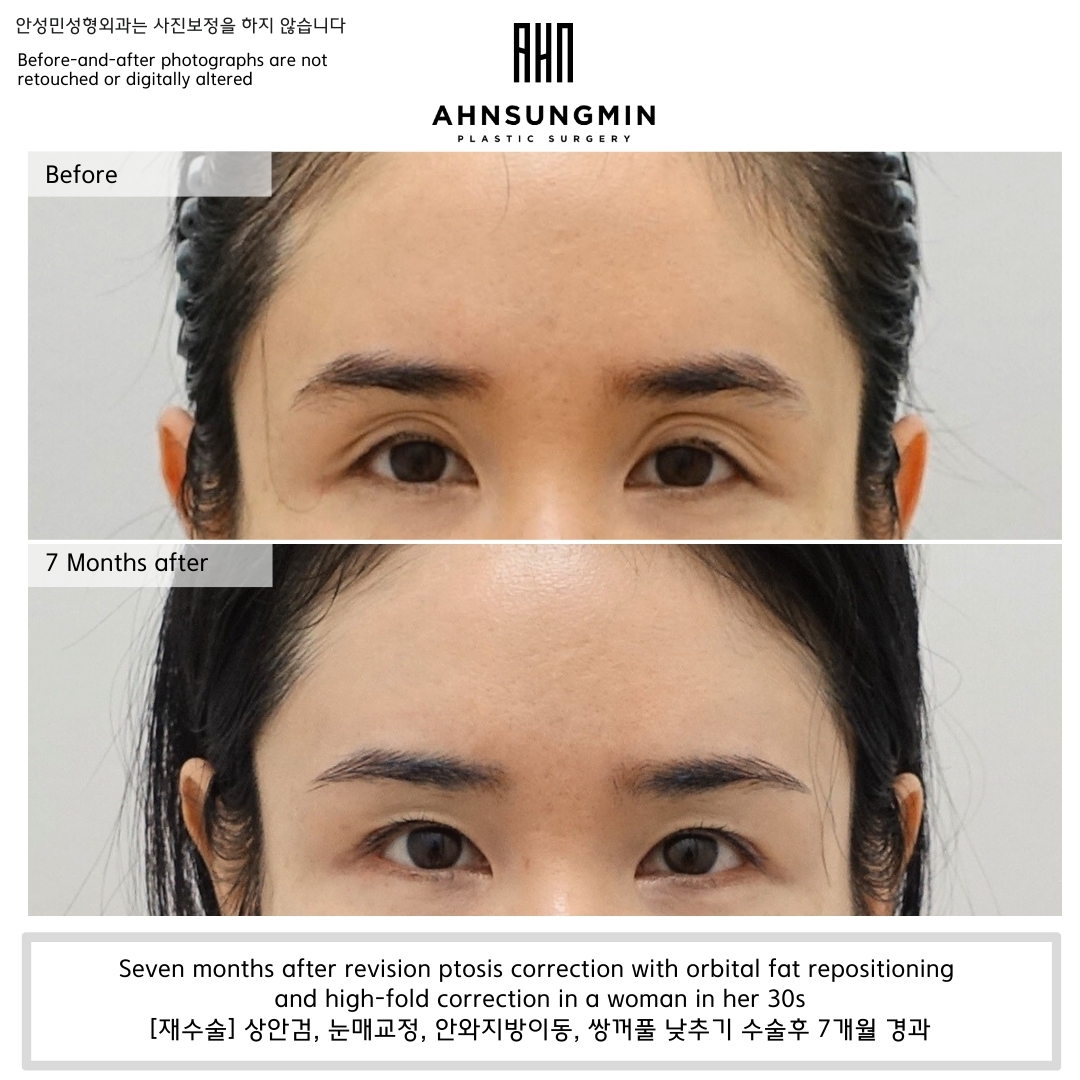
Revision Hollowing After Multiple Eyelid Surgeries
Structural Correction Through Orbital Fat Repositioning
This patient presented with hollow upper eyelids, a high eyelid fold, and ptosis-related imbalance.
The hollow appearance was not caused by volume loss alone. Eyelid support changes, orbital fat position, and weakened eyelid opening all contributed to the overall appearance.
Treatment focused on repositioning existing orbital fat, improving eyelid function, and restoring a smoother upper eyelid contour.
Upper eyelid fat repositioning was combined with ptosis correction and high fold correction to achieve a more natural and stable result.
CASE 3
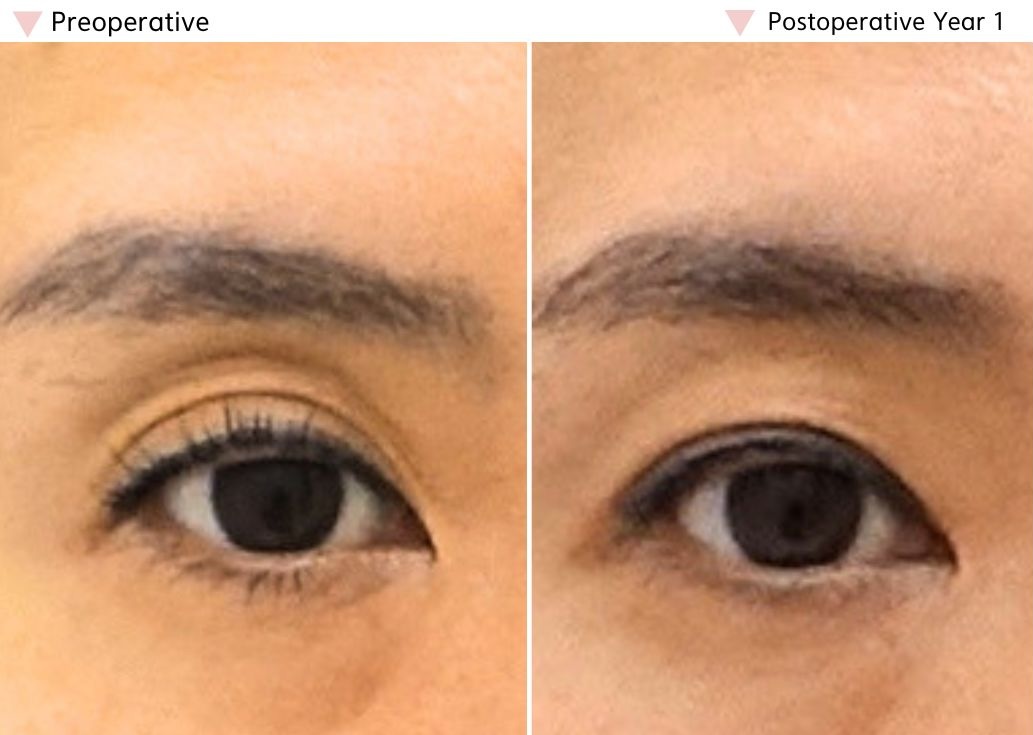
A Revision Case of Hollow Upper Eyelids After Previous Surgery
Upper Eyelid Fat Repositioning Combined With High Fold Correction
This patient presented with hollow upper eyelids and an excessively high eyelid fold following previous eyelid surgery.
The hollow appearance was not simply caused by volume loss. Changes in eyelid structure and the elevated crease contributed to a deeper and more sunken appearance.
Revision surgery focused on lowering the eyelid fold and repositioning existing orbital fat to restore a smoother and more natural upper eyelid contour.
Rather than adding excessive volume, the goal was to improve structural balance while preserving natural eyelid anatomy.
At one year after surgery, the upper eyelid appears softer, more balanced, and better integrated with the overall eye shape.
CASE 4
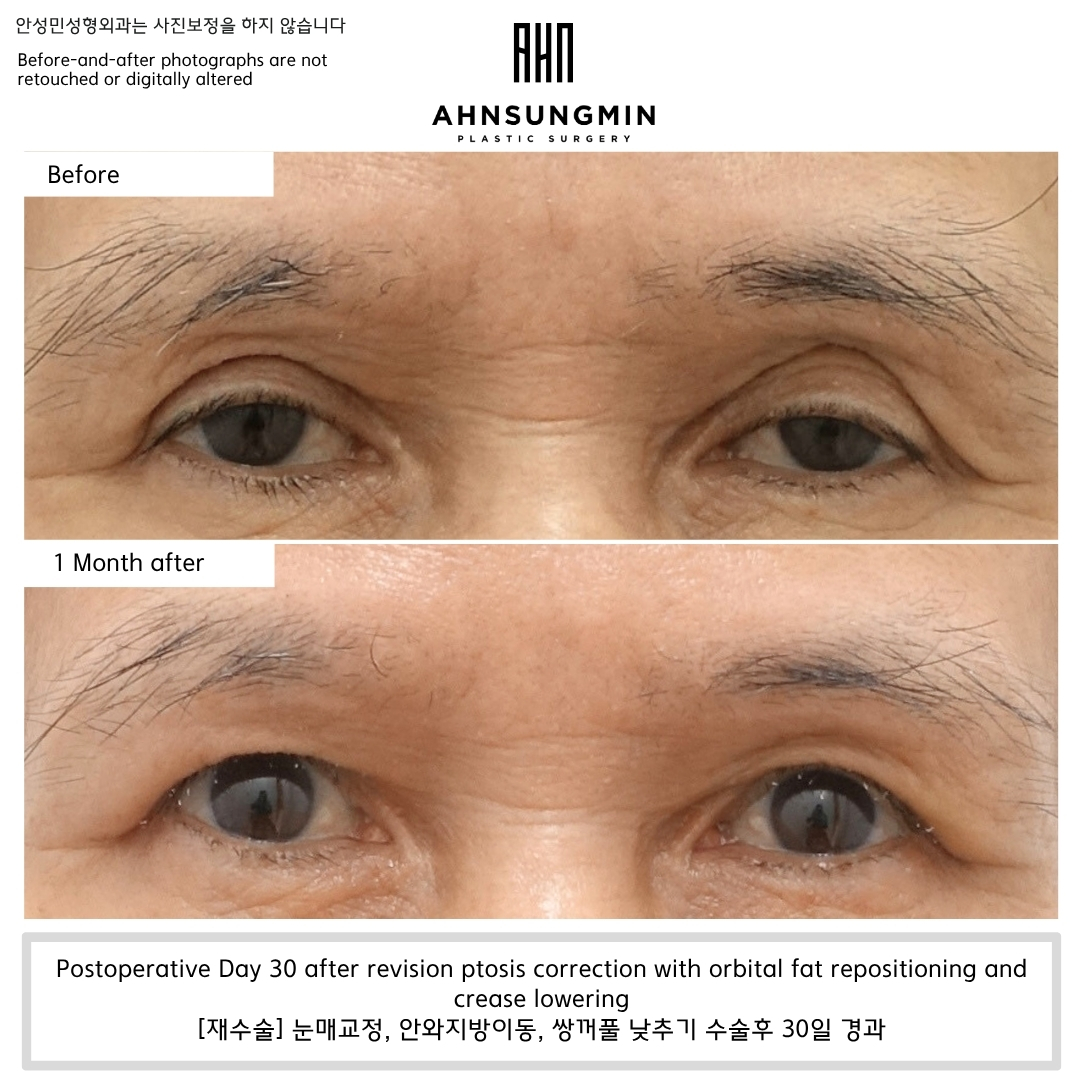
Hollowing Associated With Ptosis and High Fold
Upper Eyelid Fat Repositioning Combined With Ptosis Correction
This patient presented with hollow upper eyelids, a high eyelid crease, and incomplete eyelid opening.
The hollow appearance was not simply caused by volume loss. Changes in eyelid opening, crease position, and the distribution of existing orbital fat all contributed to the overall appearance.
Treatment focused on improving eyelid function, lowering the crease to a more natural position, and repositioning existing orbital fat to restore a smoother upper eyelid contour.
One month after surgery, eyelid opening improved, the upper eyelid appeared less hollow, and the overall contour became more balanced and natural.
Successful treatment of upper eyelid hollowing depends on understanding the structural cause rather than simply adding volume.
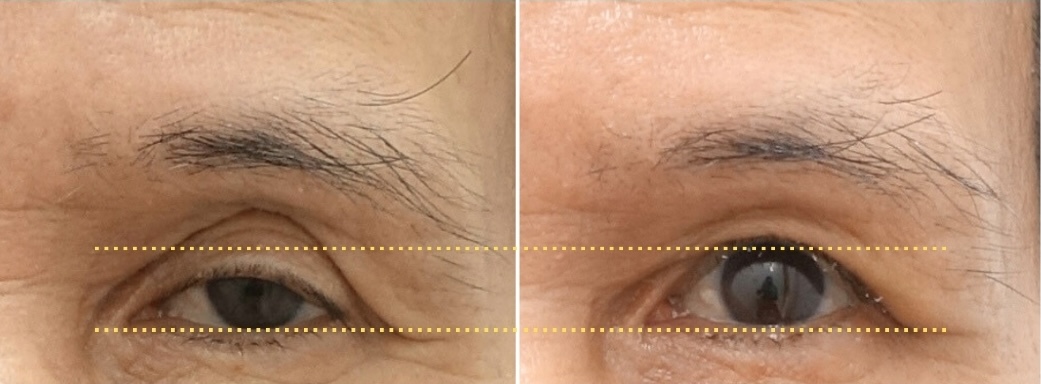
Improved Eyelid Opening
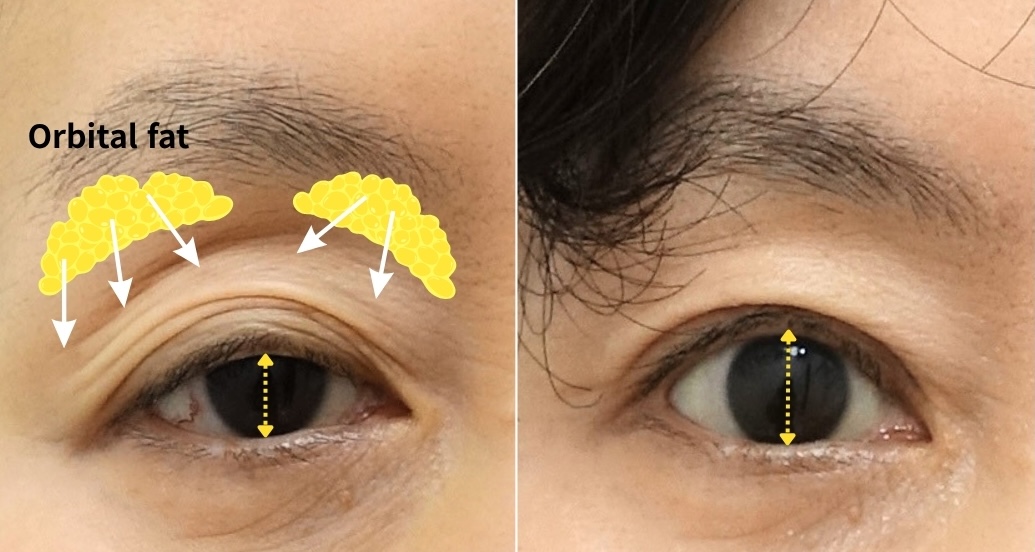
Ptosis can make upper eyelid hollowing appear more noticeable.
By improving eyelid opening and restoring structural balance, the eyes appear more open while the upper eyelid contour becomes smoother and more natural.
The comparison demonstrates increased pupil exposure one month after surgery.
Not Every Hollow Upper Eyelid Is the Same
Upper eyelid hollowing is not always the result of volume loss.
In many patients, the appearance is influenced by a combination of aging, previous eyelid surgery, changes in orbital fat position, ptosis, and alterations in eyelid support structures.
Because different causes can create a similar hollow appearance, treatment should begin with identifying the underlying reason rather than simply adding volume.
In selected cases, upper eyelid fat repositioning can restore a smoother contour by utilizing existing orbital fat while preserving natural eyelid anatomy.
Successful treatment depends on understanding the structure of the eyelid and choosing the appropriate approach for each individual patient.
UPPER EYELID FAT REPOSITIONING RECOVERY
Healing Takes Time
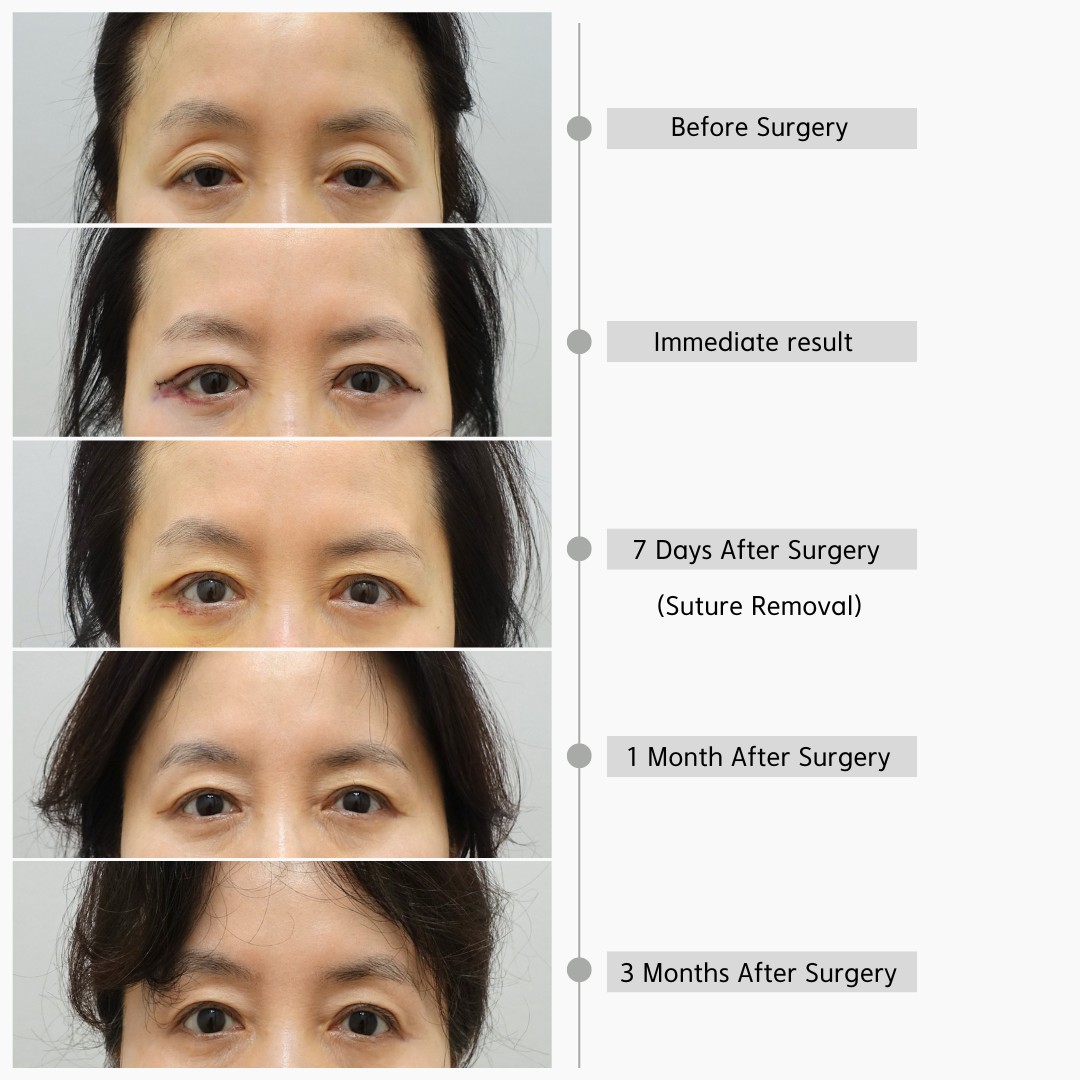
Recovery after upper eyelid fat repositioning is a gradual process.
The appearance seen immediately after surgery does not represent the final result.
As swelling decreases and tissues settle, the upper eyelid contour becomes smoother and more natural.
Meaningful evaluation is possible only after sufficient healing has occurred.
UPPER EYELID FAT REPOSITIONING RECOVERY TIMELINE
Recovery after upper eyelid fat repositioning occurs gradually over time.
The appearance seen immediately after surgery does not represent the final result.
As swelling decreases and tissues settle, the upper eyelid contour becomes smoother and more natural.
Meaningful evaluation is possible only after sufficient healing has occurred.
Related Insight
Why Do My Eyes Look Hollow Even After Double Eyelid Surgery
Some patients continue to notice hollow upper eyelids even after double eyelid surgery. Understanding the underlying cause is often more important than simply adding volume.
International Consultation Process
Many of our patients travel to Korea for evaluation and treatment of hollow upper eyelids, previous eyelid surgery, ptosis-related changes, and structural eyelid concerns.
Online photo evaluations and individualized treatment planning are available before travel.
Online Photo Evaluation
Submit photographs before traveling.
Personalized Surgical Planning
Individualized assessment for each case.
International Patient Coordination
Assistance with scheduling and preparation.
One-Surgeon
Care
Direct care from consultation through follow-up.

Approximately 1–2 hours

Incision: Performed through the natural eyelid crease when structural repositioning is required

Not required

Typically 5-7 days after surgery
Initial recovery generally occurs within 1–2 weeks, while contour refinement and tissue stabilization continue over several months.

Local anesthesia with real-time functional evaluation
UPPER EYELID FAT REPOSITIONING IN KOREA
Frequently Asked Questions
About Upper Eyelid Fat Repositioning
Answers to the most common questions about upper eyelid hollowing,
fat repositioning, structural balance, recovery, and long-term results.
F&Q
Frequently Asked Questions About Upper Eyelid Fat Repositioning
1. What is upper eyelid fat repositioning?
Upper eyelid fat repositioning is a procedure that restores volume balance in hollow or sunken upper eyelids by conservatively repositioning existing orbital fat rather than aggressively removing tissue.
2. Why do upper eyelids become hollow over time?
Upper eyelid hollowing may develop due to aging, previous eyelid surgery, excessive fat removal, ptosis imbalance, or loss of structural support around the upper eyelid.
3. Can upper eyelid hollowing be caused by previous surgery?
Yes. Excessive fat removal during previous eyelid surgery can increase hollow appearance, structural tension, and long-term instability over time.
4. Is fat removal always necessary in upper eyelid surgery?
No. In many patients, preserving or repositioning healthy tissue may create more natural and stable long-term results than aggressive fat removal alone.
5. How is fat repositioning different from filler treatment?
Fat repositioning restores structural balance using the patient’s existing tissue, while fillers temporarily add volume externally. Structural imbalance and ptosis-related hollowing may not improve with filler treatment alone.
6. Can ptosis make the upper eyelid look hollow?
Yes. Weak eyelid opening function and compensatory muscle use may create a hollow or sunken appearance even when volume loss itself is not severe.
7. Does upper eyelid fat repositioning leave visible scarring?
The procedure is generally performed through the natural eyelid crease, allowing scars to become less noticeable over time as healing progresses.
8. Can upper eyelid fat repositioning be combined with ptosis correction?
Yes. In some patients, ptosis correction and fat repositioning are performed together to restore both eyelid function and structural volume balance.
9. What is the goal of upper eyelid fat repositioning?
The goal is not excessive fullness, but restoration of natural upper eyelid contour, balanced structure, and long-term stability.
10. When is revision surgery necessary after upper eyelid fat removal?
Revision may be considered when previous surgery creates persistent hollowing, asymmetry, excessive tension, or functional imbalance that cannot improve naturally over time.
Orbital Fat Reposition & Eyelid Hollowing Insights
Understanding eyelid hollowing requires careful structural evaluation. In many patients, hollowing is not simply a matter of volume loss, but a combination of muscle imbalance, orbital fat displacement, and previous surgical changes. The following articles explain common causes and clinical considerations related to eyelid hollowing and fat reposition procedures.
Why Eyelid Hollowing Occurs—and Why Volume Is Not Always the Answer
Eyelid hollowing is not always caused by volume loss, and understanding the underlying mechanism is critical for proper treatment.
Why Eyelid Hollowing Can Return After Fat Grafting.
Understanding why hollowing may gradually reappear after fat grafting and what structural factors influence long-term stability.
Why We Did Not Use Fat Grafting in This Case of Eyelid Hollowing.
A case analysis explaining why fat repositioning was chosen instead of fat grafting.
Eyelid Hollowing Is Not Always Caused by Aging Alone.
Exploring functional and structural factors that contribute to hollow upper eyelids.
When Eyelid Hollowing Is Worsened by Ptosis Asymmetry.
How eyelid opening imbalance can gradually deepen hollowing.
Eyelid Hollowing in a Younger Patient: A Revision Case.
A clinical case showing that hollowing can occur even in younger patients following prior surgery
UPPER EYELID FAT REPOSITIONING SURGERY IN KOREA
CONCERNED ABOUT HOLLOW UPPER EYELIDS?
Every hollow upper eyelid has a different cause.
Understanding the reason behind the hollow appearance is the first step toward choosing the right treatment.
Request an evaluation to learn whether upper eyelid fat repositioning may be appropriate for your condition.
Online Consultation Available for International Patients
Ahnsungmin Surgical Philosophy
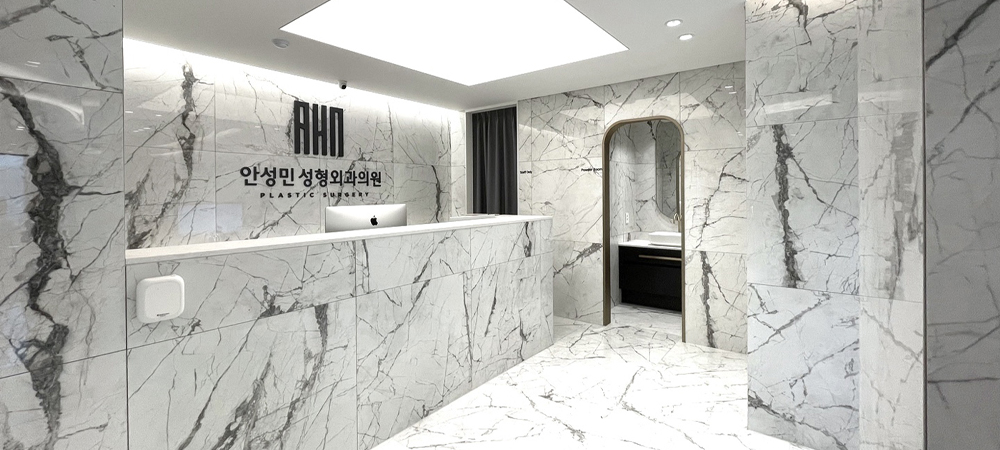
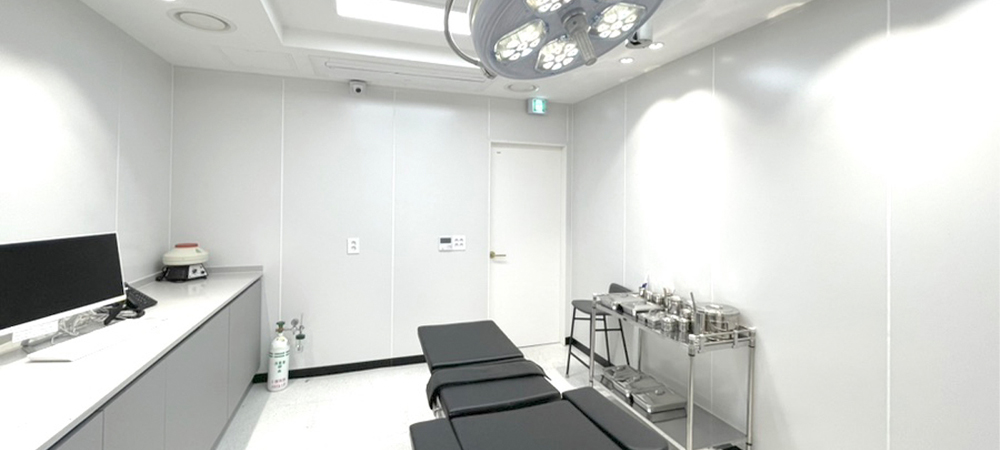
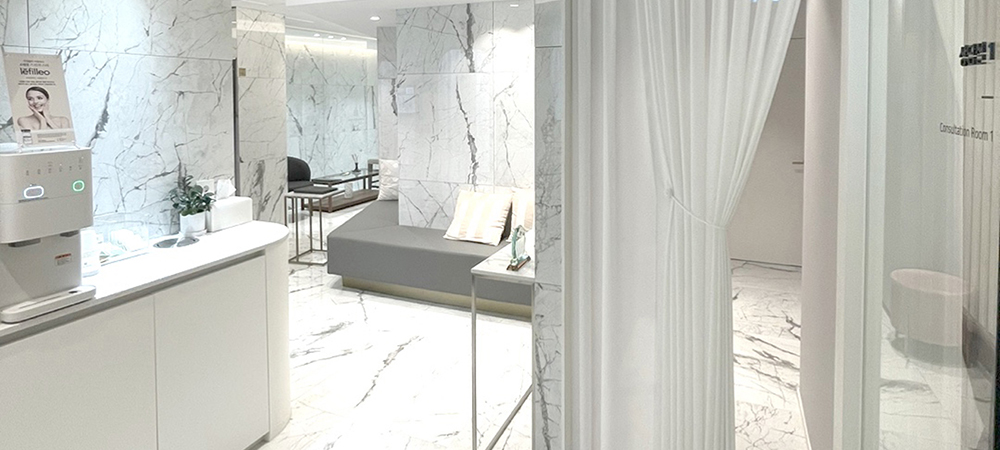
At Ahnsungmin Plastic Surgery, eyelid surgery is approached through careful structural analysis rather than simply focusing on cosmetic change.
Many eyelid conditions such as ptosis, eyelid hollowing, lower eyelid bags, or postoperative imbalance are closely related to the underlying anatomy of the eyelid.
Our surgical philosophy focuses on restoring natural balance while preserving healthy tissue and achieving long-term structural stability.
Concerned About Hollow Upper Eyelids?
Share your photos and surgical history for an initial assessment.
Seoul, Republic of Korea
