When the Problem Is Not Just the Fold
Why do my eyes still look hollow after double eyelid surgery?
“My eyes look more sunken than before.”
“The crease is there, but the upper eyelid feels empty.”
“It doesn’t look natural, even though the line is visible.”
At first glance, this often appears to be a problem with the crease.
But in many cases, the issue is not the fold itself.
Upper eyelid hollowing in these situations is not caused by volume loss, but by structural imbalance.
The Structure Was Never Fully Corrected
The Structure Was Never Fully Corrected
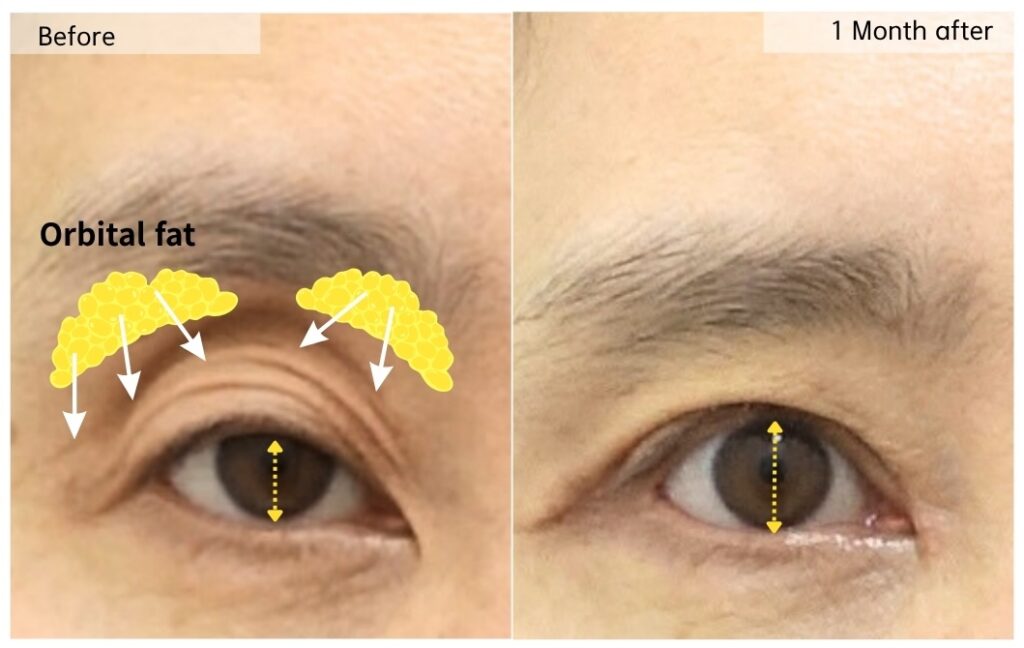
In this case, the eyelid did not appear hollow because of volume loss.
The problem was the position of the existing tissue.
Orbital fat had shifted downward,
and the structural balance of the eyelid had changed.
At the same time, the eye-opening function was still limited.
This combination creates a very specific pattern:
- The eyelid appears heavy
- The crease looks unstable
- The eye does not open clearly
Why Filling Alone Does Not Solve the Problem
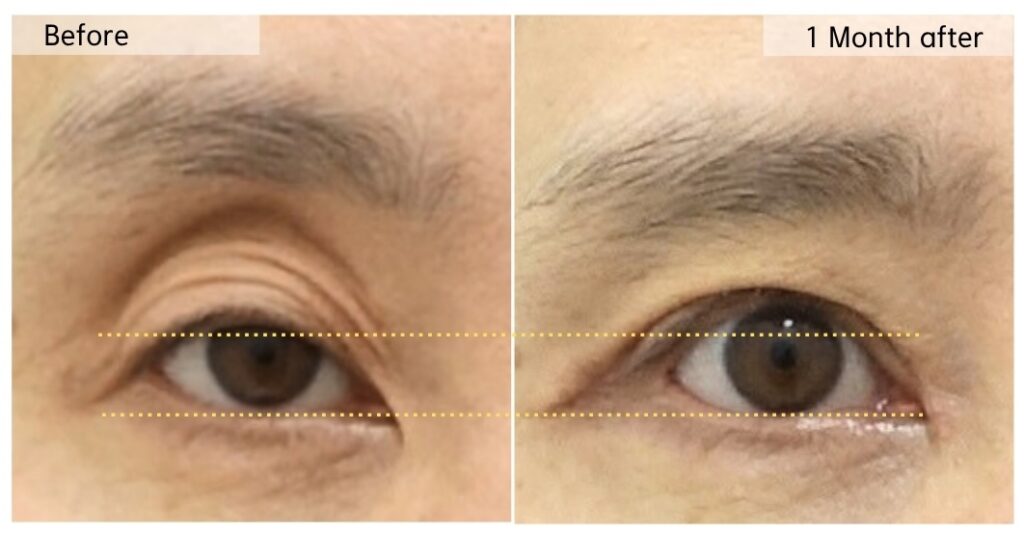
When hollowing appears, many assume that adding volume will fix it.
But in cases like this, the issue is not the amount of tissue.
It is how that tissue is positioned, especially in cases of upper eyelid hollowing.
Adding volume without correcting structure can make the eyelid feel thicker,
less defined, and even more unbalanced over time.
To better understand how this structural approach is applied, you can explore our approach to upper eyelid fat repositioning
Function Must Be Addressed First
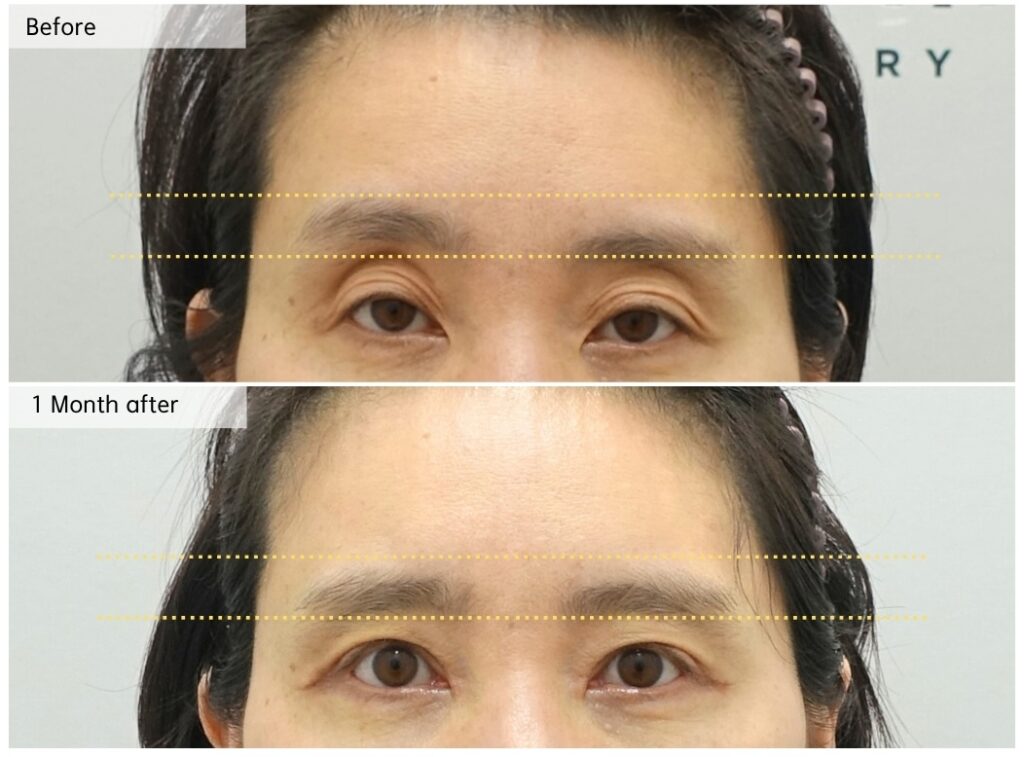
Another key issue in this case was persistent ptosis.
Because the eye could not open properly,
the brow compensated by lifting.
This creates tension, fatigue, and an unnatural appearance.
Once ptosis was corrected:
- The eyes opened more naturally
- The brow position stabilized
- The overall balance improved
Structural Correction, Not Just Line Adjustment
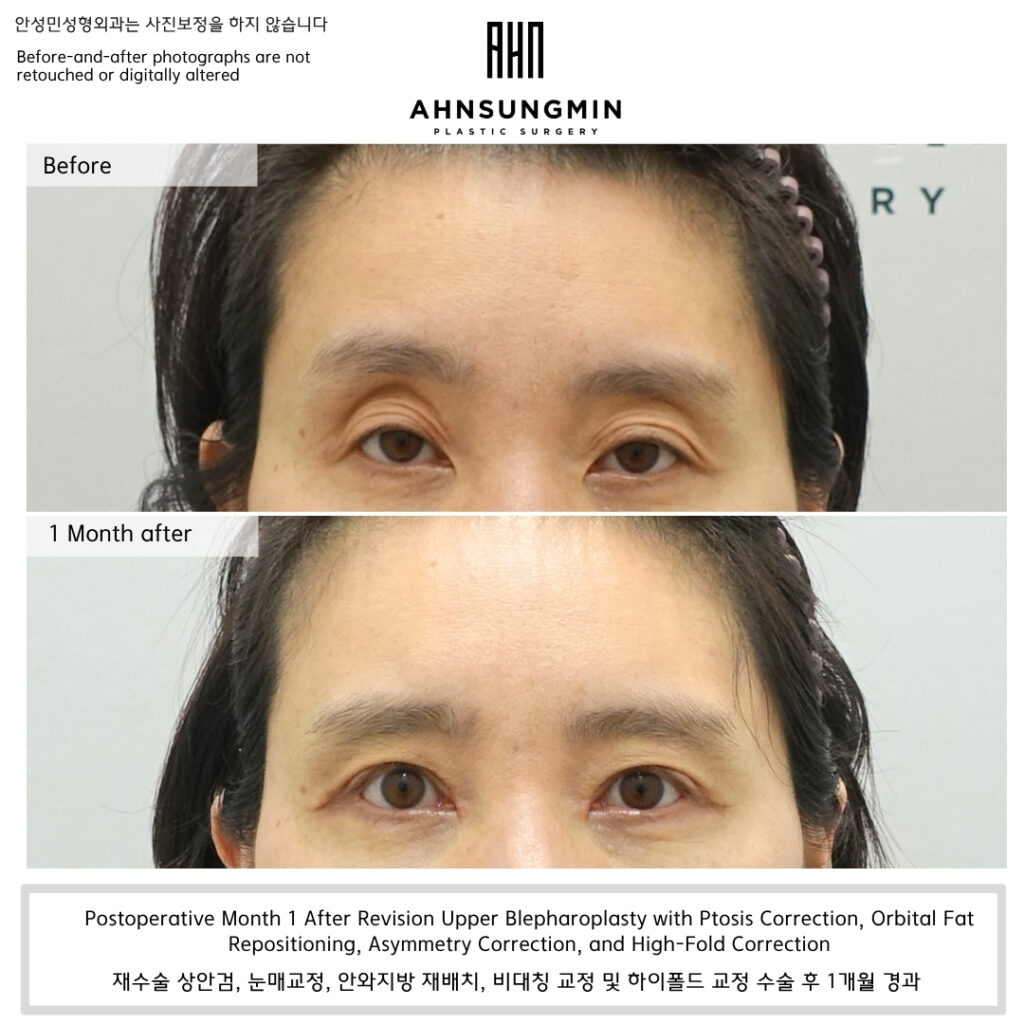
Instead of focusing only on lowering the crease,
the approach was based on restoring structure.
- Orbital fat was repositioned
- Eye-opening function was corrected
- Asymmetry was addressed
- The high fold was adjusted within this structural framework
At one month, the result is already more stable.
But more importantly, the direction is correct.
The Goal Is Not Just a Visible Change
The goal is not simply to create a visible crease.
The goal is to remove the cause of the hollow appearance.
Because when the underlying structure is properly corrected,
the result is not only more natural—but more stable over time.
→ Request a Ptosis and Eyelid Structure Evaluation
Seeing the Eye as a Whole, Not in Parts
A Clinic Dedicated to Eyelid Revision Surgery in Korea
Ahnsungmin Plastic Surgery
Frequently Asked Questions
What causes hollow eyes after double eyelid surgery?
Hollow eyes after surgery are often caused by structural changes, such as displaced orbital fat, excessive tissue removal, or adhesion—not simply volume loss.
Why do my upper eyelids look hollow even after surgery?
If the underlying structure is not properly balanced, the eyelids may appear hollow even when a crease is present.
Can hollow eyelids be fixed with fillers?
In many cases, fillers do not address the root cause. Without correcting structural imbalance, adding volume can make the eyelid appear heavier or less defined over time.
What is the role of fat repositioning in hollow eyelids?
Fat repositioning restores the natural distribution of existing tissue, improving contour without simply adding volume.
When should hollow eyes be treated with revision surgery?
Revision may be considered when hollowing persists due to structural imbalance, especially when it affects contour, symmetry, or long-term stability.
Eyelid Hollowing Improved Through Ptosis Correction and Orbital Fat Repositioning
Understanding how structural repositioning improves hollowing without adding volume
Why We Corrected Hollowing Without Adding Volume
Explaining why structure matters more than simply filling hollow eyelids
Why We Did Not Use Fat Grafting in This Case of Eyelid Hollowing
A case-based explanation of avoiding fat grafting in structurally complex eyelids
Why Eyelid Hollowing Can Return After Fat Grafting
Explaining why volume-based correction alone may not provide lasting results
