Before and After
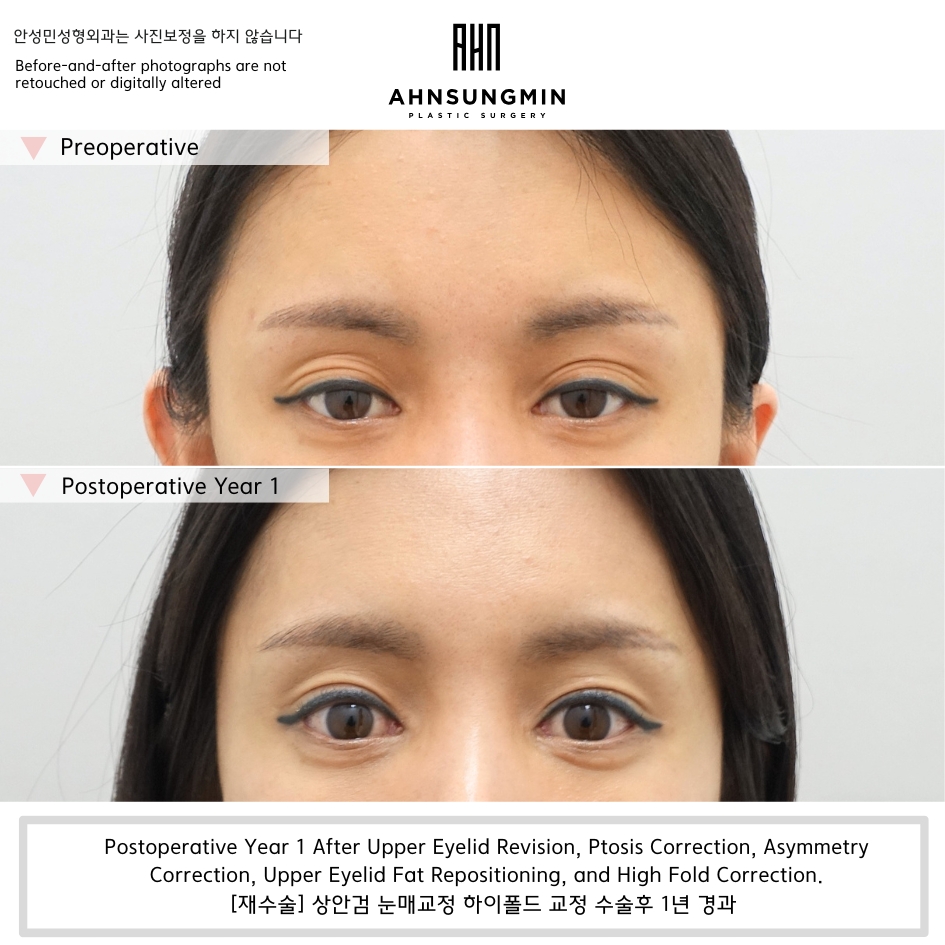
Postoperative Year 1 After Upper Eyelid Revision, Ptosis Correction, Asymmetry Correction, Upper Eyelid Fat Repositioning, and High Fold Correction.
Not all hollow eyelids require added volume—this case demonstrates structural correction through repositioning rather than simple filling.
A Functional Problem, Not a Volume Deficiency
At first glance, the upper eyelids appeared hollow.
This is often interpreted as volume loss, leading many patients to consider filler or fat grafting.
However, in this case, the hollow appearance was not primarily caused by a lack of fat.
The underlying issue was structural.
Ptosis was present, and the patient had developed compensatory eyebrow elevation over time.
As the forehead remained engaged to keep the eyes open, the upper eyelid skin gradually stretched.
This repeated tension created a hollow appearance—even though sufficient orbital fat was still present.
Why We Did Not Add Volume
Adding volume in this situation would not address the cause.
Filler or fat grafting may temporarily mask the hollow, but it does not correct the structural imbalance created by ptosis and eyelid stretching.
In some cases, volume addition can even worsen the appearance by creating irregular contours or exaggerating asymmetry.
For this reason, we did not pursue volume-based treatment.
Structural Correction Instead of Filling
The surgical plan focused on restoring balance rather than adding volume.
Ptosis correction was performed to normalize eyelid opening and eliminate the need for compensatory brow elevation.
At the same time, the existing orbital fat was carefully repositioned—not removed or replaced.
This allowed the hollow area to be addressed using tissue that already belonged to the eyelid, preserving its natural blood supply.
This approach is based on upper eyelid fat repositioning, a technique that restores volume using existing orbital fat rather than adding new tissue.
Results at One Year
At one year, the hollow appearance has improved without the use of filler or grafted fat.
The eyelid appears more balanced, and the patient no longer relies on forehead compensation to maintain eye opening.
This is not the result of adding volume.
It is the result of restoring structure.
If you are considering treatment for hollow eyelids, understanding whether structural repositioning is appropriate is an essential first step.
Insight
Hollow eyelids are not always caused by volume loss, and in many cases, structural imbalance is the primary issue. This is discussed in more detail in our article, Why Your Eyelids Look Hollow—And Why Filler May Not Be the Answer.
High Fold Revision Surgery Korea
If your eyelids appear hollow, the most important step is identifying the cause—not simply choosing a treatment.
→ Request a Hollow Eyelid Evaluation
Surgical Approach
Upper Eyelid Revision
Ptosis Correction
Asymmetry Correction
Upper Eyelid Fat Repositioning
High Fold Correction
Frequently Asked Questions
Is eyelid hollowing always caused by volume loss?
No. Eyelid hollowing is not always the result of fat loss. In many cases, it is caused by structural factors such as ptosis or repeated stretching of the eyelid rather than true volume deficiency.
Why can eyelid hollowing appear worse after filler or fat grafting?
Because the underlying problem may not be volume loss. When filler or fat is added without correcting structural imbalance, the result can look uneven or more pronounced over time.
Can ptosis make the eyelids look hollow?
Yes. Patients with ptosis often compensate by lifting their eyebrows, which stretches the eyelid skin over time and creates a hollow appearance even when fat is still present.
When is fat repositioning preferred over filler?
Fat repositioning is preferred when the goal is to restore volume while maintaining blood supply. Unlike filler or grafted fat, orbital fat repositioning uses existing tissue, which allows for more stable and predictable long-term results.
How can you tell what is causing eyelid hollowing?
A structural evaluation is necessary. The key is to determine whether the issue is true volume loss, skin stretching, or changes caused by previous surgery.
