Before and After
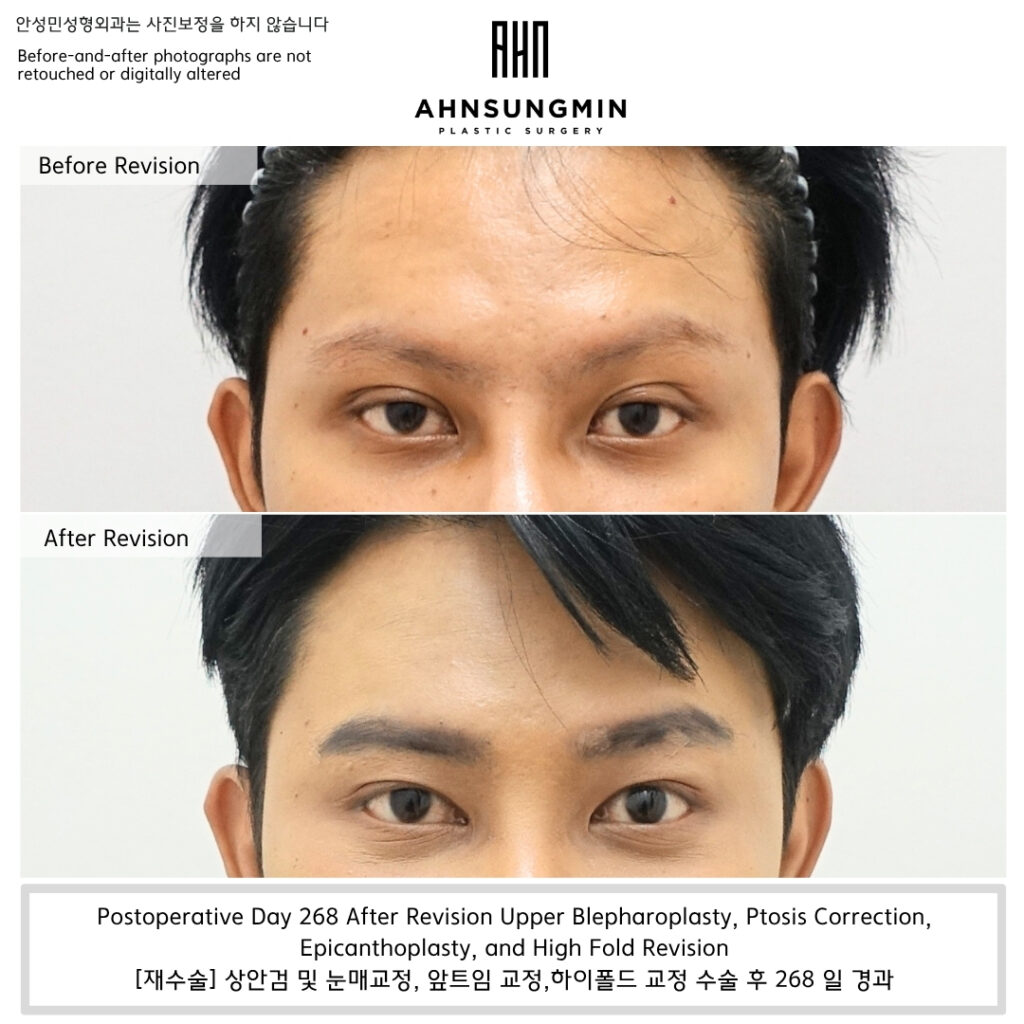
Before Revision / After Revision
Postoperative Day 268 After Revision Upper Blepharoplasty, Ptosis Correction, Epicanthoplasty, and High Fold Revision
A Functional Problem
At first glance, this case appeared to be a problem of a high and heavy double eyelid crease.
The fold looked deep, thick, and positioned higher than what would typically appear natural.
However, this was not simply a matter of crease height.
The eyelid did not open fully, and there was clear reliance on the forehead to compensate.
This type of persistent compensation pattern is also commonly seen in patients with residual ptosis after previous eyelid surgery, where unstable eyelid opening mechanics continue to create heaviness, forehead dependence, and gradual crease instability over time.
→ Revision Ptosis Surgery Case: Correcting Residual Ptosis and Restoring Clearer Eyelid Opening.
This indicated that the primary issue was functional—not purely aesthetic.
Why We Did Not Pursue a Lower Fold First
Lowering the crease alone would not have resolved the underlying problem.
If the eyelid continues to rely on compensatory mechanisms, the heaviness and unnatural appearance persist regardless of crease position.
In revision cases, the visible issue is often not the true cause.
The decision was made to address function first, rather than directly altering the crease height.
Structural Correction
This was a revision case.
The patient had undergone previous eyelid surgery, and the goal was not simply to change the appearance, but to correct the structural imbalance that remained.
Ptosis correction was performed to restore proper eyelid opening.
At the same time, the high fold was revised in a way that reduced tension and allowed for a more natural contour.
The approach focused on restoring balance between eyelid structure and function.
Results
After correction, the eyelid opens more naturally without the need for forehead compensation.
The heaviness is reduced, and the crease appears softer and more stable.
The change is not defined by how much the fold was lowered, but by how the eye functions after surgery.
The overall expression appears more relaxed and balanced.
fold correction often requires more than simply lowering the visible crease. Previous fixation, scar tissue, eyelid opening, and remaining tissue must be evaluated together. These factors are part of the broader evaluation required when planning eyelid revision surgery in Korea.
Surgical Approach
This case was approached with a focus on structural correction, functional restoration, and long-term stability, rather than simply lowering the crease.
Internal References
→ Why your double eyelid looks too high over time
→ Why thickness—not height—often determines how unnatural a fold looks
→ Why a high fold may actually be a functional issue
→ When a high fold should be lowered—and when it should not
→ High Fold Revision Surgery Korea
If your eyelid appears high, thick, or unnatural—and you notice that your eyes do not open fully or rely on your forehead—a structural evaluation is necessary to determine the correct approach.
Request a Revision Ptosis & Eyelid Structure Evaluation →
Seeing the Eye as a Whole, Not in Parts
A Clinic Dedicated to Eyelid Revision Surgery in Korea
Ahnsungmin Plastic Surgery
