Upper eyelid hollowing is often treated as a simple volume loss problem. However, in many patients, hollow upper eyelids are actually related to ptosis, muscle compensation, and structural imbalance rather than true fat deficiency.. In many patients, however, the eyelids may appear hollow because the eyes are not opening with stable functional support.
When ptosis is present, the forehead and brow muscles often compensate for weak eyelid opening. Over time, this repeated compensatory effort can alter the resting position of the upper eyelids, stretch the eyelid skin, and create a hollow appearance even without significant volume loss.
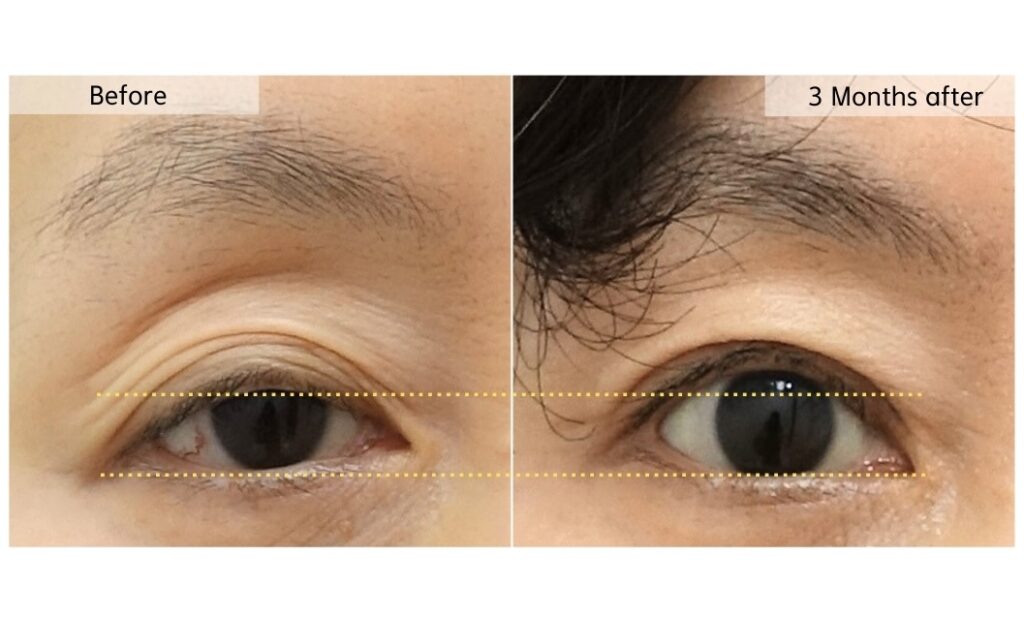
[ Before / Three Months After]
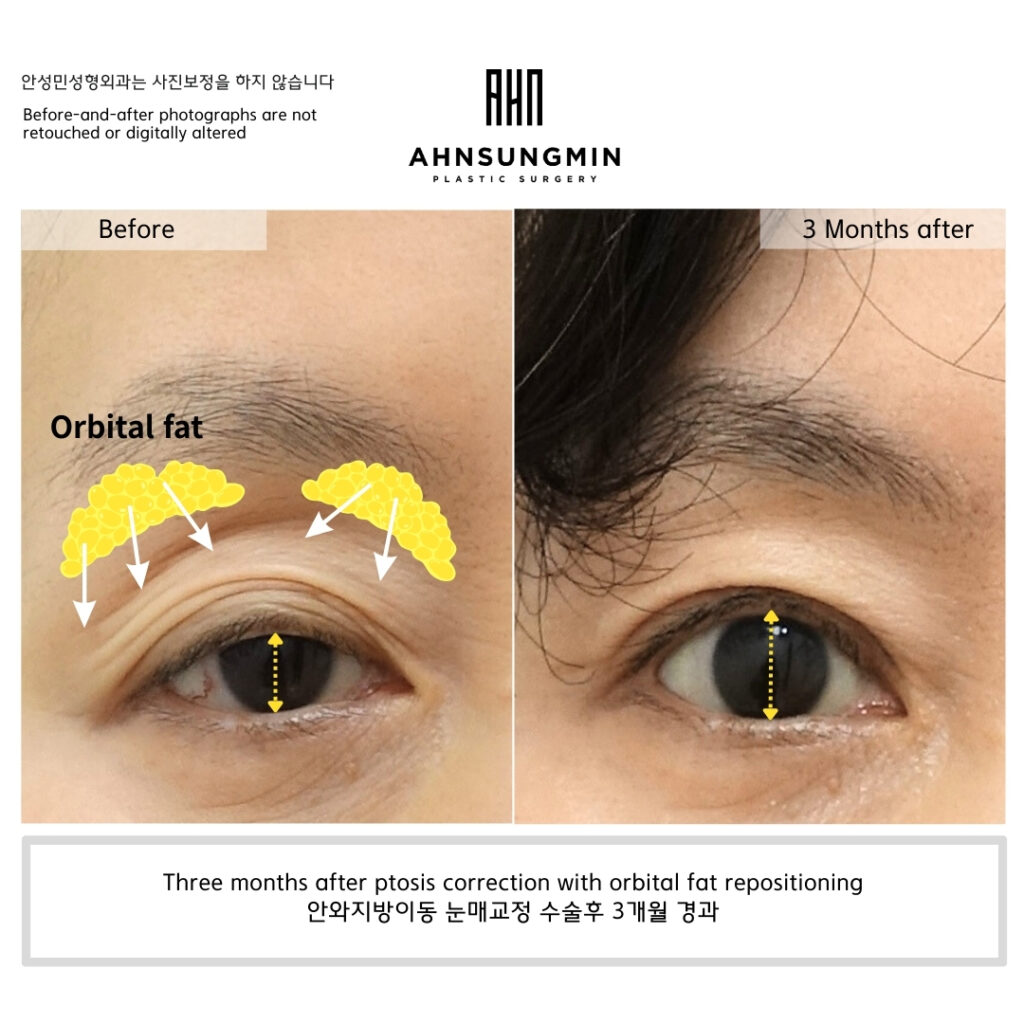
Clinical Example
Three months after ptosis correction with conservative orbital fat repositioning
Three months after ptosis correction with conservative orbital fat repositioning, the upper eyelid contour appears smoother and more balanced than before surgery.
Eyelid hollowing is often described as a problem of volume loss. Clinically, however, hollowing frequently reflects a combination of functional imbalance, chronic compensation, and structural change rather than simple fat deficiency.
In some patients, improvement can occur after restoring stable eyelid opening and reducing the excessive muscular tension acting around the upper eyelid. Conservative fat repositioning may then be used in a supportive role to improve contour balance without excessive volume addition.
The underlying issue is often not volume itself, but instability in how the eyelids function and rest.
Before correction, patients with ptosis frequently rely on continuous forehead and brow muscle activation in order to open the eyes more comfortably.
Over time, this chronic compensatory effort can alter the resting position of the upper eyelid, increase tissue tension, and contribute to a hollow appearance even when severe volume loss is not present.
How Ptosis Correction Changes the Forces Acting on the Eyelid
The first priority in these situations is often to restore stable and comfortable eyelid opening.
When ptosis is corrected, the need for excessive forehead and brow compensation is reduced. As this chronic muscular tension decreases, the forces acting across the upper eyelid become more balanced and stable.
Once this compensatory strain is relieved, the eyelid is often able to settle into a more natural resting position.
In many patients, this functional stabilization alone can partially improve the appearance of hollowing.
Structural Support May Still Be Necessary
Functional correction, however, does not always completely resolve the hollow contour.
In selected patients, conservative structural support may still be beneficial after eyelid opening has been stabilized.
One approach is upper eyelid fat repositioning, where existing orbital fat is carefully redistributed to support contour balance using the patient’s own tissue rather than introducing excessive new volume.
The purpose of this approach is not to aggressively “fill” the eyelid, but to reinforce structural support while respecting the limitations of the patient’s anatomy.
Improvement Does Not Always Mean Complete Correction
At follow-up, many patients show more stable eyelid opening and a smoother upper eyelid contour after functional correction and conservative structural support.
However, meaningful improvement does not necessarily require complete elimination of every hollow area.
Excessive correction can create heaviness, unnatural fullness, or long-term imbalance.
For this reason, eyelid hollowing is not always a problem that can—or should—be fully erased.
Meaningful improvement often depends on restoring function first and using structural support judiciously rather than pursuing excessive volume correction.
In revision surgery especially, restraint is not a limitation.
It is part of the solution.
Insight
Hollow eyelids are not always caused by volume loss. In many cases, functional imbalance and structural changes play a more important role. This is discussed in more detail in our article, Why Your Eyelids Look Hollow—And Why Filler May Not Be the Answer.
Frequently Asked Questions
Is eyelid hollowing always caused by volume loss?
No. Eyelid hollowing is not always caused by fat loss. In many cases, it is related to functional imbalance, such as ptosis, or structural changes in the eyelid.
Can ptosis make the eyelids look hollow?
Yes. Patients with ptosis often use their forehead muscles to compensate, which can stretch the eyelid over time and create a hollow appearance even without significant volume loss.
Is filler always necessary for hollow eyelids?
No. In some cases, hollowing can improve through structural correction rather than adding volume. Treating the underlying cause is often more important than filling the area.
When is fat repositioning used instead of adding volume?
Fat repositioning is used when existing orbital fat can be redistributed to improve contour. This approach avoids introducing new volume and maintains natural tissue balance.
Can ptosis correction improve hollow upper eyelids?
In some patients, correcting ptosis can improve hollow upper eyelids by reducing chronic forehead compensation and restoring more stable eyelid function.
If your eyelids appear hollow, identifying the underlying cause is more important than choosing a treatment.
Determining whether hollowing is caused primarily by volume loss, ptosis, or structural imbalance is one of the most important parts of treatment planning.
→ Request a Hollow Eyelid Evaluation
