[Before / Seven Months After]

Seven months after revision upper blepharoplasty, ptosis correction, and orbital fat repositioning
Eyelid hollowing is often associated with aging.
However, it can also appear in younger patients—particularly after prior eyelid surgery.
Eyelid hollowing after double eyelid surgery is not always related to aging and often requires structural evaluation.
This case involves a patient in her 30s who presented with significant upper eyelid hollowing despite her age.
This type of eyelid hollowing after double eyelid surgery is often related to structural imbalance rather than simple volume loss.
A history of prior double eyelid surgery.
The patient had previously undergone double eyelid surgery.
Over time, she developed pronounced eyelid hollowing, ptosis, and multiple creases.
Although she was relatively young,
the upper eyelid appeared fatigued and structurally unstable.
The causes were multifactorial.
Evaluation showed that the hollowing was not caused by a single factor.
There was a degree of skin laxity,
limited native eyelid fat volume,
and weakening of eyelid support.
As the eyelid became lax,
the tissue rolled inward during eye opening,
worsening both the hollowed appearance and functional difficulty.
Surgery focused on restoring structure and function.
Revision surgery addressed each contributing factor.
Ptosis correction was performed to restore stable eyelid opening.
Orbital fat was carefully repositioned to provide structural volume support.
Excess upper eyelid skin was excised to correct laxity.
By restoring proper tension and alignment,
the eyelid no longer rolls inward during eye opening.
Request a Consultation for Eyelid Hollowing Evaluation
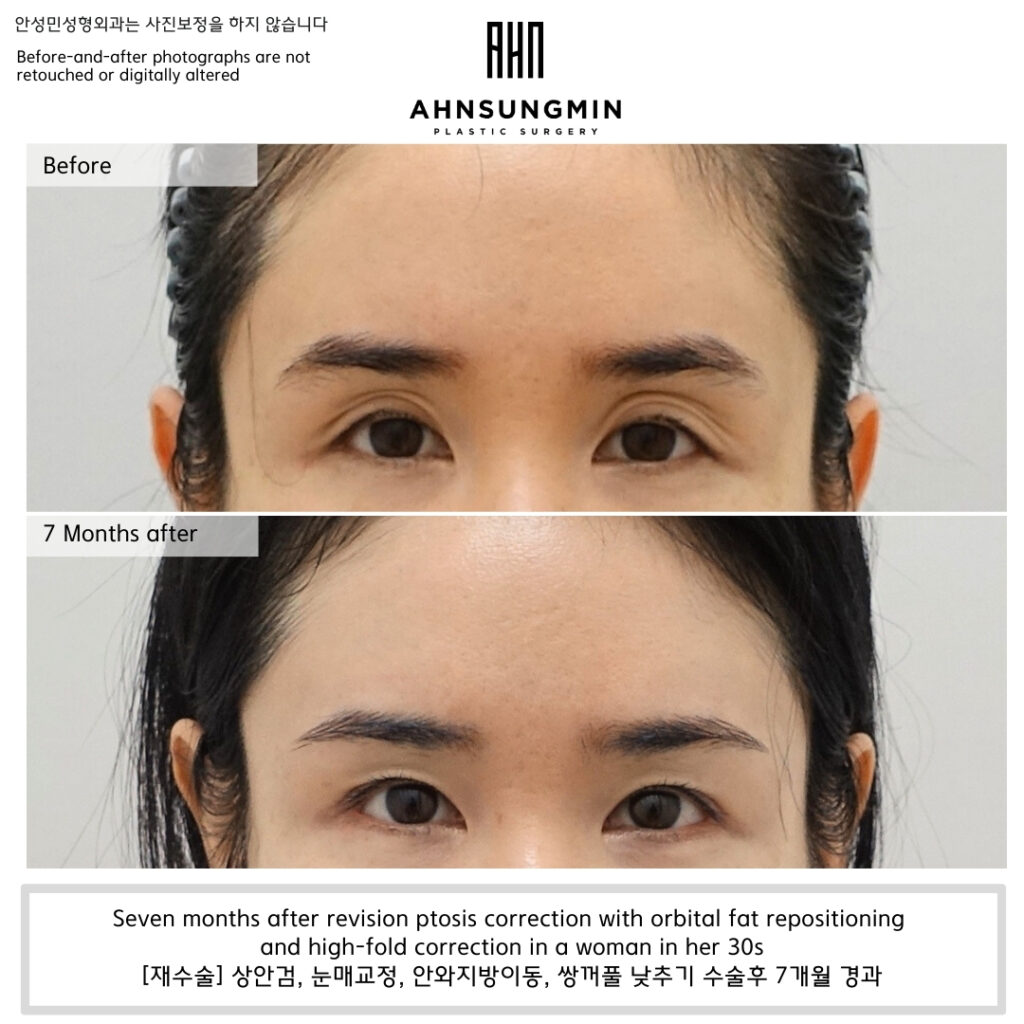
The result at seven months.
At seven months after surgery,
eyelid opening remains stable and comfortable.
The upper eyelid contour appears smoother and well balanced,
with sustained improvement in the hollowed appearance.
This case demonstrates that eyelid hollowing in younger patients
often reflects structural and functional imbalance rather than age alone.
In revision surgery,
meaningful improvement comes from addressing all contributing factors—not just one.
Seeing the Eye as a Whole, Not in Parts
A Clinic Dedicated to Eyelid Revision Surgery in Korea
Ahnsungmin Plastic Surgery
Internal References
→ Learn why eyelid hollowing is not always caused by volume loss
→ Understand why eyelid hollowing can appear worse after treatment
→ See why fat repositioning is not about adding volume
→ Best Upper Eyelid Fat Reposition Surgeon in Korea before deciding on surgery.
Request a Consultation for Eyelid Hollowing Evaluation
