Not All Hollowing Means Volume Loss
Eyelid hollowing is often assumed to be a simple issue of volume loss.
Patients frequently believe that adding volume through fat grafting or fillers will solve the problem.
However, this assumption is not always correct.
In many cases, what appears as hollowing is not caused by a lack of volume, but by changes in eyelid function and structure.
When Function Affects Appearance
The appearance of the upper eyelid is closely related to how the eyelid opens.
When ptosis is present, patients often compensate by raising their eyebrows.
This compensatory mechanism is explained in more detail in our analysis of ptosis and brow elevation.
Over time, this tension can alter the contour of the eyelid, making it appear hollow.
This is not true volume loss.
It is a structural and functional change.
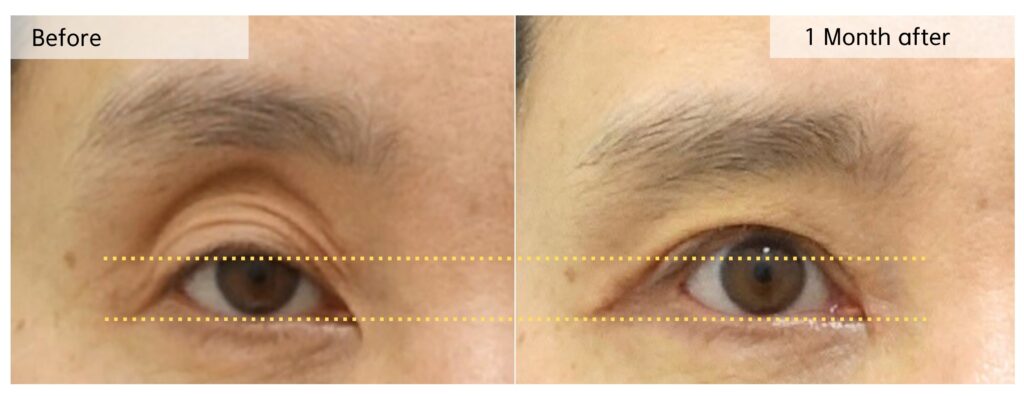
Why Adding Volume Can Be the Wrong Approach
When hollowing is misinterpreted as volume loss, treatment often focuses on adding volume.
Fat grafting or fillers may temporarily improve the appearance.
However, in many cases, recurrence after fat grafting occurs when the underlying cause is not addressed.
In some cases, it can even lead to unnatural fullness or imbalance.
The key is not to fill what looks empty, but to understand why it appears that way.
Understanding the Cause Comes First
Eyelid hollowing cannot be approached as a single problem with a single solution.
Each case must be evaluated based on structure, function, and the patient’s individual anatomy.
In patients with ptosis or compensatory brow elevation, correcting the functional imbalance should be the priority.
Only after addressing the underlying cause can volume restoration be considered.
In selected cases, carefully planned fat repositioning or volume restoration may still play an important role.
Our Perspective
Eyelid hollowing is not simply a problem of volume.
It is often a reflection of deeper structural and functional changes.
Treatment should not be based on what appears empty, but on what has actually changed.
This approach reflects our philosophy of prioritizing function, structure, and long-term stability over visual correction.
Request an Upper Eyelid Hollowing Evaluation
If you are experiencing hollow upper eyelids, brow compensation, or recurrent hollowing after fillers or fat grafting, you may request a personalized evaluation based on eyelid function, structural balance, ptosis compensation, and long-term stability.
Seeing the Eye as a Whole, Not in Parts
A Clinic Dedicated to Eyelid Revision Surgery in Korea
Ahnsungmin Plastic Surgery
