When the Problem Is Not Just the Crease
Many patients come in with the same concern after double eyelid surgery.
“My eyes still feel heavy.”
“They do not open clearly.”
“I expected a brighter look, but my eyes still feel tired.”
In many of these cases, the problem is not simply the crease itself.
The issue is that the eyelid function was not fully corrected.
A double eyelid line may be present, but if ptosis remains unaddressed, the eyes can still feel heavy, strained, and less defined than expected.
Why the Eyes Can Still Feel Heavy After Surgery
Some patients assume that once the crease is created, the eyes should automatically look clearer and feel lighter.
But this is not always the case.
If the eyelid-opening function is weak, the eyes may still feel difficult to open even after surgery.
In these situations, the patient may continue to use the forehead unconsciously, and the eyes may still appear tired or burdened during daily use.
This is why some patients say that the line is there, but the eyes still do not feel right.
When Ptosis Remains, the Result Can Still Feel Incomplete
When ptosis is not fully addressed, the eyelid does not open with enough strength.
As a result:
- the eyes may continue to feel heavy
- the eyelid may look thick or burdened
- the crease may appear too strong or too high
- the overall eye shape may still look unclear
This is not simply a design issue.
It is a functional issue that affects the final appearance.
A High Fold Can Make the Problem Feel Worse
In some revision cases, the fold is also positioned too high.
When the eyelid already feels heavy, a high fold can make the result look even more unnatural.
The line appears more obvious, but the eye itself still does not open in a clear and balanced way.
This is why some patients feel that the surgery made a line, but did not truly improve the eye.
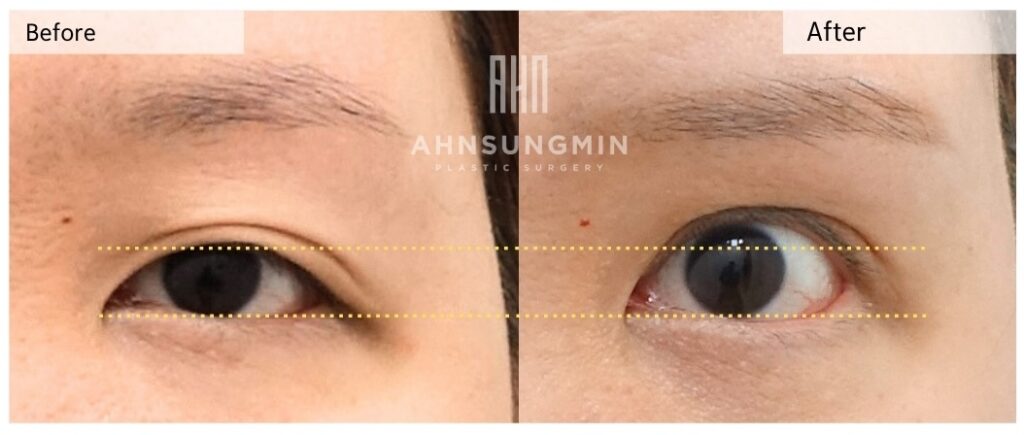
Functional Correction Changes More Than the Line
When revision surgery is planned correctly, the goal is not simply to change the crease.
The goal is to restore more natural eyelid opening.
Once ptosis is corrected and the eye begins to open with less strain, the overall expression changes.
The eyes look clearer.
They feel lighter.
And the crease becomes more balanced because the function underneath has improved.
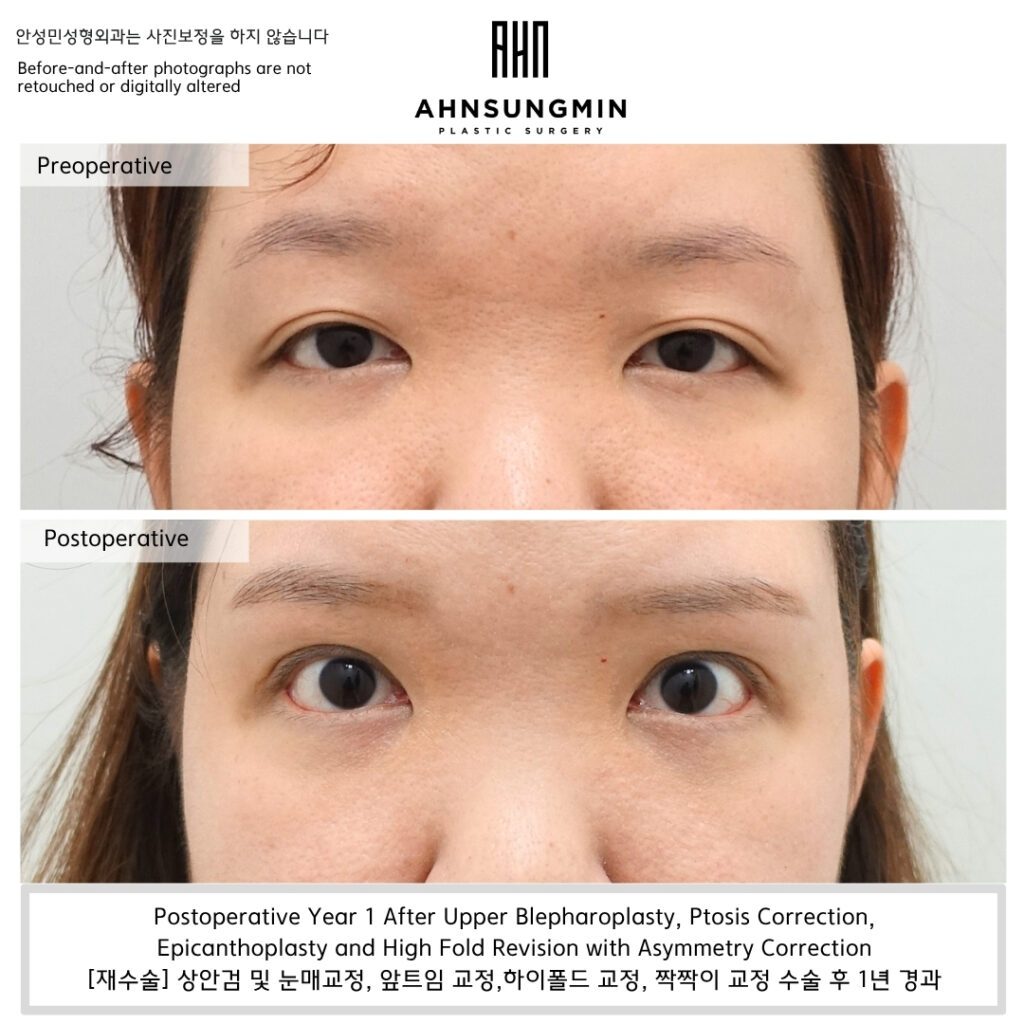
The Right Approach Begins with Understanding the Cause
The goal is not to simply lower the fold or recreate the line.
The goal is to understand why the eyes still feel heavy after surgery.
Because when the real cause is persistent ptosis or incomplete functional correction, the solution must begin there.
If you would like a more detailed breakdown of each recovery stage—from immediate postoperative changes to long-term results—you can refer to our complete guide here:
Detailed Eyelid Surgery Recovery Timeline
When Evaluation Becomes Necessary
If your eyes still feel heavy after double eyelid surgery, if you rely on your forehead to open them, or if the crease looks high without improving eye opening, a structured evaluation is necessary.
→ Request a Ptosis and Eyelid Function Evaluation
Seeing the Eye as a Whole, Not in Parts
A Clinic Dedicated to Eyelid Revision Surgery in Korea
Ahnsungmin Plastic Surgery
Internal References
- Why Does My Double Eyelid Look Too High Over Time
- How to tell if your high fold is actually ptosis
- When a high fold should be lowered—and when it should not
- What to Do If Your Double Eyelid Looks Too High
Insights
Heavy eyes after surgery are not always caused by swelling or crease design.
In many cases, the real issue is that eyelid function remains incomplete even after the line has been created.
Frequently Asked Questions
Why do my eyes still feel heavy after double eyelid surgery?
In many cases, the eyes still feel heavy because ptosis or weak eyelid-opening function was not fully corrected during the original surgery.
Can a double eyelid line exist even if ptosis is still present?
Yes. A crease may be visible, but if eyelid function remains weak, the eyes can still feel heavy and look unclear.
Why does a high fold make the eyes feel more unnatural?
When the fold is high but the eye still does not open well, the line becomes more obvious while the eye itself remains burdened. This often makes the result look more unnatural.
Does this mean the surgery failed?
Not always. In some cases, the issue is not surgical failure but incomplete correction of the underlying functional problem.
When should revision be considered?
Revision may be considered when heaviness persists, eye opening remains weak, or the crease appears strong without improving the overall function of the eye.
