Why This Is More Common Than You Think
Many patients notice that their eyes look uneven after double eyelid surgery.
One side may appear higher.
The crease may look deeper on one side.
Or the eyes may simply feel different when opening.
The immediate assumption is often the same:
“The crease must have been created incorrectly.”
But in many cases, this assumption is not accurate.
It Is Not Always a Crease Problem
Visible asymmetry is not always caused by the crease itself.
It is often related to how each eye functions.
Even if the crease height is similar on both sides, differences in eyelid opening strength can make one side appear higher, deeper, or more defined.
In some cases, one eye may rely more on the forehead to assist with opening, which further changes how the crease looks.
This type of compensation pattern is also commonly seen in patients with residual ptosis after previous eyelid surgery, where persistent forehead use and unstable eyelid opening continue to affect long-term crease stability and eye balance.
→ Revision Ptosis Surgery Case: Correcting Residual Ptosis and Restoring Clearer Eyelid Opening.
This May Be a Functional Issue, Not a Design Issue
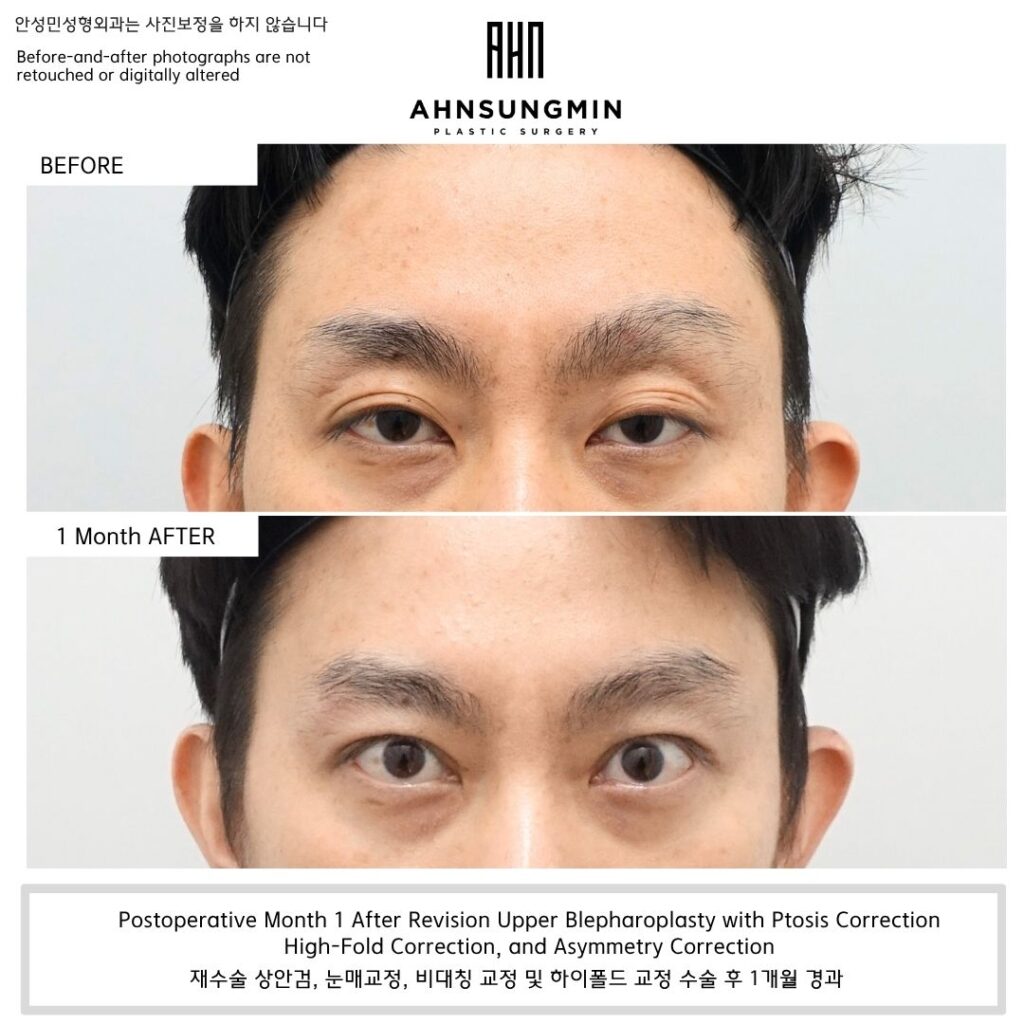
In cases where ptosis is present, the eyelid does not open fully on its own.
As a result, the crease can appear higher or thicker than it actually is.
This is why lowering the crease alone does not solve the problem.
Why Asymmetry Can Become More Noticeable Over Time
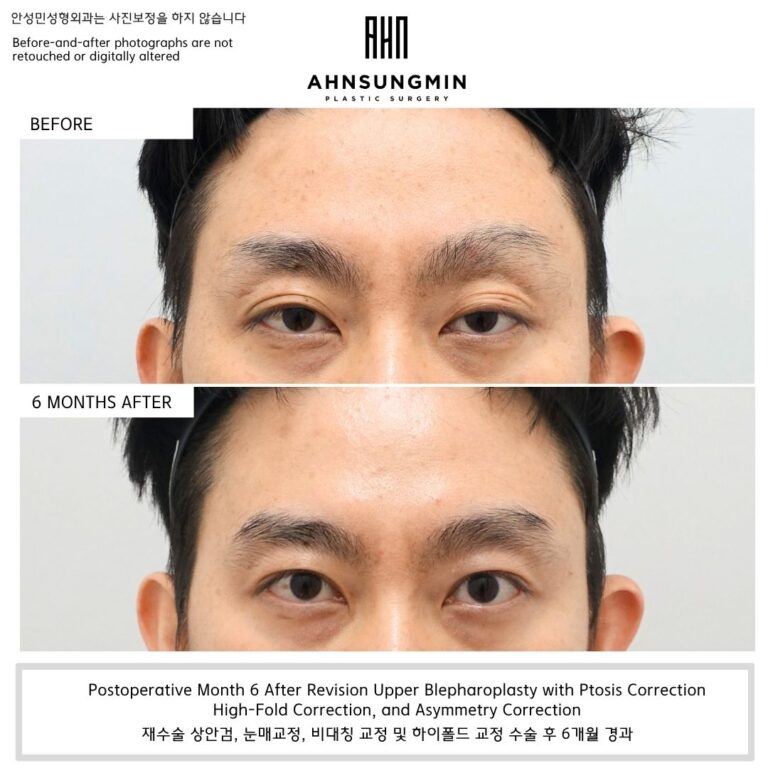
Even if the eyes look similar immediately after surgery, asymmetry can become more noticeable over time.
This is often due to:
- differences in muscle usage
- scar formation and tissue adaptation
- uneven compensation patterns between both eyes
When one eye works harder than the other, the crease gradually begins to look different.
Why Incorrect Decisions Lead to Repeat Surgery
Many revision surgeries begin with the assumption that the crease itself is the problem.
As a result, the crease is lowered or adjusted.
However, if the underlying issue is functional, the imbalance remains.
The appearance may not improve, or the asymmetry may return.
This is not a problem of surgical technique.
It is a problem of diagnosis.
What Should Be Evaluated First
Before considering revision surgery, it is essential to evaluate:
- eyelid opening strength
- presence of ptosis
- forehead compensation
- asymmetry in movement between both eyes
Without understanding these factors, even technically correct surgery may lead to unsatisfactory results.
The Right Approach Begins with Understanding the Cause
The goal is not to simply adjust the crease.
The goal is to understand why the eyes appear uneven.
Because once the cause is identified, the direction of treatment becomes clear.
To better understand how we approach these structural problems, you can explore our approach to eyelid asymmetry correction.
When Evaluation Becomes Necessary
If your eyes appear uneven, feel different when opening, or require effort to maintain symmetry, a structural evaluation is necessary.
→ Request an Eyelid Asymmetry Evaluation
Insights
When asymmetry appears after surgery, it is rarely just a design issue.
In many cases, it reflects underlying differences in eyelid function and structure.
Frequently Asked Questions
Why do my eyes look uneven after double eyelid surgery?
In many cases, uneven eyes after double eyelid surgery are not caused by the crease itself, but by differences in eyelid function, ptosis, scar formation, or compensation patterns between both eyes.
Can uneven eyelids be caused by ptosis after surgery?
Yes. Ptosis or differences in eyelid opening strength can make one eye appear higher, deeper, or more defined, even when the crease itself is not the main problem.
Is unevenness after double eyelid surgery always a crease problem?
No. Visible asymmetry is not always a design problem. In many cases, it reflects functional imbalance, forehead compensation, or structural differences between the two eyes.
Why can asymmetry become more noticeable over time after surgery?
Asymmetry can become more noticeable over time because of scar formation, tissue adaptation, and unequal muscle use between both eyes. When one eye works harder, the crease may gradually look different.
When should uneven eyelids after surgery be evaluated for revision?
Revision should be considered only after the cause of the asymmetry is clearly identified. Evaluation should focus on eyelid opening strength, ptosis, forehead compensation, and movement differences between both eyes before any decision is made.
Internal References
- Why Does My Double Eyelid Look Too High Over Time
- How to tell if your high fold is actually ptosis
- When a high fold should be lowered—and when it should not
- What to Do If Your Double Eyelid Looks Too High
Seeing the Eye as a Whole, Not in Parts
A Clinic Dedicated to Eyelid Revision Surgery in Korea
Ahnsungmin Plastic Surgery
