Not All Eyelids Move Freely.
Ptosis correction assumes that the eyelid can move in a controlled and predictable way.
In primary surgery, this is often true.
Revision surgery is different.
Scar tissue and adhesion frequently alter how the eyelid moves, making surgical planning far more complex.
Understanding tissue quality is therefore just as important as understanding eyelid anatomy.
Clinical Example
Postoperative Month 6 After Ptosis Revision Surgery
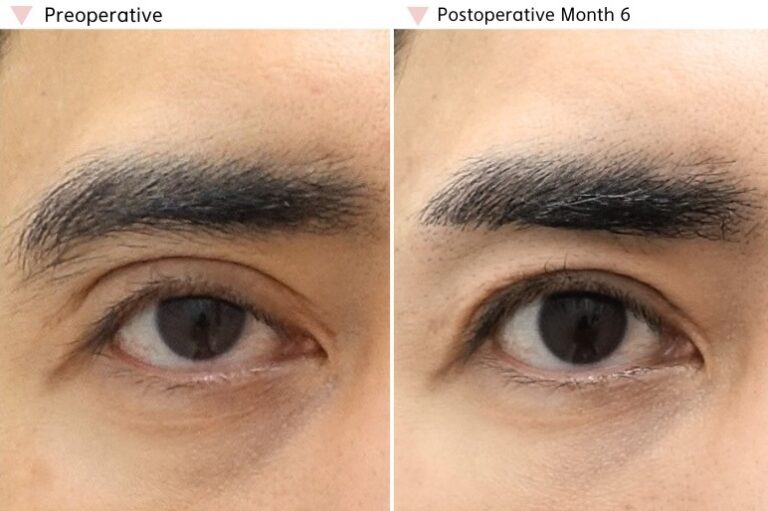
Six months after ptosis revision surgery. Although scar tissue and adhesion make revision surgery more challenging, careful structural planning restored more stable eyelid opening while respecting the limitations of the existing tissue.
Scar Tissue Changes How the Eyelid Moves.
Scar tissue is not simply leftover tissue from a previous operation.
It changes how the eyelid slides, stretches, and responds to movement.
Instead of moving smoothly, the eyelid may become stiff or resistant because the normal tissue planes have been replaced by scar adhesion.
For this reason, revision ptosis surgery often requires a completely different surgical strategy than primary surgery.
Adhesion Changes More Than Appearance.
When adhesion is present, even small adjustments become less predictable.
The eyelid may demonstrate:
- Irregular movement
- Asymmetry during blinking
- Unstable eyelid crease
- Inconsistent eyelid opening
The difficulty is not the surgical technique itself.
It is the altered tissue environment created by previous surgery.
Scar Maturation Continues After Surgery.
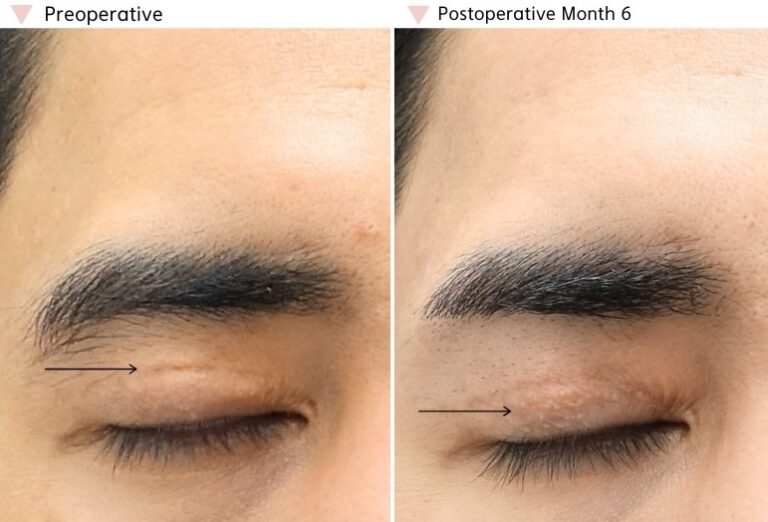
The incision line continues to mature for months after surgery. Stable healing depends not only on the surgical technique but also on careful scar management and gradual tissue remodeling over time.
Releasing Adhesion Does Not Restore Normal Tissue.
Separating scar tissue is only one part of revision surgery.
Once normal tissue planes have been disrupted, they rarely return to their original condition.
Even after meticulous release, some stiffness or movement limitation may remain.
This is why revision surgery must respect the biological limitations of the existing tissue.
Every Revision Increases Complexity.
Each operation creates additional scar tissue.
As scar accumulates, the eyelid becomes less flexible and increasingly difficult to control.
The margin for error becomes smaller with every revision.
Successful revision surgery therefore depends on careful planning rather than aggressive correction.
The Goal Is Stable Movement, Not Perfect Symmetry.
In scar-dominant eyelids, the objective changes.
The goal is not creating a perfectly symmetrical crease.
The goal is restoring controlled, comfortable eyelid movement while maintaining long-term stability.
Sometimes a more conservative correction produces the most reliable long-term result.
Concerned About Ptosis Revision?
Every revision case is different.
A personalized evaluation helps determine how scar tissue, adhesion, and eyelid function may influence the most appropriate surgical plan.
Online consultation available for international patients.
Related Insights
Why Does Ptosis Come Back After Surgery?
Learn why ptosis recurrence is often related to scar tissue, tissue quality, and long-term structural stability rather than surgical technique alone.
Still Feeling Heaviness After Upper Eyelid Surgery?
Learn why persistent eyelid heaviness after upper blepharoplasty may be related to healing, brow compensation, ptosis, or tissue adaptation rather than surgical failure.
Upper Blepharoplasty Recovery Timeline
Follow the normal healing process after upper eyelid surgery and understand when results become more natural.
Ptosis and Eyelid Hollowing
Discover how eyelid function and tissue balance influence both appearance and long-term stability.
Revision Eyelid Surgery in Korea
Learn how revision surgery is planned based on scar tissue, structural balance, and realistic long-term outcomes.
Seeing the Eye as a Whole, Not in Parts
A Clinic Dedicated to Eyelid Revision Surgery in Korea
Ahnsungmin Plastic Surgery
