Facial nerve paralysis can make one eye appear more open or more closed than the other.
At first glance, this may look like a simple difference in eyelid height. Some patients therefore assume that the problem is ptosis and that ptosis correction alone will make the two eyes symmetrical.
However, eyelid asymmetry associated with facial nerve paralysis can be more complex.
The position of the eyelid is only one part of the evaluation. Brow movement, forehead compensation, eyelid opening, eyelid closure, previous surgery, and the underlying difference in neuromuscular function may all influence how the two eyes look and move.
For this reason, the first question should not be:
“How can we make the eyelids the same height?”
It should be:
“What is actually causing the difference between the two eyes?”
Facial Nerve Paralysis Does Not Automatically Mean Ptosis
Ptosis refers to drooping of the upper eyelid related to the eyelid-opening mechanism.
Facial nerve paralysis, however, can affect the eye region in several different ways.
A difference in brow position may make one upper eyelid appear heavier. Forehead compensation may temporarily increase eye opening on one side. Changes in movement around the eye may alter the appearance of asymmetry between rest and active facial movement.
True ptosis may also be present—but it should be identified through functional evaluation rather than assumed from appearance alone.
This distinction matters because different causes require different treatment decisions.
Why Eyelid Height Alone Is Not Enough
A photograph taken while the patient is looking straight ahead provides useful information, but it does not show the entire functional picture.
In patients with facial nerve paralysis, the relationship between the two eyes may change when the patient opens the eyes naturally, attempts to open the eyes widely, or uses the brow and forehead to compensate for reduced eyelid opening.
An eyelid that appears relatively balanced at rest may behave differently during active eye opening.
This is why both static appearance and dynamic eyelid movement should be evaluated before deciding whether surgery is appropriate.
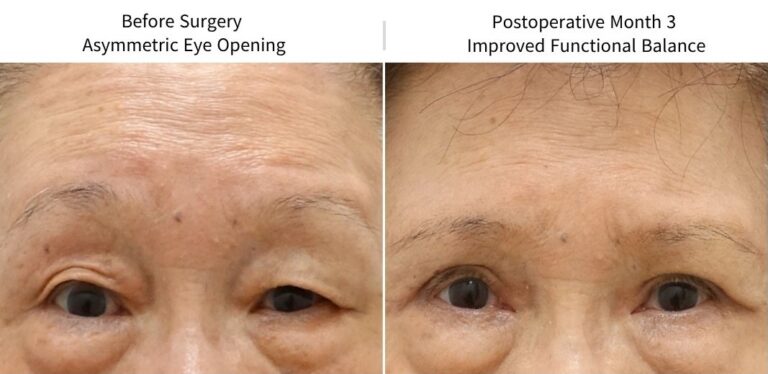
Eyelid asymmetry may become more apparent during active eye opening, which is why functional evaluation should include movement as well as resting appearance.
View the Primary Clinical Case →
Brow and Forehead Compensation Can Change the Appearance of Ptosis
The brow and forehead can influence how open or heavy an upper eyelid appears.
When a patient uses the forehead to compensate for reduced eyelid opening, the brow may elevate and partially mask the underlying functional difference.
Conversely, a difference in brow position may make the eyelids appear asymmetric even when the eyelid-opening mechanism itself is not the only problem.
Treating the eyelid without recognizing this relationship can therefore lead to an incomplete assessment.
The brow, forehead, and eyelid should be evaluated as a connected functional system.
Previous Eyelid Surgery Changes the Evaluation
Evaluation becomes even more important when a patient with facial nerve paralysis has already undergone ptosis correction or another eyelid procedure.
Previous surgery may introduce additional factors such as scar tissue, adhesions, previous overcorrection or undercorrection, tissue deficiency, and altered eyelid mechanics.
In these patients, persistent asymmetry may reflect both the underlying neuromuscular difference and structural changes created by previous surgery.
Simply repeating or strengthening the previous correction may therefore not address the actual cause.
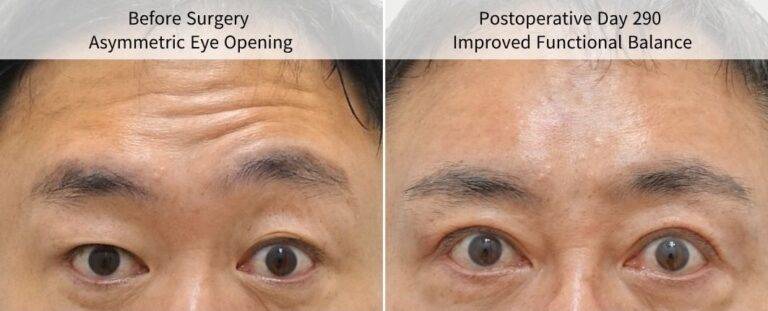
In revision cases, eyelid movement must be evaluated together with previous surgical changes and the underlying neuromuscular condition.
View the Revision Clinical Case →
When Ptosis Correction May Be Considered
If true ptosis is contributing meaningfully to reduced eyelid opening, ptosis correction may be considered.
But the amount of correction should not be determined simply by measuring the difference in eyelid height.
Each eyelid should be evaluated according to its own function, movement, tissue condition, and relationship with the opposite side.
In some patients, another approach—such as upper eyelid surgery, brow lift, asymmetry correction, or revision eyelid surgery—may be more appropriate depending on the underlying problem.
And in some patients, eyelid surgery may not be appropriate at all.
Why Perfect Symmetry Is Not the Primary Goal
Facial nerve paralysis creates an underlying difference in neuromuscular function that eyelid surgery itself cannot eliminate.
Even when eyelid position improves, some differences in facial movement or dynamic symmetry may remain.
Trying to force both eyelids into exactly the same position can require excessive correction and may compromise natural movement or create a new imbalance.
For this reason, the goal should be individualized.
The objective is not perfect symmetry or maximum eye opening, but the best functional balance that can be achieved safely while preserving natural eyelid movement.
Functional Evaluation Comes Before Surgical Correction
The same visible eyelid asymmetry can have very different causes.
One patient may have true ptosis. Another may have significant brow compensation. Another may have structural changes after previous eyelid surgery. Some patients may have several of these factors at the same time.
This is why diagnosis should come before procedure selection.
For patients with facial nerve paralysis, a meaningful surgical plan begins by understanding how each eyelid functions, why the two sides differ, and which part of that difference can realistically be improved.
For a complete overview of functional evaluation, treatment options, limitations, recovery, and clinical cases, see our Facial Nerve Paralysis Eyelid Surgery in Korea guide.
Related Clinical Cases
Ptosis Correction for Facial Nerve Paralysis and Eyelid Asymmetry
A primary case demonstrating how eyelid balance and active eye opening changed after individualized ptosis correction.
Revision Ptosis Correction for Facial Nerve Paralysis and Eyelid Asymmetry
A revision case demonstrating why previous eyelid surgery and underlying neuromuscular asymmetry must be evaluated together.
Frequently Asked Questions
Can facial nerve paralysis cause ptosis?
Facial nerve paralysis can be associated with eyelid asymmetry, but not every patient has true ptosis. Brow position, forehead compensation, eyelid movement, previous surgery, and other structural factors can also affect how open or closed an eye appears.
How do you determine whether eyelid asymmetry is caused by ptosis?
Evaluation should consider more than eyelid height at rest. Eyelid opening, active movement, brow and forehead compensation, tissue condition, and previous surgical changes should be assessed together to determine what is contributing to the asymmetry.
Why is active eye opening evaluated in patients with facial nerve paralysis?
Some differences between the two eyelids become more apparent during movement. Comparing the eyes at rest and during active eye opening can provide additional information about functional asymmetry and compensatory movement.
Does every patient with facial nerve paralysis need ptosis correction?
No. Ptosis correction may be considered when true ptosis contributes meaningfully to reduced eyelid opening. Other patients may require a different approach, while some may not benefit from eyelid surgery at all.
Can ptosis surgery make both eyes perfectly symmetrical after facial nerve paralysis?
Perfect symmetry may not be possible because the underlying neuromuscular function can remain different between the two sides. The goal is to improve meaningful functional imbalance while preserving natural eyelid movement and avoiding excessive correction.
AHNSUNGMIN Surgical Philosophy
Facial nerve paralysis should not be treated according to eyelid appearance alone.
We evaluate eyelid position, movement, brow compensation, previous surgical changes, and the underlying functional difference between the two sides before determining whether surgery is appropriate.
