Patients with facial nerve paralysis often ask a very understandable question before eyelid surgery:
“Can surgery make both eyes completely symmetrical?”
In some patients, eyelid asymmetry can be improved significantly.
However, facial nerve paralysis creates an important limitation: the two sides of the face may not have the same underlying neuromuscular function.
This means that even when eyelid position improves after surgery, the two eyes may continue to move differently.
For this reason, successful eyelid surgery should not always be judged by whether both eyelids become perfectly identical.
The more important question is whether surgery can achieve a more natural, functional, and stable balance between the two eyes.
Why Facial Nerve Paralysis Creates Dynamic Asymmetry
Eyelid symmetry is not static.
The appearance of the eyes can change depending on how widely a patient opens the eyes, how the brow moves, whether the forehead is being used for compensation, and how the muscles around the eyes function.
In facial nerve paralysis, these movements may differ between the two sides.
As a result, a patient may appear relatively balanced while looking straight ahead but show greater asymmetry during active eye opening or facial movement.
This is why eyelid symmetry should be evaluated during movement as well as at rest.
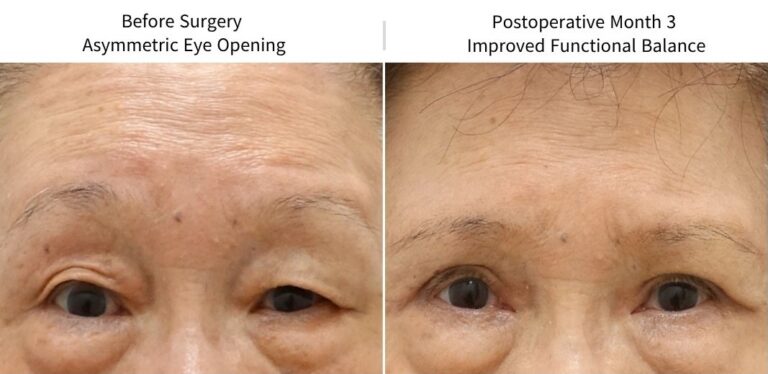
Functional asymmetry may become more apparent during active eye opening. Postoperative evaluation should therefore consider movement as well as resting eyelid position.
View the Primary Clinical Case →
Eyelid Surgery Does Not Restore the Facial Nerve
This distinction is essential when discussing surgical expectations.
Eyelid surgery can address certain eyelid problems associated with facial nerve paralysis, but it does not restore the underlying facial nerve itself.
When true ptosis contributes to reduced eye opening, ptosis correction may improve eyelid position.
When brow position, upper eyelid structure, previous surgery, or other correctable factors contribute to the imbalance, different surgical approaches may be considered.
But differences caused directly by the underlying neuromuscular condition may remain.
Improving the eyelids and restoring the facial nerve are not the same thing.
Why Making Both Eyelids the Same Height Can Be Misleading
It may seem logical to measure the difference between the two eyelids and simply correct one side until their heights match.
But eyelid height at one moment does not represent the entire functional relationship between the eyes.
If the two sides have different underlying function, forcing identical eyelid height can potentially create imbalance during movement.
The appropriate amount of correction should therefore be determined according to how each eyelid functions, not simply according to the visible difference between the two sides.
Why More Correction Is Not Always Better
A larger correction does not necessarily create a better result.
Attempting to eliminate every visible difference may require excessive adjustment of an eyelid that already has different functional characteristics from the opposite side.
This may increase the risk of an unnatural eyelid position, overcorrection, or imbalance during active eye opening.
In complex functional eyelid surgery, restraint is therefore part of surgical judgment.
The goal is not maximum correction. It is the amount of correction that provides the most appropriate functional balance for that patient.
Previous Eyelid Surgery Makes Symmetry More Complex
Achieving balance can become even more challenging when the patient has already undergone ptosis correction or another eyelid procedure.
Previous surgery may leave scar tissue, adhesions, tissue deficiency, or altered eyelid mechanics.
The surgeon must then evaluate two different sources of asymmetry:
the underlying functional difference associated with facial nerve paralysis, and structural changes resulting from previous surgery.
Further correction should therefore begin by identifying why the asymmetry remains, rather than simply repeating or strengthening the previous operation.
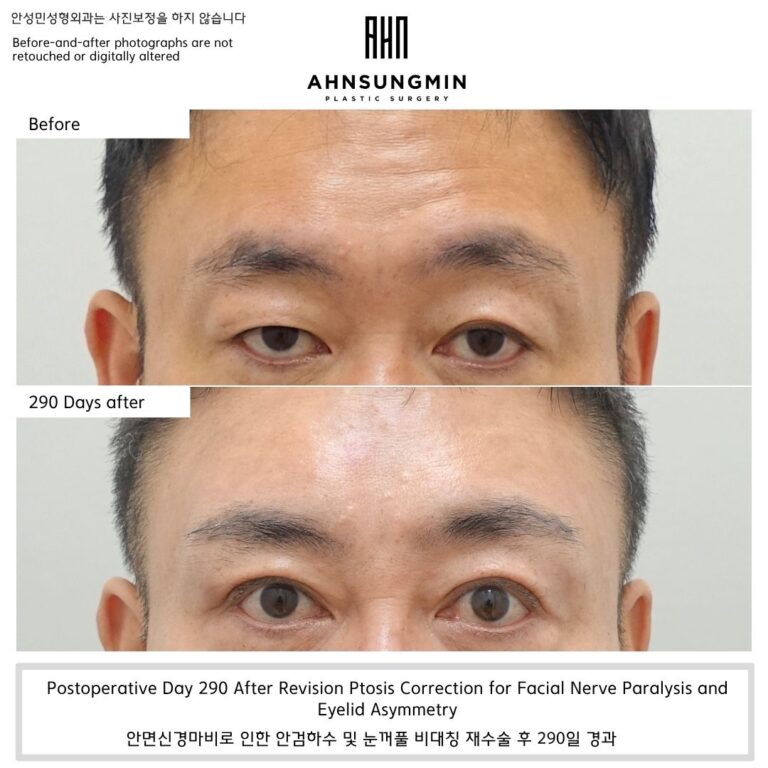
Revision eyelid surgery requires evaluation of both the underlying neuromuscular difference and structural changes created by previous surgery.
View the Revision Clinical Case →
What Can Realistically Improve?
Although perfect symmetry may not always be possible, meaningful improvement can still be achieved in appropriately selected patients.
Depending on the underlying cause, surgery may improve:
- reduced eyelid opening when true ptosis is present,
- a surgically correctable difference in eyelid position,
- functional balance between the two eyes,
- the relationship between eyelid and brow position,
- asymmetry created or worsened by previous eyelid surgery.
What can be improved differs from patient to patient.
This is why determining the cause of the asymmetry comes before choosing a procedure.
What May Remain After Surgery?
Some differences may remain even after a technically successful operation.
These may include differences in facial movement, brow activity, muscle function, or dynamic symmetry related to the underlying facial nerve condition.
Patients should understand these limitations before deciding on surgery.
This does not necessarily mean that surgery has failed.
A meaningful result may be one in which the eyelids function and appear more balanced and natural, even though they are not perfectly identical.
Functional Balance Is a Better Goal Than Forced Symmetry
Facial nerve paralysis requires a different way of thinking about eyelid symmetry.
The objective is not to make two functionally different sides mechanically identical.
Instead, treatment should determine which part of the asymmetry can be safely improved, how much correction is appropriate for each eyelid, and what differences should be respected rather than aggressively corrected.
The best result is not necessarily perfect symmetry. It is the most natural and stable functional balance possible within the limits of the underlying condition.
For a complete overview of evaluation, treatment options, recovery, limitations, and clinical cases, see our Facial Nerve Paralysis Eyelid Surgery in Korea guide.
For a complete overview of functional evaluation, surgical options, clinical cases, recovery, and treatment limitations, see our Facial Nerve Paralysis Eyelid Surgery in Korea guide.
Frequently Asked Questions
Can eyelid surgery create perfect symmetry after facial nerve paralysis?
Not always. Facial nerve paralysis can create different neuromuscular function between the two sides of the face. Eyelid surgery may improve eyelid position and functional balance, but it cannot make the underlying nerve and muscle function identical.
Why can the eyes still look different after successful eyelid surgery?
Some asymmetry may remain because facial movement, brow activity, and muscle function can continue to differ between the two sides. A successful result should therefore be evaluated by meaningful improvement in function and balance rather than perfect anatomical symmetry.
Can too much ptosis correction create problems?
Yes. When the two eyelids have different underlying function, excessive correction may create an unnatural eyelid position, overcorrection, or a new imbalance during movement. More correction does not necessarily produce a better functional result.
Why is eyelid movement important when evaluating symmetry?
The eyes may appear relatively balanced at rest but behave differently during active eye opening. Evaluating eyelid movement helps determine whether the result remains natural and balanced as the eyes function.
Is revision surgery possible if asymmetry remains after previous eyelid surgery?
It may be possible, but persistent asymmetry should first be evaluated to determine its cause. Facial nerve dysfunction, scar tissue, adhesions, previous overcorrection or undercorrection, and altered eyelid mechanics may all contribute. Further surgery should only be considered when there is a meaningful and safely correctable problem.
Related Insights
Ptosis and Facial Nerve Paralysis: Why Eyelid Asymmetry Requires Functional Evaluation
Why eyelid height alone cannot explain every asymmetry when underlying facial nerve function differs between the two sides.
Why Eyelid Movement Matters When Evaluating Ptosis and Asymmetry
Why eyelid function should be evaluated during active eye opening as well as in a resting position.
Revision Ptosis Surgery: Why Previous Eyelid Surgery Changes the Surgical Plan
How scar tissue, adhesions, and altered eyelid mechanics can change the evaluation and planning of revision ptosis surgery.
Why Overcorrection Can Be a Problem in Revision Ptosis Surgery
Why pursuing greater eyelid height or perfect symmetry may create functional imbalance in complex revision cases.
Facial Nerve Paralysis Does Not Always Mean Ptosis
Why brow position, eyelid closure, lower eyelid position, and neuromuscular function should be evaluated before assuming that ptosis correction is needed.
