When Eyelid Asymmetry Is More Than a Cosmetic Difference
Eyelid asymmetry is not always simply a difference in crease height or eye size.
In patients with facial nerve paralysis, the two sides of the face may no longer function in the same way. When previous eyelid surgery has also been performed, the situation can become more complex because scar tissue, adhesion, and altered eyelid mechanics may affect how each eyelid moves.
This patient presented with persistent eyelid asymmetry following previous eyelid surgery in the setting of facial nerve paralysis.
The central question was therefore not how to make both eyes look identical.
It was how much functional balance could realistically and safely be restored.
Why Facial Nerve Paralysis Changes the Evaluation
Ptosis correction is often discussed in terms of how widely the eyelid opens. But eyelid height alone does not provide a complete assessment.
In this case, the underlying facial nerve dysfunction meant that the two sides were already functioning differently.
The eyelids therefore needed to be evaluated not only at rest, but also during active eye opening.
This distinction was important. When the patient attempted to open his eyes widely, the functional difference between the two sides became more apparent.
Forcing the eyelids into the same static position without considering this difference could have created a result that appeared balanced in one position but remained unstable or unnatural during movement.
Revision Surgery Added Another Layer of Complexity
Previous eyelid surgery changes the conditions of revision surgery.
Scar formation, adhesion, altered tissue planes, and changes in eyelid mechanics can limit how freely the tissues can be adjusted.
For this reason, revision ptosis correction should not be approached as simply repeating the original operation with a stronger correction.
The existing anatomy must first be understood.
In this patient, the surgical plan was based on the functional condition of each eyelid rather than on achieving maximum opening.
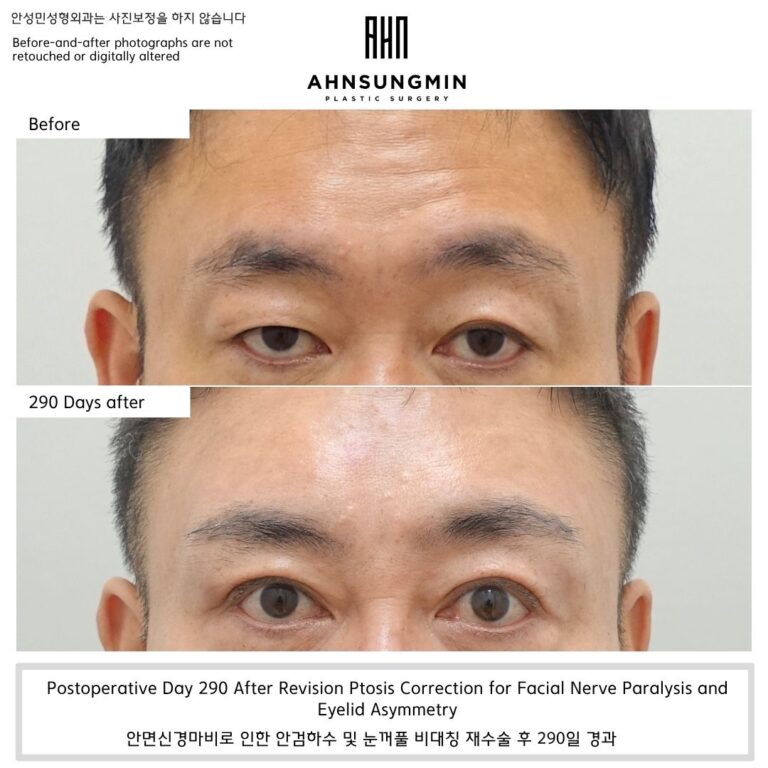
Postoperative Day 290 After Revision Ptosis Correction for Facial Nerve Paralysis and Eyelid Asymmetry
Restoring Eyelid Balance Without Overcorrection
Before revision surgery, a visible difference in eyelid opening was present between the two sides.
The objective was not to enlarge the smaller-appearing eye until it mechanically matched the opposite side.
Instead, revision ptosis correction was performed with attention to eyelid movement, asymmetry, previous surgical changes, and the underlying neuromuscular condition.
At postoperative day 290, the eyelids demonstrate improved balance at rest while maintaining a natural appearance.
The long postoperative interval is also important. In revision surgery, an early photograph cannot always demonstrate whether a correction will remain stable as swelling resolves and scar tissue matures.
Functional Balance Must Also Be Evaluated During Movement
A resting photograph tells only part of the story.
In this patient, the asymmetry became more apparent when he attempted to open his eyes widely before surgery.
Comparing active eye opening before surgery and at postoperative day 290 provides another perspective on the result.
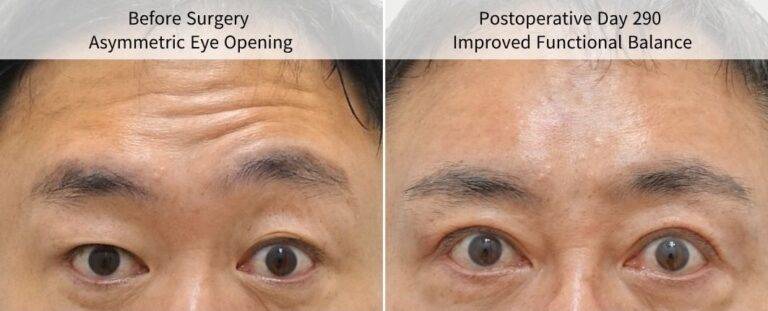
Functional eye opening before and 290 days after revision ptosis correction.
The postoperative comparison demonstrates improved functional balance between the two sides during wider eye opening.
This is particularly relevant in patients with pre-existing facial nerve dysfunction, because the quality of the result cannot be judged by eyelid height alone.
Complete Symmetry Is Not Always the Right Goal
Facial nerve paralysis creates an important limitation that should be discussed before surgery.
When the underlying neuromuscular function differs between the two sides, complete anatomical or dynamic symmetry may not always be achievable.
Revision surgery introduces additional limitations because previously operated tissues may already contain scar formation or altered structural relationships.
For these reasons, aggressive correction in pursuit of perfect symmetry can sometimes create a different problem, including overcorrection or unnatural eyelid movement.
The better objective is to determine how much correction can be achieved while preserving function, movement, and long-term stability.
What This Case Demonstrates
This case illustrates why revision ptosis surgery cannot be planned according to eye size alone.
The surgeon must consider the cause of the asymmetry, previous surgical changes, eyelid movement at rest and during active opening, and the realistic limitations created by the underlying condition.
In complex ptosis revision, a better result does not necessarily mean a larger eye. It means achieving the most balanced function possible while respecting the anatomy that remains.
Learn More About Facial Nerve Paralysis Eyelid Surgery
Related Insights
Ptosis and Facial Nerve Paralysis: Why Eyelid Asymmetry Requires Functional Evaluation
Why eyelid height alone cannot fully explain asymmetry when underlying facial nerve function is different between the two sides.
Why Perfect Eyelid Symmetry May Not Be Possible With Facial Nerve Paralysis
Understanding why functional balance and natural movement may be more important than forcing identical eyelid height.
Why Eyelid Movement Matters When Evaluating Ptosis and Asymmetry
A functional evaluation should consider how the eyelids move during active eye opening—not only how they appear at rest.
Revision Ptosis Surgery: Why Previous Eyelid Surgery Changes the Surgical Plan
Scar tissue, adhesions, and altered eyelid mechanics can make revision ptosis correction fundamentally different from primary surgery.
Why Overcorrection Can Be a Problem in Revision Ptosis Surgery
More correction does not always create better function, particularly when previous surgery or underlying neuromuscular imbalance is present.
Related Clinical Case
Ptosis Correction for Facial Nerve Paralysis and Eyelid Asymmetry
For comparison, this primary case demonstrates how eyelid balance and active eye opening were evaluated in a patient with facial nerve paralysis who had not undergone previous eyelid surgery.
Frequently Asked Questions
1. Can ptosis correction help eyelid asymmetry caused by facial nerve paralysis?
In selected patients, ptosis correction may improve eyelid opening and reduce visible asymmetry. However, facial nerve paralysis can create different functional conditions between the two sides, so the goal is usually improved functional balance rather than perfect symmetry.
2. Why is ptosis correction more complex in patients with facial nerve paralysis?
Facial nerve dysfunction can affect facial and eyelid movement differently on each side. Evaluation therefore requires more than comparing eyelid height at rest. Eyelid movement, compensatory muscle use, previous surgery, and the functional condition of each side should also be considered.
3. Can revision ptosis surgery achieve perfect eyelid symmetry?
Not always. Previous surgery may leave scar tissue, adhesions, or altered eyelid mechanics, while facial nerve paralysis can create an underlying functional difference between the two sides. Revision surgery should therefore prioritize natural movement and stable functional balance rather than forced symmetry.
4. Why should eyelid movement be evaluated during revision ptosis surgery?
A resting photograph does not always reveal the full extent of functional asymmetry. Observing the eyelids during active eye opening can help identify differences in movement and determine whether the postoperative improvement remains balanced during function.
5. Why is overcorrection a concern in revision ptosis surgery?
More correction does not necessarily produce better function. Excessive correction may create unnatural eyelid position, movement imbalance, or additional functional problems. In complex revision cases, conservative correction may provide a more stable long-term result.
