Many Patients Want Revision Surgery as Soon as Possible
One of the most common questions after an unsatisfactory eyelid surgery is:
“How long do I have to wait before revision surgery?”
For many patients, the desire to correct an uncomfortable result immediately is understandable. Swelling, asymmetry, or an unnatural crease can create anxiety, making another operation seem like the quickest solution.
However, in revision eyelid surgery, time is often one of the most important parts of the treatment itself.
Healing Continues Long After the Skin Appears Normal
Many patients judge their results within the first few weeks or months.
The problem is that the eyelid continues to heal long after the visible incision has faded.
During this period:
- swelling gradually resolves
- scar tissue continues to soften
- internal adhesions mature
- eyelid movement becomes more natural
- the final crease position gradually stabilizes
Operating before these changes have completed can make revision surgery less predictable and significantly more difficult.
Every Revision Has Its Own Timeline
There is no universal waiting period that applies to every patient.
The appropriate timing depends on:
- the previous surgical technique
- the degree of scar formation
- tissue quality
- eyelid function
- the specific reason revision is being considered
While many patients require approximately one year before a definitive structural revision can be properly evaluated, certain functional problems or complications may require earlier intervention.
This decision should always be individualized rather than based on a fixed number of months.
Clinical Example
Preoperative → Postoperative Year 1
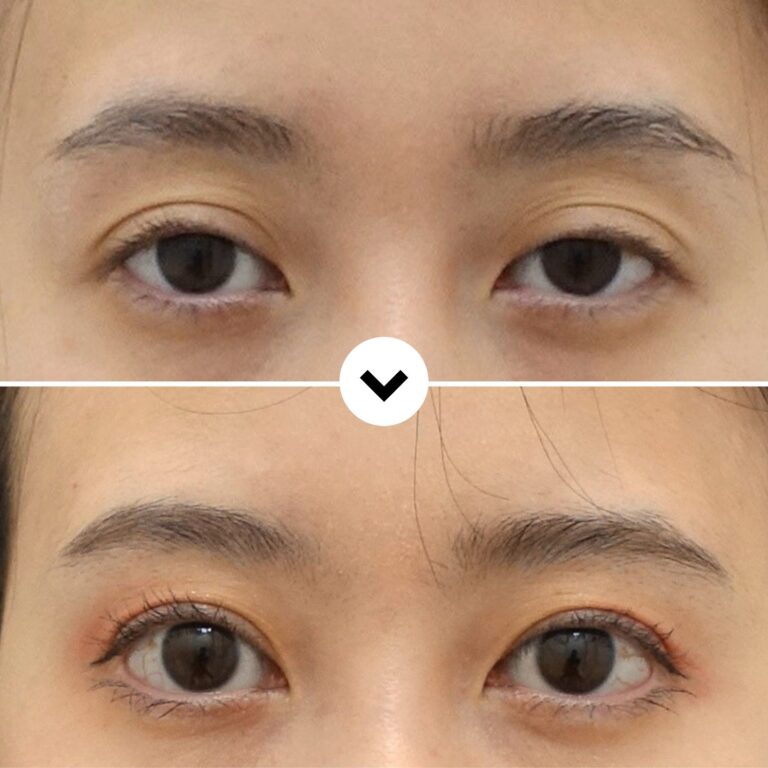
This patient demonstrates why long-term evaluation is so important after revision eyelid surgery.
Rather than judging the result during the early healing phase, the final appearance was assessed after the tissues had fully matured.
At one year after surgery, the eyelids demonstrate:
- stable symmetry
- natural crease formation
- comfortable eyelid movement
- balanced eye opening
These long-term changes cannot always be appreciated during the first few months of recovery.
Waiting Does Not Mean Doing Nothing
Patients often think waiting simply means delaying treatment.
In reality, the waiting period allows your surgeon to understand:
- which changes are temporary
- which concerns will improve naturally
- which structural problems truly require correction
A revision performed too early may address swelling rather than the underlying anatomy.
Patience often leads to better surgical planning and more stable long-term outcomes.
The Right Time Is More Important Than the Earliest Time
The goal of revision surgery is not simply to perform another operation.
The goal is to perform the right operation at the right time.
Choosing the correct timing often has just as much influence on the final outcome as the surgical technique itself.
For many patients, waiting is not a delay.
It is part of achieving a safer, more predictable, and more natural result.
Related Insights
- Why Does Double Eyelid Surgery Fail?
- Revision Eyelid Surgery Recovery Timeline
- Ptosis vs. Double Eyelid Surgery: What’s the Difference?
- How to Choose a Korean Eye Surgeon
- Best Eyelid Revision Surgery in Korea
Request a Revision Eyelid Surgery Evaluation
Every revision case follows a different recovery timeline.
A personalized consultation can help determine whether additional healing time is appropriate or whether revision surgery should be considered based on your eyelid anatomy, scar maturation, and functional concerns.
Online consultation available for international patients.
Seeing the Eye as a Whole, Not in Parts
A Clinic Dedicated to Eyelid Revision Surgery in Korea
Ahnsungmin Plastic Surgery
