Some patients are surprised when they look in the mirror immediately after ptosis surgery. Their eyes may appear much wider open than they expected.
Before surgery, they struggled to open their eyes fully. Immediately afterward, the opposite seems to be happening.
For patients undergoing revision surgery to correct eyelid asymmetry, this change can feel particularly unfamiliar.
But the appearance immediately after surgery may be quite different from what we see as recovery progresses. This patient’s photographs, taken before surgery, immediately afterward, and at one month, show how that appearance can change.
Why Correcting Uneven Ptosis Is Difficult
Correcting asymmetry caused by ptosis is one of the more challenging aspects of eyelid surgery.
One of the first decisions is determining which eye should serve as the reference when planning the correction.
The two upper eyelids do not function entirely independently. Under Hering’s law, the neural signals controlling the eyelid-lifting muscles are linked.
In simple terms, the eyelids can behave somewhat like a seesaw.
When one eyelid has significant ptosis, the patient may use greater effort to keep the eyes open. That increased effort can also affect the opposite eyelid.
After the drooping eyelid is corrected, the previously higher eyelid may descend because the additional effort is no longer needed.
This is why correcting ptosis asymmetry is not simply a matter of lifting the lower eyelid until both eyes appear equal.
Before surgery, we need to consider which eyelid should guide the correction, how the two eyelids respond to each other, and whether correction should involve one eye or both.
Can Only One Eye Be Corrected?
Patients often ask this during consultation.
“If only one eye looks different, why can’t you operate on just that eye?”
The answer depends on what is causing the asymmetry.
When the difference comes primarily from excess eyelid skin or uneven double-eyelid creases, it may be possible to improve the appearance through skin excision or crease adjustment.
Ptosis-related asymmetry is different.
If one eyelid has reduced lifting function, correcting that side can change the position of the opposite eyelid through Hering’s law.
Operating on only one eye is possible in selected patients, but it is not always the appropriate approach.
The decision must be based on how both eyelids function and respond, not simply on which eye appears smaller.
The important question is not just which eye needs surgery, but how both eyes are likely to behave after correction.
A Patient With Uneven Eyelid Opening After Previous Surgery
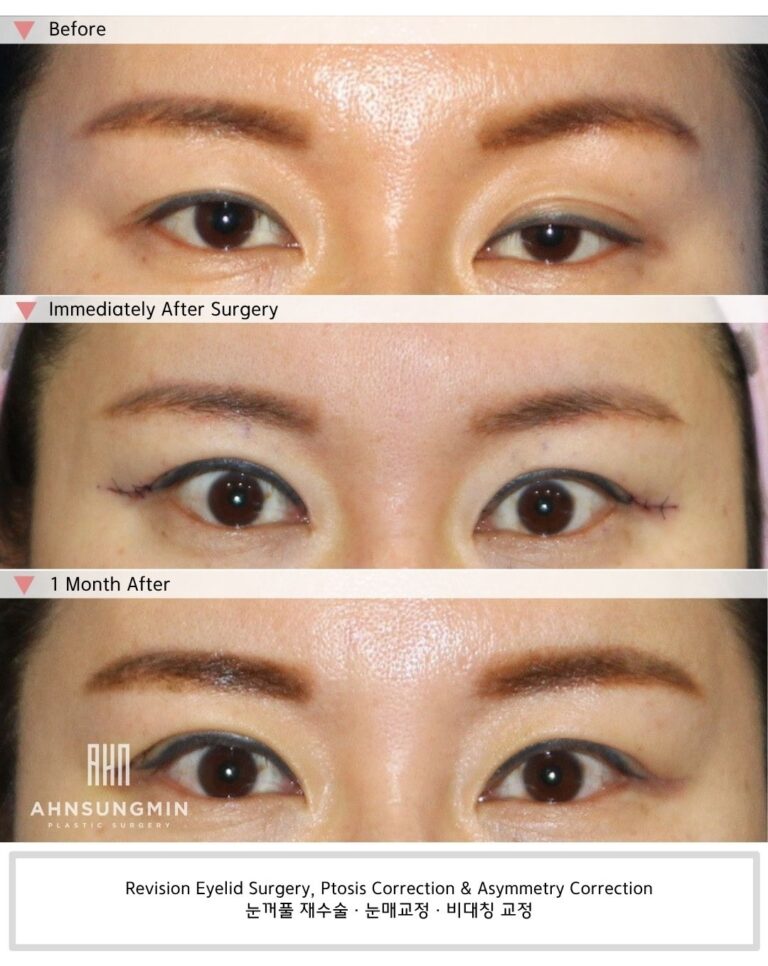
This patient had undergone eyelid surgery before but continued to have noticeable asymmetry.
One eye opened less than the other, creating an uneven appearance.
During revision surgery, we focused on improving eyelid-lifting function while reducing the difference between the two eyes.
Revision eyelid surgery was performed with ptosis correction and asymmetry correction.
Our goal was not to make both eyes open as widely as possible. It was to improve function while creating a more natural balance.
Why the Eyes Looked Overcorrected Immediately After Surgery
In the photograph taken immediately after surgery, both eyes appear considerably wider open than before.
At first glance, the result may look overcorrected.
Ptosis correction involves adjusting the muscles responsible for lifting the upper eyelids. Immediately after surgery, the effect of that adjustment can be particularly noticeable.
Postoperative swelling and temporary tension around the eyelids can also affect their appearance.
For someone who has spent a long time struggling to open the eyes fully, the new eyelid position and the way the eyes open may take some getting used to.
For these reasons, we do not diagnose overcorrection or judge the final result simply because the eyes appear unusually wide open immediately after surgery.
How the Eyes Changed After One Month
As this patient recovered, the eyelids gradually began to look more natural.
The postoperative swelling decreased, and the patient became more accustomed to the new eyelid position and way of opening the eyes.
By one month, the eyes no longer appeared as widely open as they had immediately after surgery.
Compared with the preoperative photographs, the difference in eyelid opening was also less noticeable.
What might have seemed concerning in the immediate postoperative photograph looked quite different after a period of recovery.
One month, however, is still part of the healing process. We continue to observe how the eyelid position and function settle over time.
This patient’s before-and-after photographs are also featured in our Asymmetry Correction page, where you can see how revision ptosis surgery improved eyelid balance during recovery.
Why We Follow Recovery Carefully After Revision Ptosis Surgery
Previous eyelid surgery can change the condition of the tissues and the eyelid-lifting muscles.
Before revision surgery, we need to understand why the asymmetry developed. During surgery, we must consider how both eyelids respond to correction.
After surgery, we follow how the eyelid position changes during healing.
As this case shows, eyes that initially appear overcorrected may become more natural as swelling decreases and the patient adjusts to the corrected eyelid position.
That does not mean every patient follows the same course. True overcorrection may require separate evaluation and should not be assumed to resolve simply with time.
A successful ptosis correction cannot be judged only by how widely the eyes open immediately after surgery.
What matters more is how comfortably and naturally the patient can open both eyes as recovery progresses, with better functional balance between them.
Frequently Asked Questions
Why is ptosis asymmetry difficult to correct?
Under Hering’s law, the neural signals controlling the eyelid-lifting muscles are linked. Correcting one eyelid can change the height of the other, so both eyelids must be evaluated before deciding how to correct the asymmetry.
Can surgery be performed on only one eye when one eyelid is drooping?
Yes, in selected cases. However, unilateral correction is not appropriate for everyone. The opposite eyelid may change position after surgery, so the decision depends on the function and response of both eyelids.
Why do the eyes sometimes look overcorrected immediately after ptosis surgery?
The effect of adjusting the eyelid-lifting muscles may be particularly noticeable immediately after surgery. Postoperative swelling and temporary tension can also influence the appearance of the eyelids.
Will eyes that look too wide open immediately after surgery become more natural?
They may, as seen in this patient’s recovery. Swelling can decrease, and the patient may become accustomed to the new eyelid position and way of opening the eyes. However, temporary postoperative overopening must be distinguished from true overcorrection, and not every patient will experience the same changes.
Is one month enough to judge the final result of ptosis surgery?
Not necessarily. The eyes may already look considerably more natural after one month, but healing and changes in eyelid position can continue. The appropriate time for evaluation depends on the patient’s condition, previous surgery, and the extent of correction.
Insight
Why Eyes Look Overcorrected Immediately After Ptosis Surgery.
Understand how Hering’s law and the interaction between both eyelids can affect their appearance immediately after correction.
Why Do Eyes Look Too Wide Open After Revision Ptosis Surgery?
Follow a patient’s recovery from immediately after surgery to six months, including changes in eyelid opening and adaptation to corrected eyelid function.
Request a Revision Ptosis Evaluation
If your eyes remain uneven after previous eyelid surgery, or appear unusually wide open following ptosis correction, it is important to consider both the cause and the stage of recovery.
At Ahnsungmin Plastic Surgery, we evaluate the function of the eyelid-lifting muscles, the response of both eyelids under Hering’s law, and structural changes from previous surgery before determining whether further correction is appropriate.
Request a Revision Ptosis Evaluation
Online consultation available for international patients.
Seeing the Eye as a Whole, Not in Parts
A Clinic Dedicated to Eyelid Revision Surgery in Korea
Ahnsungmin Plastic Surgery
