Many Patients Believe the Fold Is the Problem
One of the most common reasons patients seek revision surgery is simple:
“My double eyelid surgery failed.”
Sometimes the crease is too high. Sometimes it becomes uneven. Sometimes the eyes still appear heavy even after surgery.
Because these concerns are so visible, many patients naturally assume that the double eyelid fold itself is the problem.
However, in many cases, the fold is only the result of a deeper structural issue.
Successful revision begins by identifying why the original surgery failed, not by creating another crease.
Double Eyelid Surgery Does Not Fail for Just One Reason
There is no single cause of an unsatisfactory result.
Common reasons include:
- Residual or unrecognized ptosis
- Incorrect crease height for the individual’s anatomy
- Scar adhesion restricting normal eyelid movement
- Excessive tissue removal
- Asymmetrical eyelid structure
- Surgical planning based primarily on appearance rather than function
Although these patients may appear to have similar problems, the appropriate revision strategy can be completely different.
That is why two patients with almost identical-looking eyes may require entirely different surgical approaches.
A Better Fold Does Not Always Mean a Better Eye
One of the biggest misconceptions is that revision surgery simply means lowering, raising, or changing the crease.
In reality, changing the crease without correcting the underlying structural problem often leads to another disappointing result.
Revision surgery should restore the relationship between:
- eyelid opening
- muscle function
- crease formation
- tissue support
- overall facial balance
When these elements work together naturally, the crease becomes more stable and the eyes appear more comfortable rather than simply larger.
Clinical Example
Preoperative → Postoperative Month 3
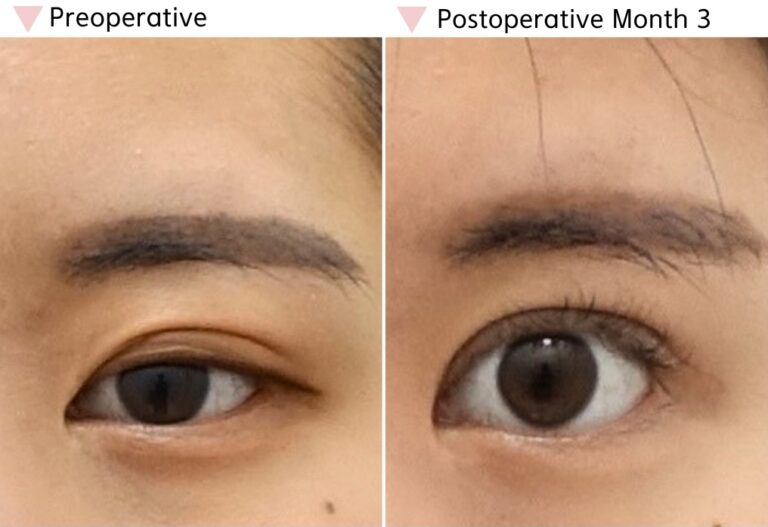
In this patient, the goal was not simply to create a different-looking fold.
Instead, revision focused on correcting the structural factors that were preventing natural eyelid opening while creating a crease that matched the patient’s anatomy.
At postoperative month 3, the eyelids demonstrate:
- more balanced eye opening
- a natural crease position
- improved symmetry
- stable eyelid function
Rather than appearing overcorrected, the eyes look more relaxed and proportionate because the underlying cause was addressed.
Before Considering Revision Surgery
Many patients ask whether another surgery will finally solve the problem.
The better question is:
Why did the first surgery fail?
Without understanding the original cause, revision surgery becomes little more than another attempt to change the appearance.
A careful structural evaluation often provides far more useful information than simply measuring the height of the crease.
Related Insights
- How Long Should You Wait Before Revision Eyelid Surgery?
- Revision Eyelid Surgery Recovery Timeline
- Ptosis vs. Double Eyelid Surgery: What’s the Difference?
- How to Choose a Korean Eye Surgeon
- Best Eyelid Revision Surgery in Korea
Request a Revision Eyelid Surgery Evaluation
Every unsuccessful double eyelid surgery has its own cause.
A personalized evaluation helps determine whether the concern is related to ptosis, scar adhesion, crease design, tissue support, or another structural factor before deciding on revision surgery.
Online consultation available for international patients.
Seeing the Eye as a Whole, Not in Parts
A Clinic Dedicated to Eyelid Revision Surgery in Korea
Ahnsungmin Plastic Surgery
