The Early Appearance Is Not the Final Result
Many patients become anxious within the first few days after eyelid surgery.
The crease may look too high.
The eyelids may appear uneven.
One eye may seem more swollen than the other.
Some patients immediately worry that the surgery has failed.
In many cases, however, they are not seeing the final result.
They are seeing swelling.
Swelling Can Temporarily Change the Shape of the Eyelids
Swelling affects far more than the size of the eyelids.
It can temporarily influence:
- the height of the crease
- eyelid symmetry
- eye opening
- contour of the upper eyelid
- overall facial balance
These temporary changes often improve gradually as healing progresses.
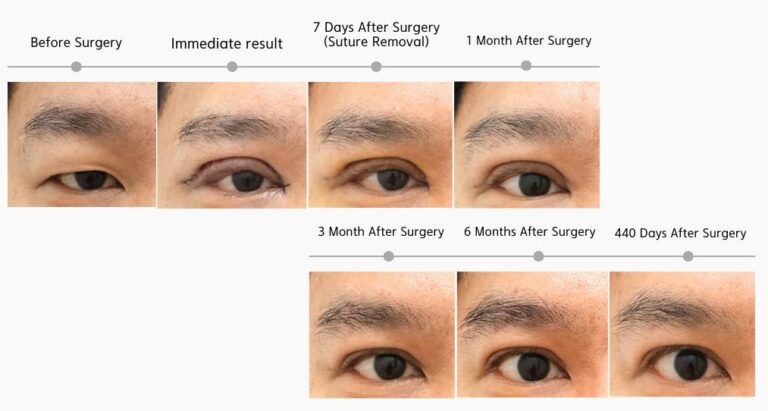
Healing Continues for Months
The recovery timeline above demonstrates why eyelid surgery should not be judged too early.
Immediately after surgery, swelling can make the eyelids appear larger, higher, or less symmetrical than expected.
As swelling gradually subsides and scar tissue matures, the eyelids continue to change over the following weeks and months.
For many patients, the final result becomes much clearer only after sufficient healing has occurred.
Swelling and Surgical Failure Are Not the Same
Swelling is a normal part of healing.
A failed eyelid surgery usually involves structural or functional problems that persist even after recovery.
Examples include:
- persistent asymmetry
- residual ptosis
- multiple folds
- excessively high creases
- significant scar-related deformities
These issues should be evaluated after healing rather than during the early postoperative period whenever possible.
Patience Is Part of Successful Recovery
One of the biggest mistakes after eyelid surgery is judging the result too soon.
Healing is an ongoing biological process rather than a single event.
Allowing enough time for swelling to resolve often leads to a more accurate assessment and better decisions about whether additional treatment is truly necessary.
Related Insights
- Why Does Double Eyelid Surgery Fail?
- How Long Should You Wait Before Revision Eyelid Surgery?
- Revision Eyelid Surgery Recovery Timeline
- Best Eyelid Revision Surgery in Korea
Request a Revision Eyelid Surgery Evaluation
If your eyelids still appear uneven after adequate healing, a comprehensive evaluation can help determine whether your concerns are related to normal recovery or a structural issue that may benefit from revision surgery.
Online consultation available for international patients.
