Many patients expect their eyelids to feel lighter immediately after upper blepharoplasty.
When that does not happen, it is natural to wonder whether the surgery was unsuccessful.
In reality, a heavy sensation after surgery is often a normal part of the healing process rather than a sign of a poor result.
Understanding why the eyelids still feel heavy is an important part of evaluating recovery.
Recovery Timeline
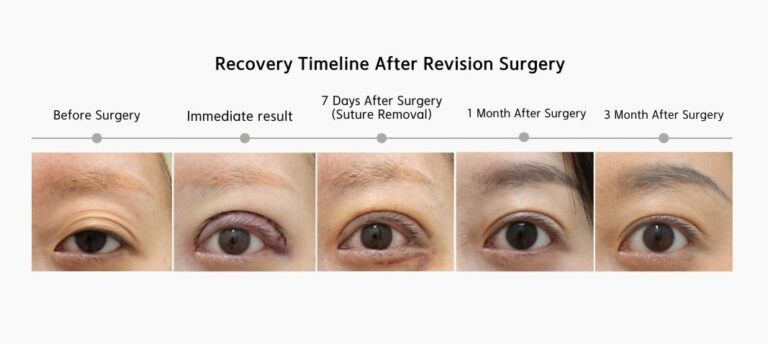
Recovery timeline following upper blepharoplasty, showing the eyelids before surgery, immediately after surgery, at suture removal (7 days), 1 month, and 3 months. Although swelling and heaviness are noticeable during the early recovery period, the eyelids gradually become more comfortable and natural as healing progresses.
A Heavy Feeling Does Not Always Mean the Eyelids Are Still Heavy.
The sensation of heaviness and the actual weight of the eyelid are not always the same.
During the first several weeks after surgery, swelling, tissue stiffness, and normal scar maturation can temporarily create a feeling of tightness or heaviness.
Although excess skin has been removed, the eyelid tissues are still adapting to their new position.
As shown in the recovery timeline above, the eyelids continue to change well beyond the first week after surgery.
For many patients, the feeling of heaviness gradually improves as swelling subsides and the tissues soften.
Eyelid Function Also Plays an Important Role.
Not every heavy eyelid is caused by excess skin alone.
Some patients also have mild ptosis, brow compensation, or age-related changes that affect how the eyelids function.
If these underlying factors are present, removing skin alone may not completely eliminate the sensation of heaviness.
This is why understanding the true cause before surgery is just as important as the operation itself.
Recovery Takes Longer Than Most Patients Expect.
Upper blepharoplasty should not be judged during the first several weeks after surgery.
Swelling gradually decreases.
Scar tissue softens.
The eyelid crease settles into a more natural position.
The muscles and surrounding tissues continue adapting.
As healing progresses, both the appearance and the sensation of the eyelids usually improve together.
Recovery is a gradual process rather than an immediate event.
Successful Surgery Is Measured Over Time.
A successful upper blepharoplasty should not be evaluated by how the eyelids feel immediately after surgery.
The more meaningful question is whether the eyelids become comfortable, natural, and stable over the following months.
Time is part of the treatment.
Understanding the true cause of heavy eyelids before surgery—and allowing sufficient time for recovery afterward—often produces the most natural long-term outcome.
Related Insights
Why Upper Eyelids Become Heavy
Explore the different anatomical causes of heavy upper eyelids beyond excess skin.
Why Eyes May Look Smaller After Eyelid Surgery
Learn why swelling, eyelid function, and the healing process can temporarily change the appearance of the eyes after surgery.
Upper Blepharoplasty in Korea
Discover our individualized approach to upper eyelid surgery focused on function, natural appearance, and long-term stability.
Concerned About Heavy Eyelids After Surgery?
Feeling that your eyelids are still heavy after surgery does not necessarily mean something is wrong.
A personalized evaluation can help determine whether your recovery is progressing normally or whether additional assessment is appropriate.
Request an Upper Eyelid Evaluation
Online consultation available for international patients.
Seeing the Eye as a Whole, Not in Parts
A Clinic Dedicated to Eyelid Revision Surgery in Korea
Ahnsungmin Plastic Surgery
