It Is Not Just About Volume
When the upper eyelid appears hollow,
the most common assumption is simple:
“If it looks sunken, it should be filled.”
As a result, fillers or fat grafting are often considered first.
However, in many clinical cases,
this approach does not solve the real problem.
Because the issue may not be volume.
It may be structure.
Hollowing Often Reflects Structural Imbalance
Upper eyelid hollowing is not always caused by fat loss.
The eyelid is a dynamic structure composed of skin, muscle, fat,
and supporting layers that must function in balance.
When this balance is disrupted,
the eyelid may appear hollow.
But what is seen externally does not always reflect true volume deficiency.
Instead, it is often related to:
- Imbalance in eyelid opening strength
- Restricted movement due to adhesions
- Weakening of structural support
These factors can create the appearance of hollowing,
even when volume is not the primary issue.
Why Volume Alone Does Not Solve the Problem
When volume is added without addressing the underlying structure,
the result often becomes unnatural.
The crease may appear heavier,
the eyelid movement may become more restricted,
and over time, the hollow appearance may return.
Because the underlying cause has not been corrected.
This is why treating hollowing as a simple volume problem
can lead to repeated, unsatisfactory results.
For a deeper understanding of why volume alone does not solve hollow eyelids, see:
Why Hollow Eyes Cannot Be Fixed with Fillers
The Role of Eyelid Function
In many patients,
upper eyelid hollowing is closely related to how the eye opens.
When eyelid opening strength is insufficient,
compensatory mechanisms develop over time.
The forehead becomes more active,
the eyelid is repeatedly pulled upward,
and structural imbalance gradually increases.
As this continues:
- The support system weakens
- Adhesions become more pronounced
- The eyelid loses its natural movement
And the hollow appearance becomes more evident.
When Structural Correction Becomes Necessary
In these cases,
simply adding volume is not a fundamental solution.
The issue is not appearance alone—it is function.
When eyelid opening strength is reduced,
ptosis correction becomes essential to restore structural stability.
By improving how the eye opens:
- The eyelid regains balance
- The structure becomes more stable
- The hollow appearance can improve naturally
Without excessive or artificial volume.
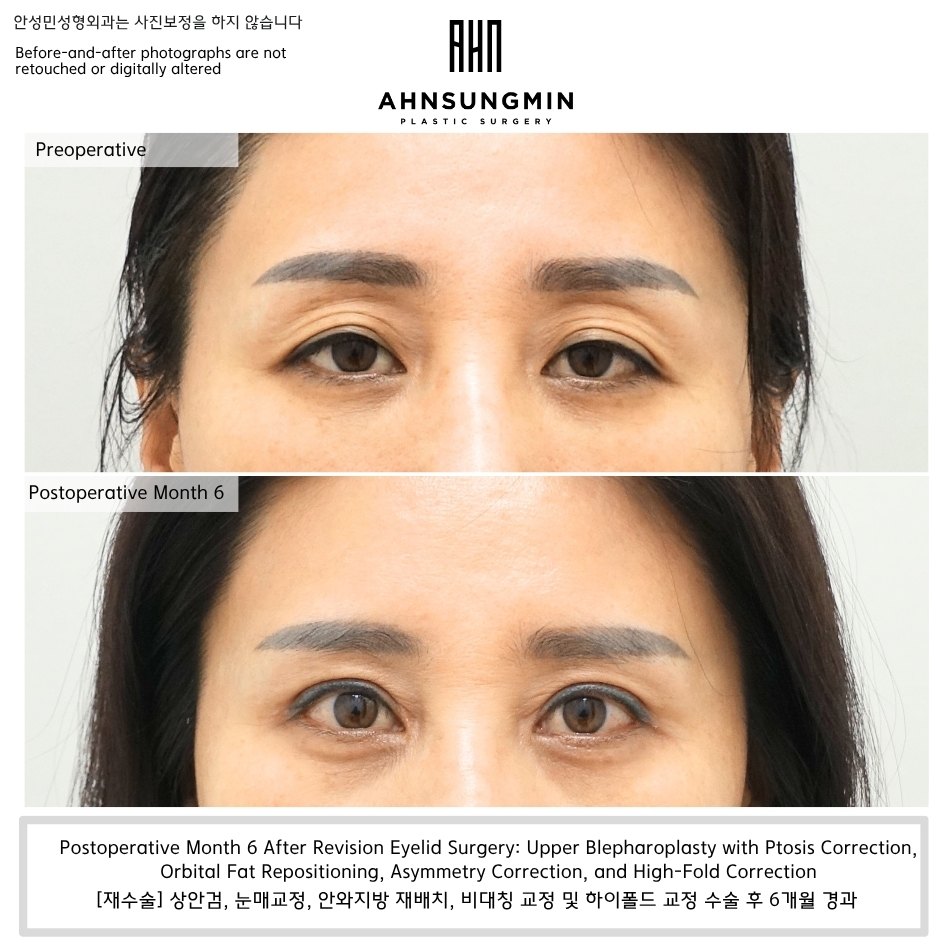
Postoperative Month 6 after revision upper eyelid surgery including ptosis correction, fat repositioning, asymmetry correction, and high-fold correction
What This Looks Like in a Revision Case
In this patient, upper eyelid hollowing was not an isolated issue.
It was accompanied by:
- Asymmetry of the double eyelid crease
- Multiple fold formation
- An unstable eyelid structure
The crease did not follow a consistent line,
and the eyelid appeared functionally imbalanced.
This was not a condition that could be corrected
by simply adding volume.
The underlying problem was structural.
Reduced eyelid opening strength led to instability,
and over time, this resulted in hollowing, asymmetry,
and irregular crease formation.
The Key to Treatment
In this situation,
the goal was not to add volume.
It was to restore function.
Ptosis correction was necessary
to re-establish structural balance.
By normalizing eyelid opening:
- The crease became more stable
- The asymmetry improved
- The hollow appearance resolved more naturally
The Conclusion Is Not Simple
Upper eyelid hollowing is not always a cosmetic issue.
It is often the visible result
of deeper structural changes.
The key question is not
“how much volume should be added,”
but
“why the eyelid appears hollow in the first place.”
If the cause lies in structural imbalance,
the treatment approach must reflect that.
Otherwise, the problem will continue to repeat.
Frequently Asked Questions
1. What causes upper eyelid hollowing?
Upper eyelid hollowing is not always caused by volume loss. In many cases, it is related to structural imbalance, reduced eyelid opening strength, adhesions, or weakening of support structures.
2. Can fillers fix hollow upper eyelids?
Fillers can improve appearance in selected cases, but when hollowing is caused by structural problems, volume addition alone often does not provide stable or natural results.
3. Why do hollow eyelids come back after treatment?
If the underlying structural issue is not addressed, the hollow appearance may return over time, even after fillers or fat grafting.
4. Is ptosis related to upper eyelid hollowing?
Yes. Reduced eyelid opening strength, or ptosis, is one of the common underlying factors associated with upper eyelid hollowing, especially in revision cases.
5. When is ptosis correction needed for hollow eyelids?
When hollowing is associated with weak eyelid opening, asymmetry, or unstable crease formation, ptosis correction may be necessary to restore structural balance.
Insights
Why Hollow Eyes Cannot Be Fixed with Fillers
Volume alone does not address structural imbalance in hollow eyelids.
Hollow Eyes After Surgery? It’s Not a Volume Problem
Hollowing after surgery is often caused by functional issues, not just volume loss.
Why We Corrected Hollowing Without Adding Volume
Structural correction can restore balance without relying on volume addition.
Even after surgery, eyelid structure continues to change gradually over time.
For a detailed breakdown of each recovery stage, see:
Upper Eyelid Surgery Recovery Timeline
To learn more about our approach to structural eyelid correction and volume restoration, visit:
Upper Eyelid Fat Repositioning
If you are experiencing upper eyelid hollowing, asymmetry, or unstable double eyelid folds,
it is important to determine whether the issue is truly related to volume
or to underlying structural imbalance.
→ Request a Structural Evaluation for Upper Eyelid Hollowing
