It Is Not Just About Height.
A high fold does not look unnatural simply because it is high.
It becomes unnatural when the eyelid cannot support that position.
Most patients focus on how high the crease looks.
But the more important issue is whether the eye can function normally at that level.
When function does not match position,
the fold begins to look separate from the eye.
When Ptosis Is Ignored, the Fold Will Not Stay Stable.
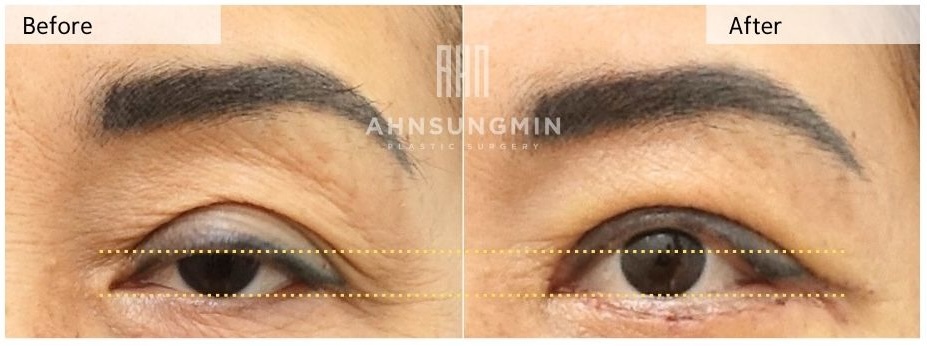
In many cases, a high fold is created without addressing underlying ptosis.
If the eyelid does not open properly,
any crease placed above its natural range becomes unstable.
At first, the fold may appear defined.
But over time, it tends to rise further and lose balance.
This is not a design issue.
It is a functional problem that was left uncorrected.
Related Insight:
How to Tell If Your High Fold Is Actually Ptosis.
In cases where eyelid function is compromised,
proper evaluation for ptosis correction becomes essential.
The Forehead Compensation Pulls the Fold Higher.
When the eyelid cannot open sufficiently on its own,
patients begin to use the forehead to compensate.
This repeated movement gradually pulls the fold upward.
As a result:
- The crease becomes higher over time
- The eye appears more strained rather than more open
- The overall expression becomes less natural
The problem is not that the fold was made high.
It is that the eye was never able to support it.
A Common Misunderstanding About Bigger Folds.
Many patients believe that a larger fold makes the eyes look bigger.
This assumption often leads to requests for higher creases.
But eye size is not determined by the fold.
It is determined by how well the eye opens.
When ptosis is present,
raising the fold does not make the eye clearer.
Instead, it often creates a heavier and more artificial appearance.
Why High Folds Become Thick and Unnatural.
When a high fold is created on a weak or unsupported eyelid,
it must be fixed more aggressively to maintain its shape.
This leads to:
- A deeper, thicker crease
- Limited natural movement
- A fold that remains visible even when the eye is closed
This is commonly recognized as a “sausage-like” eyelid.
The result is not simply a high fold.
It is a fold that no longer behaves like a natural part of the eye.
This Problem Cannot Be Solved by Lowering the Fold Alone.
When a high fold looks unnatural,
lowering the crease is not the first solution.
If ptosis remains uncorrected,
the same pattern will repeat.
The fold may change temporarily,
but it will not remain stable over time.
Related Insight:
Why Does a High Fold Return After Revision Surgery.
The order of correction matters.
For a detailed approach to correcting this issue,
see how we approach high fold correction in revision cases.
What Should Be Evaluated First.
If a high fold appears unnatural,
the first step is not to adjust the fold.
It is to evaluate how the eye functions.
You should first check:
- Whether the eye opens comfortably without using the forehead
- Whether there is asymmetry in opening strength
- Whether the eye appears tired despite a high crease
- Whether the fold continues to rise over time
If these signs are present,
ptosis should be addressed before any crease adjustment.
If surgery becomes necessary after proper evaluation,
understanding the recovery process is equally important.
You can review the expected recovery timeline here:
upper eyelid surgery recovery timeline
The Conclusion Is Simple.
A high fold is not the root of the problem.
If the eyelid function is not corrected,
no fold will remain natural.
And in those cases,
raising or lowering the crease alone will only repeat the same outcome.
You can also explore real outcomes in our
revision case examples based on structural correction.
A high fold does not improve on its own.
If your eyelid appears too high, unstable, or unnatural,
it is important to determine whether the issue is caused by the fold itself
or by underlying eyelid function.
Many patients considering revision eyelid surgery in Korea initially focus on crease height or fold appearance. However, long-term improvement often depends on correcting ptosis, restoring functional balance, and reducing compensatory tension rather than simply lowering the fold itself.
→ Request a Functional Evaluation for High Fold Eyelids
Insights
Why Do High Fold Eyelids Look Unnatural
A high fold often appears unnatural not because of its height, but because underlying ptosis and structural imbalance prevent the eyelid from supporting the crease properly.
Understanding how this is addressed in high fold correction is essential.
Frequently Asked Questions
Q1. Why do my eyelids look unnatural after double eyelid surgery?
High fold eyelids often look unnatural when the eyelid cannot support the crease due to underlying ptosis or structural imbalance.
Q2. Can a high eyelid fold be fixed without another surgery?
If the issue is structural, non-surgical methods are limited. In many cases, correcting eyelid function is necessary before adjusting the fold.
Q3. Why does my eyelid fold keep getting higher over time?
When ptosis is not corrected, patients use the forehead to open the eyes, which gradually pulls the fold higher.
Q4. Does making a bigger eyelid fold actually make my eyes look larger?
No. Eye size is determined by how well the eye opens, not by the height of the fold. A higher crease can sometimes make the eye look heavier.
Q5. How do I know if my high fold is a functional problem, not just cosmetic?
If the eye feels heavy, opens with effort, or uses the forehead to lift, the issue is likely functional and should be evaluated before adjusting the fold.
