Before and After
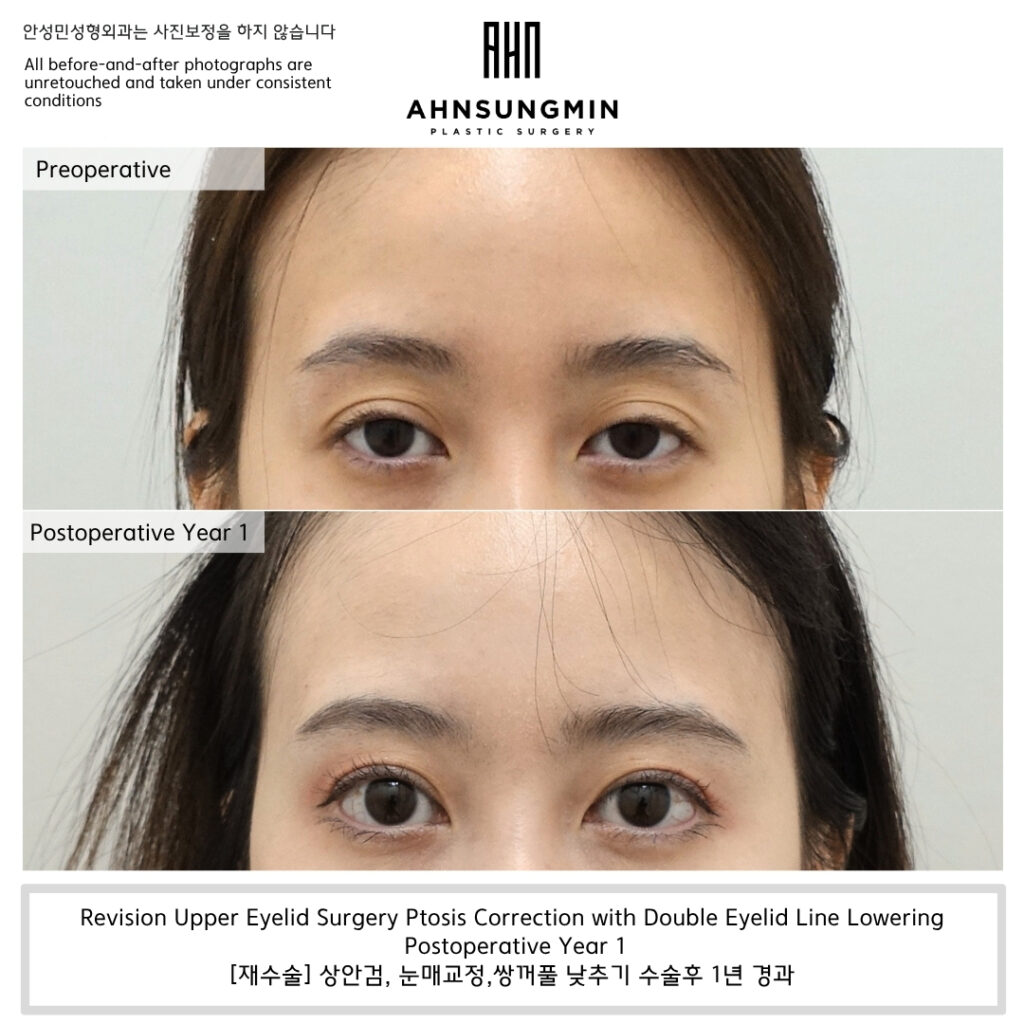
Preoperative
Postoperative Year 1 After Revision Upper Eyelid Surgery
A Functional Problem
This patient presented with a double eyelid line that was positioned too high and lacked stability. The crease did not follow the natural anatomy of the eyelid, and the imbalance was not only aesthetic but functional. The eyes appeared strained, and the effort required to open them was visibly increased.
In cases like this, the issue is not simply how the eyelid looks—but how it works.
Why We Did Not Pursue a Larger Fold
There is a common misconception that a more defined or higher fold will improve the appearance of the eyes. In reality, increasing the fold height in an already elevated crease often worsens both function and long-term stability.
The problem here was not a lack of definition.
It was a mispositioned structure.
Making the fold larger would have reinforced the original problem rather than correcting it.
Structural Correction
The approach in this case focused on two key elements: restoring eyelid function through ptosis correction, and repositioning the crease to a lower, anatomically appropriate level.
Lowering the double eyelid line is not a simple adjustment. It requires releasing prior adhesions, rebalancing tissue tension, and rebuilding the crease in a way that allows the eyelid to move naturally.
Every step must be controlled. Overcorrection creates a new set of problems.
Results
At one year postoperative, the eyelid position is stable and the crease sits at a level that aligns with the natural contour of the eye. The patient’s gaze appears more relaxed, and the eyes open without visible strain.
The result is not defined by how large the fold is, but by how naturally the eyelid functions.
Surgical Approach
Revision Upper Eyelid Surgery
Ptosis Correction with Double Eyelid Line Lowering
Performed under local anesthesia with a focus on structural stability and long-term balance.
→ Request a Ptosis & Revision Eyelid Evaluation
If you have been told that your eyelid fold needs to be higher or more defined, it may be worth reconsidering the underlying structure first.
In many revision cases, the solution is not to add—but to reposition and restore.
Request a consultation to evaluate whether your current eyelid condition requires correction, not enlargement.
Internal References
→ Why Does My Double Eyelid Look Too High Over Time?
→ How to Tell If Your High Fold Is Actually Ptosis.
→ When a High Fold Starts to Feel Too Much.
→ When a High Fold Should Be Lowered—and When It Should Not.
Frequently Asked Questions About Revision Eyelid Surgery
Is lowering a double eyelid line more difficult than creating one?
Yes. Lowering a previously created high crease requires releasing scar tissue and rebuilding the structure. It is significantly more complex than primary surgery.
Can ptosis be corrected at the same time as revision?
In many cases, yes. Functional correction is often necessary to achieve a stable and natural result in revision surgery.
Will lowering the crease make the eyes look smaller?
Not necessarily. When the eyelid function improves, the eyes often appear more open and balanced, even with a lower crease.
How long should I wait before revision surgery?
In most cases, at least 6–12 months is required to allow tissues to stabilize before accurate evaluation.
Insights
Why Does My Double Eyelid Look Too High Over Time?
→ What appears to be a high fold is often a structural or functional issue—not just a matter of height.
How to Tell If Your High Fold Is Actually Ptosis.
→ What appears to be a high fold may actually be related to eyelid function, not just crease design.
When a High Fold Should Be Lowered—and When It Should Not.
→ Lowering the crease is not always the solution. Learn when function must be addressed first.
