Before and After
A Functional Problem, Not Just a Cosmetic One
At first glance, this case may appear to be about hollowing or fold definition.
But the primary issue was not the crease—it was incomplete eyelid opening due to unresolved ptosis.
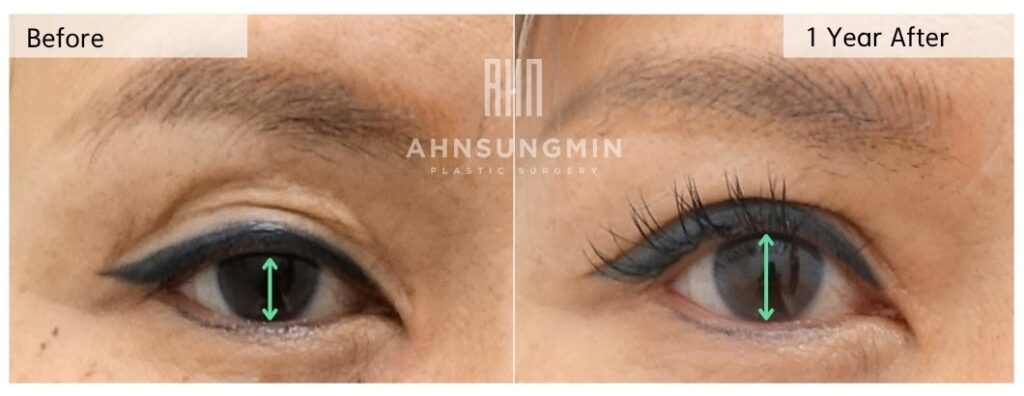
Before revision, the eye appeared heavy, with limited vertical opening and a lack of natural contour above the fold.
The hollowing was not simply a volume deficiency, but a result of structural imbalance.
This type of heavy appearance and unstable eyelid opening is also commonly seen in patients with residual ptosis after previous eyelid surgery, where chronic forehead compensation and incomplete functional correction continue over time.
→ Revision Ptosis Surgery Case: Correcting Residual Ptosis and Restoring Clearer Eyelid Opening.
Why We Did Not Add Volume
In cases like this, adding volume does not solve the underlying problem.
The hollow appearance was caused by:
- Incomplete eyelid elevation
- Improper distribution of existing orbital fat
- Tension imbalance across the upper eyelid
Instead of adding volume, we focused on repositioning what was already present.
Structural Correction
This case involved two key components:
- Ptosis revision to restore proper eyelid opening
- Orbital fat repositioning to correct hollowing without overfilling
No unnecessary excision was performed.
No artificial volume was added.
The goal was to restore balance—not to exaggerate form.
Results
At one year, the changes are not just visible—they are stable.
- Improved eyelid opening
- Smoother upper eyelid contour
- Reduced hollowing without added volume
- More natural transition from brow to eyelid
What matters here is not how the eye looks immediately after surgery,
but how it behaves over time.
Understanding how the eyelid changes during recovery is essential.
You can review the typical healing process in our Upper Eyelid Surgery Recovery Timeline.
Surgical Approach
Revision eyelid surgery performed with a focus on structure, preservation, and long-term stability.
