The Problem Is Not Just the Fold—It Is the Missing Volume Beneath It
High fold hollow eyelids often appear deeper not because of the fold itself, but because of underlying structural imbalance. In many cases, the issue is not the position of the fold, but the condition of the structure beneath it.
A high eyelid fold is often approached as a positional issue. The line is too high, too deep, or too fixed.
But in many patients, that is not the full problem.
What makes high fold correction significantly more difficult is not the fold itself—but the hollowing underneath it.
When upper eyelid volume is depleted, the fold does not simply sit higher. It becomes structurally exaggerated.
The depth increases. The fixation becomes more visible. The transition between fold and lash line becomes abrupt.
In these cases, lowering the fold alone does not resolve the imbalance.
Because the problem is not where the fold is—it is what is missing beneath it.
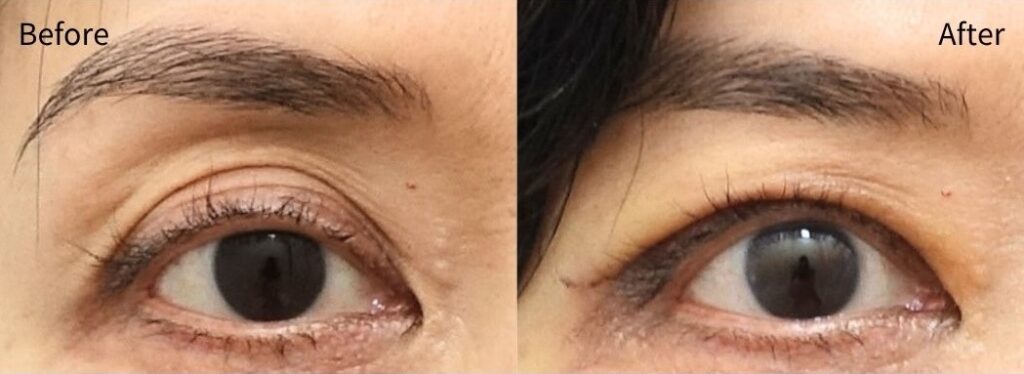
A High Fold Over a Hollow Eye Behaves Differently
A high fold on a well-supported eyelid and a high fold on a hollow eyelid are fundamentally different clinical situations.
In a hollow eye:
The skin collapses inward due to volume deficiency
The fold appears deeper and more rigid than it actually is
Adhesions become more visually prominent
The upper eyelid loses its natural glide
This means that even if the fold height is surgically lowered, the result may still look unnatural.
This is why simply lowering the fold does not always lead to a softer or more natural result.
For a deeper explanation, see:
Why Lowering a High Fold Does Not Always Make the Eyes Look Softer
Because the underlying structure has not been restored.
In many cases, what appears to be a fold problem is actually related to underlying hollowing.
To understand how volume loss affects eyelid structure, see:
Upper Eyelid Hollowing Evaluation at Ahnsungmin Plastic Surgery
Even when the early swelling improves, the eyelid structure continues to change over time.
Understanding this gradual process is essential before evaluating the outcome.
For a detailed breakdown of each stage, see the full recovery timeline here:
Upper Eyelid Surgery Recovery Timeline
Why Simple Fold Lowering Often Fails in Hollow Eyes
Patients often expect that lowering the fold will make the eyes look softer and more natural.
But in hollow eyelids, this expectation does not hold.
If the surgeon only lowers the fold:
- The hollow remains
- The skin may appear even more deflated
- The new fold may lack support and become unstable
- The eye can look heavier rather than softer
In some cases, the outcome can feel more artificial than before.
Not because the surgery was incorrect—but because the indication was incomplete.
Structural Consideration Comes Before Design
In revision surgery, design decisions should never precede structural evaluation.
When hollowing is present, the question is not “Where should the new fold be?”
It is “What is the condition of the tissue that must support that fold?”
This is where many high fold corrections fail.
Because the surgery focuses on repositioning the fold
without addressing the lack of volume, weakened support, or internal scarring.
A fold cannot look natural if the structure beneath it cannot support it.
When Volume Becomes Part of the Strategy
Not all hollow eyelids require volume restoration.
But when hollowing is significant, ignoring it limits the surgical outcome.
Depending on the case, this may involve:
- Releasing scar adhesions
- Repositioning existing tissue
- Conservatively restoring volume where needed
The goal is not to “fill” the eyelid.
The goal is to recreate a stable anatomical foundation where a fold can exist naturally.
High Fold Correction Is Not Always a Fold Problem
One of the most important judgments in revision surgery is recognizing when a visible issue is not the primary problem.
A high fold may appear to be the main concern.
But if hollowing is driving the unnatural appearance,
then treating the fold alone is a partial solution at best.
And partial solutions often lead to repeated surgeries.
Surgical Decision-Making Changes the Outcome
The difference between a natural result and an artificial one often comes down to this:
Was the surgery focused on what is visible,
or on what is structurally responsible?
In hollow upper eyelids, the answer determines everything.
→ Request a High Fold & Hollow Eyelid Evaluation
If your high fold appears deeper, harsher, or more unnatural over time,
the issue may not be the fold itself—but the structure beneath it.
A proper evaluation determines whether correction should focus on fold adjustment, structural release, or volume restoration.
Frequently Asked Questions
1. Why do high fold eyelids look deeper in hollow eyes?
When the upper eyelid loses volume, the skin collapses inward, making the fold appear deeper and more pronounced. The issue is not just the fold itself, but the lack of structural support beneath it.
2. Can lowering a high fold fix the problem completely?
Not always. In hollow eyelids, lowering the fold alone may not produce a natural result because the underlying structure remains unchanged.
3. What causes hollow upper eyelids?
Hollowing can result from aging, previous surgery, fat loss, or excessive tissue removal. In revision cases, it is often related to scarring or structural imbalance.
4. Do all hollow eyelids require volume restoration?
No. Not every case requires volume addition. The decision depends on the degree of hollowing and the overall structural condition of the eyelid.
5. Why is structural correction more important than fold design?
A fold cannot look natural without proper support. Structural correction ensures stability, while fold design alone may not address the root cause of the problem.
Insight
Why High Fold Eyelids Often Look Deeper Over Time
High fold eyelids can appear progressively deeper when underlying structural support weakens or volume loss develops.
Why Lowering a High Fold Does Not Always Make the Eyes Look Softer
Simply lowering the fold may not improve the appearance if hollowing and structural imbalance are not addressed.
Upper Eyelid Hollowing: When Volume Loss Becomes a Structural Problem
Upper eyelid hollowing is not just a cosmetic issue—it often reflects deeper structural deficiency affecting fold stability.
Ptosis Correction vs High Fold: When Opening the Eye Makes the Fold Look Higher
Correcting ptosis can change the perception of fold height, sometimes making an existing high fold appear more pronounced.
Why Some High Fold Revisions Require Structural Release First
In revision cases with scarring or adhesion, releasing structural restrictions is often necessary before adjusting the fold.
Seeing the Eye as a Whole, Not in Parts
A Clinic Dedicated to Eyelid Revision Surgery in Korea
Ahnsungmin Plastic Surgery
