Not All Limitations Come from Muscle
Ptosis correction is often discussed in terms of muscle function, particularly the levator.
However, in many revision cases, the true limitation is not the muscle.
It is the skin.
When the available skin is insufficient, the eyelid cannot be safely elevated beyond a certain point. The limitation is structural, not technical.
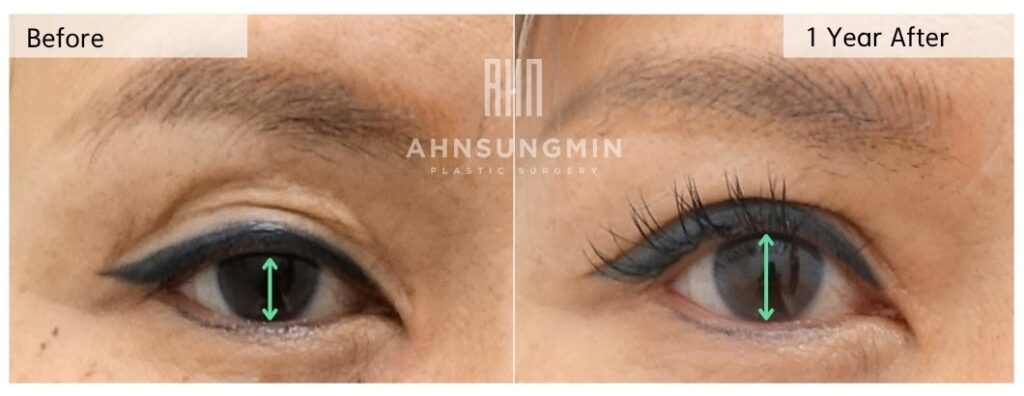
Skin Is a Structural Resource
Eyelid skin is not excess tissue that can be freely removed.
It is a functional component that allows smooth closure, stable movement, and proper distribution of tension.
When too much skin is removed, these functions are compromised, often in ways that cannot be fully reversed.
Why Skin Shortage Leads to Complications
In revision ptosis surgery, these complications are often difficult to fully reverse once significant skin shortage develops.
the eyelid is elevated without sufficient skin, the system loses balance.
This can lead to incomplete closure, eyelid retraction, lagophthalmos, and chronic dryness.
These are not minor side effects. They are structural complications that directly affect long-term comfort and function.
Many Revisions Begin with Excessive Skin Removal
A significant number of revision cases originate from prior procedures where excessive skin was removed.
At the time, the result may have appeared clean and well-defined.
However, as healing progresses and tissue settles, the lack of skin becomes the defining limitation.
Correction Has Limits When Skin Is Lacking
In these cases, ptosis correction must be approached with restraint.
Aggressive elevation is no longer an option.
Instead, the focus shifts to preserving closure, maintaining comfort, and preventing further damage.
The final result may be intentionally limited, but it is functionally safer.
Surgical Planning Must Consider Future Revision
Every primary procedure should be planned with the possibility of revision in mind.
Preserving adequate skin is not hesitation.
It is preparation.
Once skin is removed, it cannot be easily replaced, and the margin for correction becomes progressively narrower.
The Decision Is Based on What Must Be Preserved
In ptosis correction, the question is not how much can be lifted.
It is what must be preserved.
When skin becomes the limiting factor, restraint is not optional. It is necessary for long-term stability.
Related Insights
→ Why Aggressive Ptosis Correction Can Create Long-Term Problems
→ Why Some Ptosis Revisions Require Structural Restraint
→ Why Revision Eyelid Surgery Must Preserve Closure
→ Upper Eyelid Hollowing Is Not Always Caused by Aging
→ Understanding Recovery After Ptosis Surgery
→ Best Ptosis Surgeon in Korea
Request a Ptosis Revision Evaluation
If you are experiencing eyelid tightness, incomplete closure, dryness, or limited correction after previous ptosis surgery, you may request a personalized evaluation based on eyelid skin condition, structural balance, closure function, and long-term stability.
Seeing the Eye as a Whole, Not in Parts
A Clinic Dedicated to Eyelid Revision Surgery in Korea
Ahnsungmin Plastic Surgery
