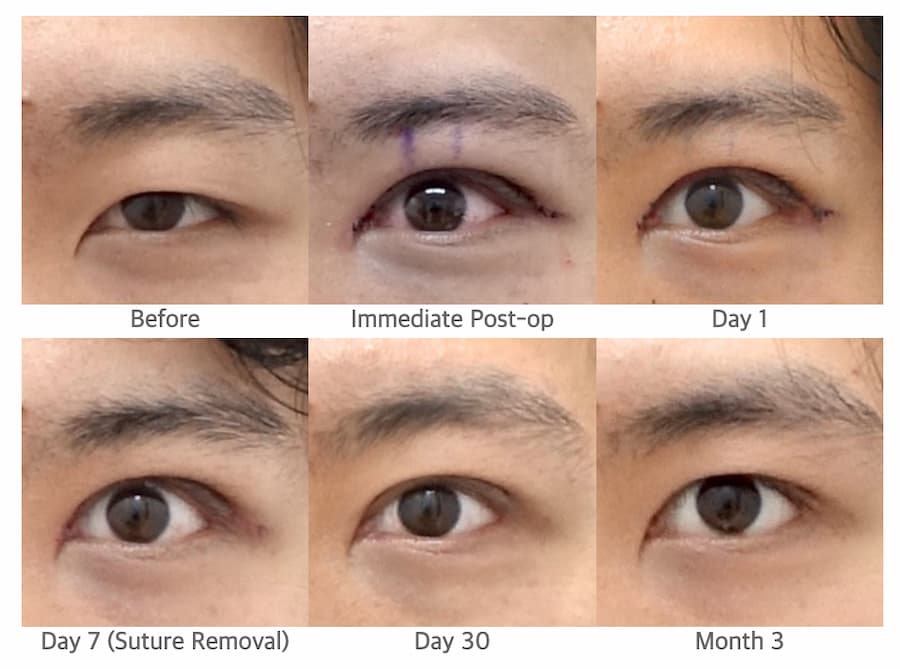
Understanding Ptosis Recovery
Ptosis surgery recovery is a gradual process, not an immediate transformation.
While eyelid opening may improve immediately after surgery, swelling, temporary asymmetry, eyelid tightness, and changes in crease position can make the eyes look different during the early healing period.
The eyelid position gradually stabilizes as swelling decreases, tissues heal, and the eye-opening muscles adapt to the corrected position.
For this reason, understanding the ptosis surgery recovery timeline is important before judging symmetry or the final surgical result.
Immediate Postoperative Stage
Immediately after surgery, swelling and temporary asymmetry are common.
The eyelids may appear higher, more open, or uneven because of swelling and the temporary response of the eyelid muscles.
Tightness around the incision and difficulty judging the final crease or eyelid height are also common during this stage.
The appearance immediately after surgery should not be interpreted as the final result.
Postoperative Day 1
Swelling often becomes more noticeable during the first postoperative day.
The two eyes may swell differently, making temporary asymmetry more noticeable. Bruising may also begin to appear around the eyelids.
At this stage, the priority is recovery rather than evaluating eyelid height or symmetry.
Postoperative Days 3–7
Swelling and bruising gradually begin to improve during the first week.
The eyelid contour becomes easier to see, but residual swelling can still affect eyelid height, crease definition, and symmetry.
Sutures are typically removed according to the surgical approach and individual healing progress.
Even after suture removal, the eyelids may still feel tight or appear slightly unnatural.
Postoperative Weeks 2–4
During the following weeks, visible swelling continues to decrease and the eyes gradually begin to look more natural.
Many patients can see a clearer eyelid shape during this period, but subtle asymmetry or differences in eyelid height may still change as healing continues.
One month is an important recovery milestone, but it is generally too early to judge the final result.
Postoperative Month 1
Around one month after ptosis surgery, much of the obvious swelling has usually improved.
Eyelid movement and opening may feel more comfortable, and the overall appearance becomes more stable.
However, residual swelling and continued tissue adaptation can still influence subtle differences between the two eyes.
Postoperative Months 2–3
Between two and three months, eyelid position becomes progressively more stable as swelling continues to resolve and the tissues adapt.
By around three months, the eyes often appear significantly more natural and early evaluation of the surgical result becomes more meaningful.
Some patients may continue to experience subtle changes beyond this stage depending on the extent of surgery, individual anatomy, and healing pattern.
When Does Ptosis Surgery Look Natural?
Ptosis surgery does not necessarily look natural immediately after the operation.
During the early recovery period, swelling can temporarily make the eyelids appear higher, tighter, or less symmetrical than expected.
As swelling decreases and eyelid movement becomes more comfortable, the eyes gradually begin to look more natural.
Many patients notice significant improvement during the first month, but eyelid position and symmetry should be evaluated over a longer period rather than from a single early postoperative photograph.
Is Asymmetry Normal During Ptosis Surgery Recovery?
Temporary asymmetry can occur during ptosis surgery recovery.
The two eyelids may not swell at exactly the same rate, and temporary differences in muscle response can also affect eyelid height during the early healing period.
For this reason, uneven eyelids during the first days or weeks do not necessarily indicate a final asymmetrical result.
Persistent asymmetry should be evaluated in the context of the complete recovery process rather than judged immediately after surgery.
When Should Ptosis Surgery Results Be Evaluated?
Ptosis surgery should not be judged based on early postoperative appearance.
Swelling, muscle adaptation, tissue healing, and temporary asymmetry can all influence how the eyes look during recovery.
Although meaningful evaluation often becomes possible around three months, the appropriate timing can vary depending on the surgical procedure, previous surgery, and individual healing.
This is especially important before considering revision surgery. An early postoperative appearance may continue to change as the eyelids stabilize.
Before considering revision, it is also important to distinguish true ptosis from pseudoptosis, since similar eyelid appearances may have different underlying causes. Learn more about the difference between pseudoptosis and true ptosis.
Male Ptosis Surgery
Although the general recovery timeline is similar for men and women, surgical planning may differ depending on the patient’s anatomy and aesthetic goals.
In male ptosis surgery, particular attention is often given to improving eye opening while preserving natural masculine facial features and overall facial balance.
Learn more about Male Eyelid Surgery in Korea
Best Ptosis Surgeon in Korea
Why Sleepy Eyes in Men Often Require Ptosis Correction.
Frequently Asked Questions
1. How long does it take to recover from ptosis surgery?
Most visible swelling improves within 2 to 4 weeks, but eyelid position typically takes around 3 months to become more stable. Subtle changes may continue beyond this stage.
2. When can ptosis surgery results be evaluated?
Initial improvements can be seen within the first few weeks. Eyelid position becomes progressively more stable over the following months, and meaningful evaluation is often possible around three months, although subtle changes may continue beyond this stage.
3. Is asymmetry normal during ptosis recovery?
Yes, temporary asymmetry is common during ptosis recovery due to swelling and muscle adaptation. It usually improves as healing progresses.
4. Why do my eyes look uneven after ptosis surgery?
Swelling and temporary muscle imbalance can make the eyes appear uneven after surgery. This is part of the normal healing process and should not be judged too early.
5. Can I judge my ptosis surgery result within the first month?
No. Early postoperative appearance does not reflect the final outcome. Proper evaluation usually requires several months of healing and stabilization.
Online consultation available for international patients
Seeing the Eye as a Whole, Not in Parts
A Clinic Dedicated to Eyelid Revision Surgery in Korea
Ahnsungmin Plastic Surgery
