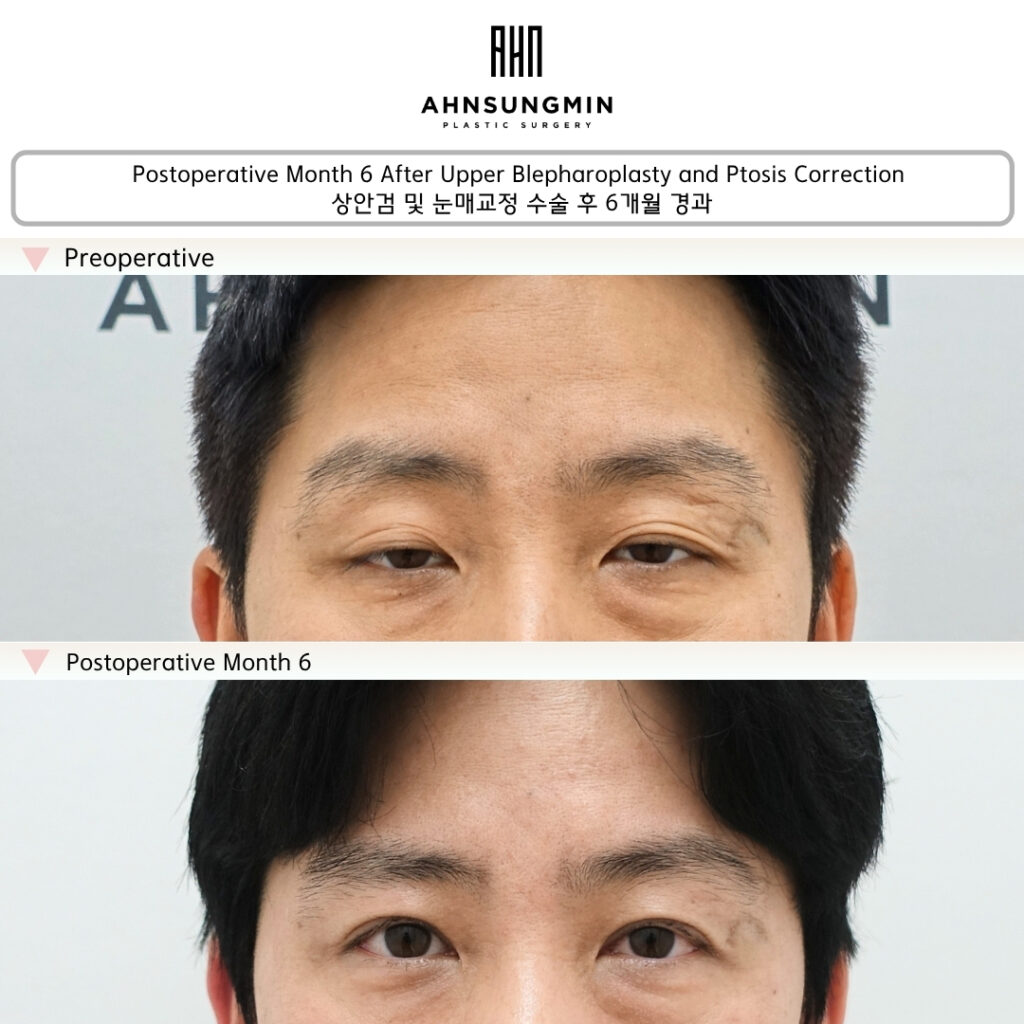
[Before / 6 Months After]
Postoperative Month 6 After Upper Eyelid Ptosis Correction Surgery
A Functional Problem, Not a Cosmetic One
This case was not about making the eyes appear larger.
The patient presented with limited eyelid opening due to ptosis, along with a tired appearance and reduced visibility of the pupil. While some may interpret this as a need for a higher or more defined double eyelid fold, the underlying issue was functional rather than aesthetic. In many patients with ptosis, the forehead becomes overactive in an attempt to compensate for limited eyelid opening, creating a heavier and more fatigued appearance over time. This pattern of forehead compensation caused by ptosis is often mistaken for a cosmetic fold problem rather than a functional issue.
The goal was not enlargement, but restoration.
Why We Did Not Pursue a Higher Fold
Increasing the crease height can sometimes create the illusion of larger eyes. However, when the fundamental issue lies in insufficient eyelid elevation, such an approach does not address the true cause.
In this case, raising the fold would have resulted in an artificial appearance without improving function.
Instead, the decision was made to correct ptosis directly, focusing on restoring proper eyelid opening while maintaining a natural crease.
Structural Correction Over Visual Expansion
By restoring levator muscle function, the eyes are able to open more effectively and consistently.
This results in:
Improved eye opening without excessive tension
Better balance between both eyes
A more natural and stable appearance over time
Rather than forcing a larger fold, the procedure focused on structural integrity and functional recovery.
6 Months After Surgery
At six months postoperatively, the eyelid position is stable and fully settled.
There is no excessive elevation, no asymmetry caused by tension, and no sign of overcorrection.
The eyes appear naturally open and well-balanced with the patient’s facial structure.
This is not a case of making the eyes bigger.
It is a case of restoring how the eyes should function.
Surgical Approach
Ptosis Correction
Each component was selected to support functional improvement and long-term stability, rather than short-term visual impact.
In revision ptosis cases, restoring comfortable and natural eyelid opening is often more important than simply creating a larger or higher fold.
Internal References
→ See ptosis correction cases
