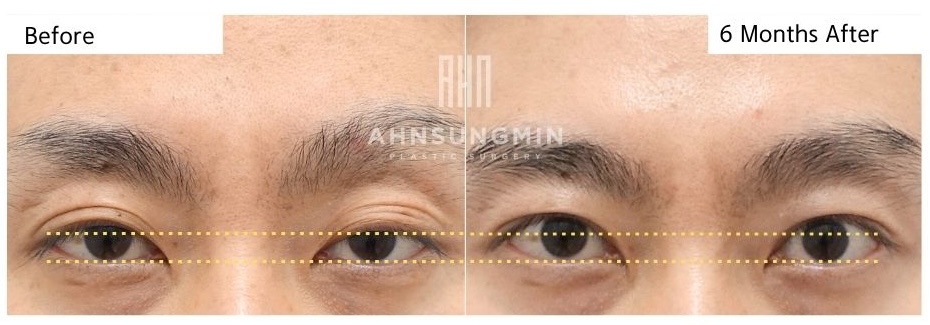
Many patients describe a similar concern during consultation.
When they look in the mirror, both eyes appear relatively similar. Friends and family often do not notice anything unusual.
Yet the patient continues to feel that one eye is different.
One eye may feel heavier.
One side may seem more difficult to open.
Some patients notice that they are constantly more aware of one eye throughout the day, even though the visible appearance appears relatively balanced.
This often becomes frustrating because the discomfort feels real, while the difference itself can be difficult to explain.
Looking Similar Does Not Always Mean Functioning the Same
One of the most common misunderstandings in eyelid surgery is the assumption that appearance and function always match.
In reality, two eyelids may look similar while functioning very differently.
One eyelid may require more effort to open.
One side may rely more heavily on forehead compensation.
One eye may experience subtle residual ptosis that is not immediately obvious in photographs.
Because patients experience their eyes through movement and effort—not through still photographs—they often notice functional differences long before visible asymmetry becomes obvious.
The Feeling Often Appears Before the Appearance
Patients frequently focus on appearance because it is easier to describe.
However, many functional eyelid problems begin as a sensation rather than a visible change.
The eye may feel tired by the end of the day.
Reading may require more effort.
The forehead may become tense without the patient realizing it.
Some patients notice that they unconsciously raise one eyebrow more often than the other.
At this stage, the eyes may still appear relatively symmetrical.
The discomfort arrives first.
The visible changes sometimes follow later.
Why Previous Surgery Does Not Always Eliminate the Feeling
Some patients become concerned because they have already undergone eyelid surgery.
They assume that if the fold looks acceptable, the problem must have been solved.
However, surgery that improves appearance does not always eliminate every functional imbalance.
Residual ptosis, uneven muscle function, scar-related restriction, or subtle differences in eyelid movement may still affect how the eyes feel during daily activities.
This is one reason why patients occasionally report that their eyes “look fine” but still do not feel completely comfortable.
What Patients Often Notice
During consultation, patients commonly describe:
- One eye feels heavier than the other
- One side becomes more tired throughout the day
- The forehead feels more active on one side
- Eye opening feels less effortless
- The eyes appear similar, but one side feels different
Interestingly, these complaints often reflect functional differences that may not be obvious to others.
When Evaluation May Be Helpful
A feeling of heaviness does not automatically mean that another surgery is necessary.
In many situations, observation and additional healing time remain appropriate.
However, when the sensation persists, gradually worsens, or continues to interfere with comfort during daily activities, it may be helpful to evaluate whether subtle differences in eyelid function are contributing to the problem.
The goal is not simply to identify asymmetry.
The goal is to understand why the eyes feel different, even when they appear similar.
Frequently Asked Questions
1. Why does one eye feel heavier even if both eyes look the same?
Appearance and function do not always match. One eyelid may require more effort to open even when visible asymmetry is minimal.
2. Can residual ptosis cause a feeling of heaviness?
Yes. Subtle residual ptosis may sometimes create a sensation of heaviness before obvious visual differences become noticeable.
3. Is this feeling always caused by eyelid surgery?
No. Some patients experience functional differences even without previous surgery. However, previous surgery may occasionally influence eyelid movement, muscle balance, or tissue flexibility.
4. Why does the heaviness become more noticeable later in the day?
Fatigue often makes subtle functional differences more noticeable. Some patients become increasingly aware of eyelid effort as the day progresses.
5. Does feeling heavier mean I need revision surgery?
Not necessarily. The sensation alone does not determine whether surgery is appropriate. Careful evaluation is often necessary to identify the underlying cause.
Insights
Patients often assume that visible symmetry means both eyelids are functioning equally. In reality, subtle differences in eyelid opening may become noticeable through sensation long before obvious asymmetry appears.
Why Do My Eyes Still Feel Heavy After Double Eyelid Surgery?
Residual ptosis may sometimes be more noticeable through fatigue, heaviness, or effort rather than appearance alone.
Revision Ptosis Surgery Case: Correcting Residual Ptosis and Restoring Clearer Eyelid Opening
Some patients continue using forehead compensation without realizing it, even when visible asymmetry appears minimal.
Why Your Eyes Feel Heavier After Forehead Botox
A fold that appears stable does not always mean eyelid function has fully normalized.
Why Revision Ptosis Surgery Should Not Focus Only on Bigger Eyes
Patients who experience persistent heaviness, eyelid fatigue, or difficulty keeping one eye open may benefit from understanding how eyelid function affects daily comfort.
Ptosis Correction Korea: Restoring Natural Eyelid Function
Request a Functional Eyelid Evaluation
Some patients are more bothered by how their eyes feel than how they look.
If one eye continues to feel heavier, more fatigued, or more difficult to open despite relatively similar appearance, a functional eyelid evaluation may help identify factors contributing to the difference.
