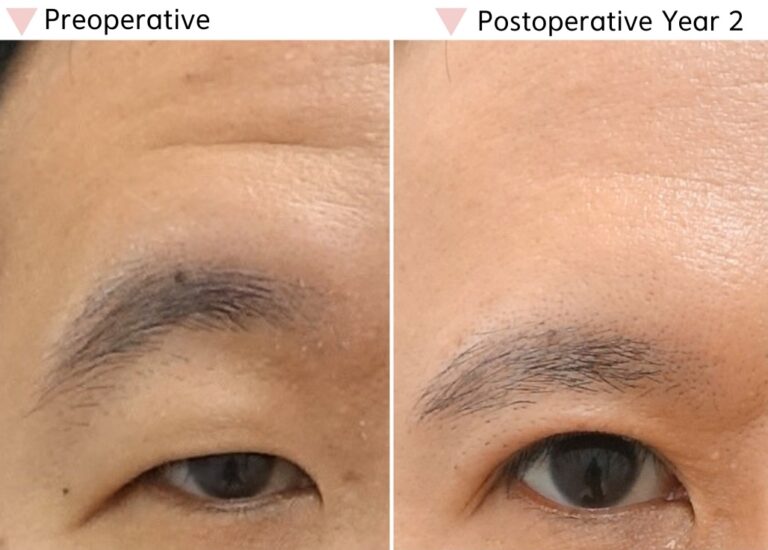
Forehead Compensation Before and After Functional Eyelid Correction
In this patient, the forehead had gradually become overactive over time in order to compensate for reduced eyelid opening function.
The patient was often unaware that the forehead was constantly being used to help keep the eyes open.
Over time, the forehead remained elevated in order to assist with maintaining a clearer visual field.
Postoperative Year 2 after ptosis correction demonstrates more stable and natural eyelid opening without excessive reliance on forehead compensation.
The goal was not to create exaggerated folds or artificially larger eyes, but to restore more natural functional balance and long-term eyelid stability.
Many patients notice the same change after forehead Botox—their eyes feel heavier, more fatigued, or harder to open.
A number of patients report a similar experience after receiving forehead Botox.
They feel that their eyes have become heavier, more swollen, or more difficult to open. Some describe a sensation of pressure around the eyes, while others feel that their eyes appear smaller than before.
In most cases, this is not a complication of Botox itself.
It is a functional change that reveals how the eyes were being opened prior to treatment.
This may indicate an underlying eyelid function issue.
Learn more about eyelid revision surgery in Korea.
In many patients, forehead Botox does not create a new eyelid problem. Instead, it reveals how much the forehead had already been compensating for reduced eye-opening function over time.
The reduction of forehead compensation does not occur instantly. Functional adaptation and eyelid stabilization continue gradually over time after ptosis correction.
Recovery after ptosis correction is gradual, as swelling, muscle adaptation, and eyelid position continue to stabilize over time. Learn more in our Ptosis Surgery Recovery Timeline.
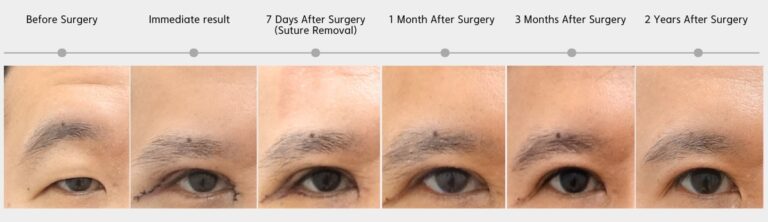
How the Forehead Compensates for Weak Eye Opening.
In patients with underlying ptosis, the eye-opening muscle does not function sufficiently on its own. To maintain a clear visual field, the body recruits the forehead muscle as a compensatory mechanism.
Over time, this compensation becomes habitual. Patients are often unaware that they are using their forehead to open their eyes. The raised forehead is perceived as “normal,” while the true baseline of the eye remains hidden.
What Changes After Forehead Botox.
Why do my eyes feel heavier after forehead Botox?
Forehead Botox temporarily weakens the muscle responsible for this compensation. When that support is removed, the eyelids can no longer rely on the forehead to assist with eye opening.
As a result, the forehead descends and the true opening capacity of the eyelids becomes visible. The eyes may feel heavier, more fatigued, or less open—not because Botox caused damage, but because it eliminated a long-standing compensatory mechanism.
This Is Not a New Problem.
Patients often believe that Botox has created a new issue. In reality, it has exposed an existing one.
The discomfort experienced after forehead Botox often reflects the loss of compensation that had been masking underlying ptosis for years.
When This Matters Clinically.
If the eyes feel noticeably heavier or more difficult to open after forehead Botox, it suggests that the eye-opening muscle may not be functioning adequately on its own.
In such cases, repeating Botox or adjusting dosage does not address the underlying issue. The correct question is not how to lift the forehead again, but whether eye-opening function itself requires evaluation.
Why This Is Often Misunderstood.
Forehead wrinkles and drooping eyelids are frequently treated as isolated aesthetic concerns. However, in patients with ptosis, these findings are often interconnected.
Treating the forehead without understanding its compensatory role can lead to confusion, dissatisfaction, and repeated treatments that fail to resolve the core problem.
What This Reveals About Eye Shape Correction.
Eye shape correction is not intended to counteract the effects of Botox or restore forehead elevation. Its purpose is to normalize eye-opening function so that compensation is no longer required.
When the eyes open properly on their own, the forehead no longer needs to work excessively, and treatments targeting the forehead can be approached more safely and predictably.
Frequently Asked Questions
1. Why do my eyes feel heavier after forehead Botox?
In many patients, forehead Botox does not create a new eyelid problem. Instead, it reveals reduced eyelid opening function that had previously been compensated for by constant forehead muscle activity.
2. Can forehead Botox reveal underlying ptosis?
Yes. When forehead compensation is temporarily weakened after Botox, underlying ptosis or reduced eye-opening function may become more noticeable.
3. Why do I unconsciously use my forehead to open my eyes?
Patients with reduced eyelid opening strength often recruit the forehead muscle to help maintain a clearer visual field. Over time, this compensation becomes habitual and may feel normal.
4. Does forehead Botox permanently damage the eyelids?
In most cases, no. The heaviness patients experience after forehead Botox is usually related to the temporary loss of forehead compensation rather than permanent damage to the eyelids.
5. Can ptosis correction reduce forehead compensation?
Yes. When eyelid opening function improves more naturally, the forehead often no longer needs to compensate excessively to help keep the eyes open.
Insights
Reduced eyelid opening strength often causes patients to rely unconsciously on forehead compensation over time.
When Eye Shape Correction Is Necessary
Many patients mistake high folds or heavy eyelids for a cosmetic problem when the underlying issue is functional imbalance.
How to Tell If Your High Fold Is Actually Ptosis
Eyes that continue to feel heavy after eyelid surgery may still have unresolved functional instability rather than a simple crease issue.
Why Do My Eyes Still Feel Heavy After Double Eyelid Surgery?
Ptosis correction is intended to restore more natural eye-opening function rather than simply creating larger or stronger-looking eyes.
Ptosis Correction Is Not About Making the Eyes Bigger
Natural eye opening and long-term functional balance are often more important than creating a stronger or higher eyelid crease.
Why Natural Eye Opening Matters More Than Crease Design
Why Does My Double Eyelid Look Too High Over Time?
Patients who continue to rely on forehead compensation, experience heavy eyelids, or feel persistent fatigue when opening the eyes may have underlying functional ptosis rather than a simple cosmetic concern.
Ptosis Correction Korea: Restoring Natural Eyelid Function
Men with ptosis often compensate differently due to heavier brows and thicker upper eyelid tissues. Successful treatment requires improving eyelid function while preserving natural masculine facial characteristics.
Male Eyelid Surgery in Korea
Request a Ptosis & Functional Eyelid Evaluation
Patients who experience persistent heaviness, forehead tension, fatigue when opening the eyes, or worsening asymmetry after forehead Botox may actually have underlying eyelid opening imbalance rather than a Botox-related complication.
A personalized evaluation may help determine whether reduced eye-opening function or underlying ptosis is contributing to these symptoms.
Request a Ptosis & Functional Eyelid Evaluation
