Our Approach Is Not to Create Artificially High Folds.
Intentionally creating a high and prominent double eyelid fold does not align with our surgical philosophy.
A higher crease does not necessarily create a larger or more natural-looking eye.
In fact, lowering an excessively high crease is often far more difficult than creating it in the first place.
This is why restraint at the initial decision stage matters.
Crease Height Should Match the Eye—Not a Trend.
While the double eyelid line should reflect a patient’s preferences, it must first be appropriate for the individual eye.
Eye size, globe position, eyelid thickness, and eye-opening strength all determine how much crease height the eye can realistically support.
Designing a crease without respecting these factors often leads to instability over time.
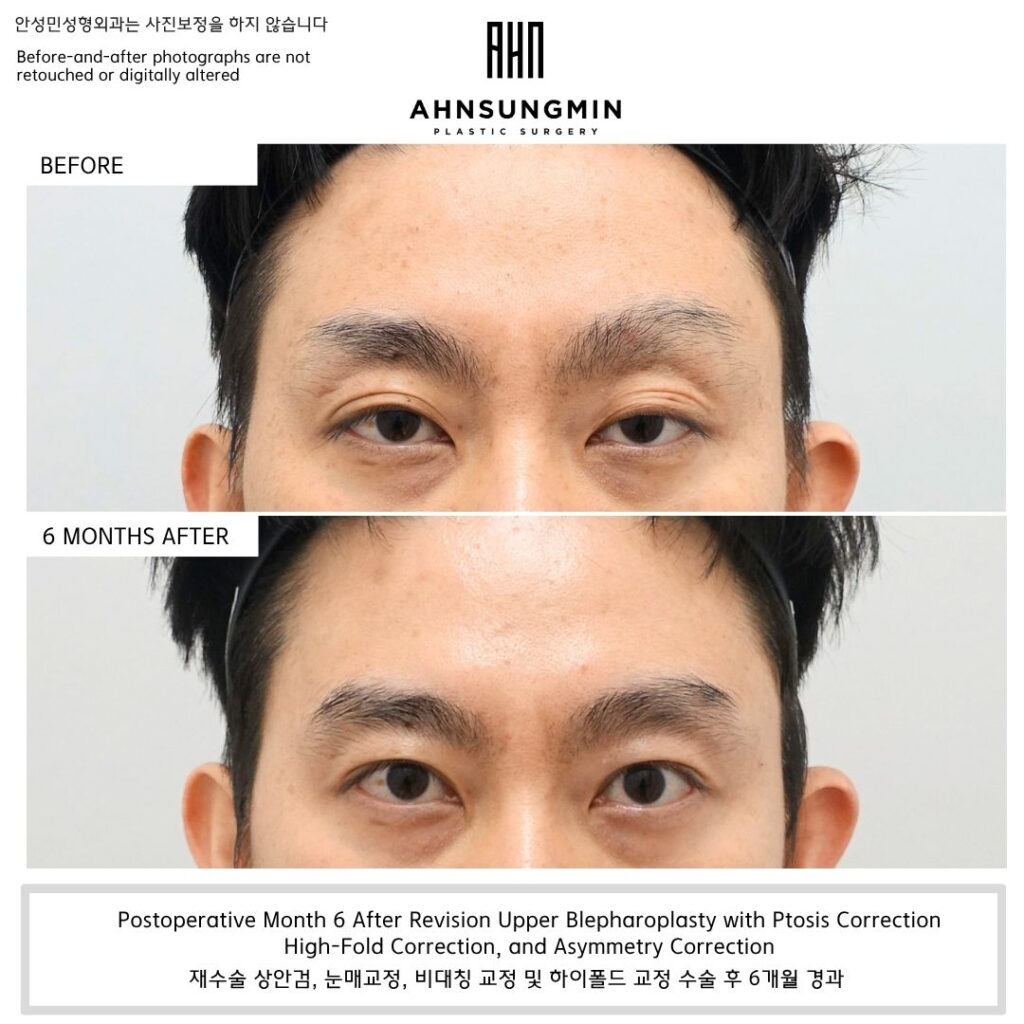
When Aesthetic Preference Overrides Eyelid Function.
Requesting a large, celebrity-like crease in the presence of weak eye-opening function creates long-term problems.
When the eye-opening muscle cannot adequately support the chosen crease height, compensatory forces emerge.
Over time, this can result in thickened folds, heaviness, asymmetry, and ultimately the need for revision surgery.
These outcomes are not failures of technique.
They are failures of judgment.
In some patients, this functional imbalance remains even after previous eyelid surgery, leading to persistent forehead compensation and unclear eye opening. See a revision ptosis surgery case involving residual ptosis and forehead compensation after previous surgery.
Why Natural Eye Opening Matters.
Natural eye opening is not determined by crease height alone.
When eyelid opening function is stable, the eyes often appear clearer and lighter without excessive tension or compensatory muscle use.
However, when eye-opening mechanics are weak, patients frequently rely on forehead compensation to maintain eye opening.
Over time, this imbalance can make the eyelids appear heavier, thicker, and less stable—even when the crease itself initially appeared acceptable.
For this reason, natural eye opening should be prioritized before aggressive crease design.
Double Eyelid Surgery Is Not a Trend.
A double eyelid crease is not a fashion item.
Although aesthetic preferences may change with time, anatomy does not.
Sex, age, eye structure, eye-opening function, and overall facial balance must be considered together.
Ignoring these fundamentals in favor of temporary trends often leads to results that do not age well.
Our Goal.
At Ahnsungmin Plastic Surgery, our goal is not to follow trends or exaggerate features.
We aim to create eyelids that open naturally, remain stable over time, and harmonize with the face as a whole.
Related Insights
→ Why High Fold Correction Requires Functional Balance
→ Why High Folds Tend to Become Thicker Over Time
→ How to Tell If Your High Fold Is Actually Ptosis
→ Ptosis Surgery: Why Patients Raise Their Eyebrows When Ptosis Is Present
→ Revision Ptosis Surgery Case: Correcting Residual Ptosis and Restoring Clearer Eyelid Opening
→ High Fold Revision Surgery Korea
→ Ptosis Correction Surgery Korea
Frequently Asked Questions
Does a higher double eyelid crease make the eyes look bigger?
Not necessarily. A higher crease may create a more defined appearance, but eye size and natural eye opening depend more on eyelid function and structural balance than crease height alone.
Why can high folds become thick or heavy over time?
When the eye-opening muscle cannot adequately support the crease height, compensatory tension may gradually create thickening, heaviness, and instability.
Why is natural eye opening important?
Natural eye opening reflects stable eyelid function and balanced eye-opening mechanics. When function is unstable, even an initially attractive crease may become heavy or unstable over time.
Can forehead compensation affect eyelid appearance?
Yes. Chronic forehead compensation may change eyelid tension patterns and contribute to heaviness, asymmetry, and unstable crease appearance.
Can weak eye-opening function lead to revision surgery?
Yes. When functional imbalance persists beneath a high or exaggerated crease, patients may eventually develop heaviness, asymmetry, or instability that requires revision surgery.
Why is restraint important during primary eyelid surgery?
Once a crease is created too high or aggressively, revision can become significantly more difficult. Conservative and structurally appropriate decisions help preserve long-term stability.
Request a Consultation
If you are concerned about high folds, heavy eyelids, unstable double eyelid creases, forehead compensation, or revision surgery after previous eyelid procedures, you may request a personalized evaluation based on eyelid function, structural balance, and long-term stability.
Seeing the Eye as a Whole, Not in Parts
A Clinic Dedicated to Eyelid Revision Surgery in Korea
Ahnsungmin Plastic Surgery
