Many patients seeking lower eyelid surgery have more than one concern.
Some are bothered by under-eye bulging, hollowing, or excess skin. Others are also concerned about the shape and position of the outer corner of the eye.
When both issues are present, patients often ask whether the procedures can be performed together.
In selected patients, the answer is yes.
This patient underwent lower blepharoplasty with fat repositioning, SMAS fixation, and lateral canthoplasty during the same operation.
Before and After
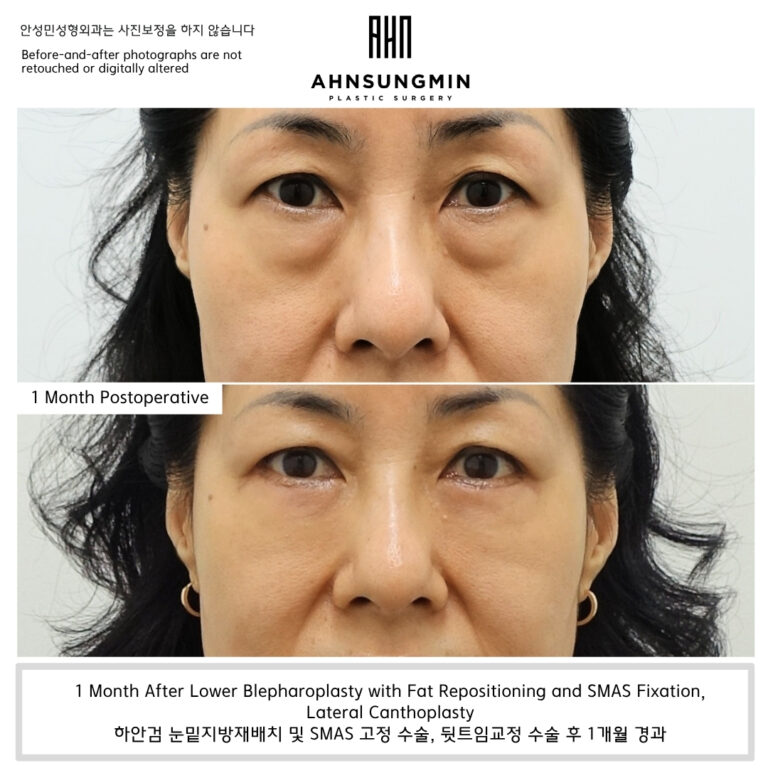
Postoperative Month 1 After Lower Blepharoplasty, Fat Repositioning, SMAS Fixation, and Lateral Canthoplasty
The lower eyelid contour appears smoother following correction of under-eye bulging and volume redistribution. At the same time, lateral canthoplasty was performed to improve the balance of the outer eye contour.
Because the surgical areas are closely related anatomically, both procedures were addressed during a single operation and recovery period.
Why We Combined These Procedures
Lower eyelid surgery and lateral canthoplasty are performed for different reasons.
Lower eyelid surgery focuses on restoring a smoother and more stable under-eye contour.
Lateral canthoplasty focuses on the outer corner of the eye and may help improve eye shape balance and lower eyelid support in selected patients.
In this patient, both concerns were present.
Rather than approaching them separately, a combined surgical plan allowed both areas to be addressed at the same time.
The goal was not simply to make the eyes appear larger.
The goal was to create a more balanced relationship between the lower eyelid and the lateral eye contour while maintaining long-term stability.
A Closer Look at the Lateral Eye Area
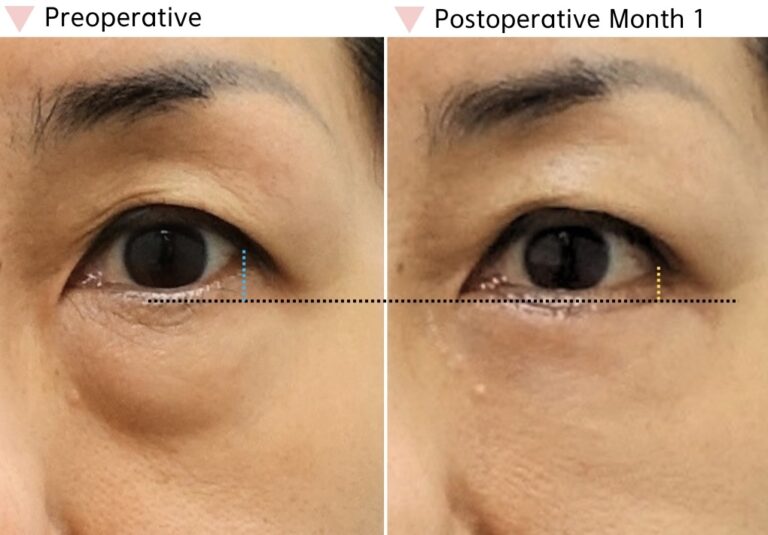
Preoperative and Postoperative Month 1 Comparison of the Lateral Eye Area
The outer corner of the eye demonstrates a more balanced contour following surgery.
Because lower eyelid surgery and lateral canthoplasty involve adjacent anatomical structures, simultaneous correction may be possible when both concerns are present.
This does not mean that every lower eyelid surgery patient requires lateral canthoplasty.
The decision depends entirely on individual anatomy and surgical goals.
One Recovery Period Instead of Two
One advantage of combining procedures is that patients recover from both operations during the same healing period.
Rather than undergoing separate surgeries months apart, selected patients may address related concerns through a single surgical plan.
At one month, recovery is still ongoing.
Residual swelling and tissue remodeling continue beyond the early postoperative period, and the final result should not be judged based solely on the first few weeks of healing.
Surgical Approach
The surgical plan focused on:
- Lower blepharoplasty
- Fat repositioning
- SMAS fixation
- Lateral canthoplasty
- Preservation of lower eyelid support
- Long-term structural stability
The goal was not aggressive correction.
The goal was to improve under-eye contour and lateral eye balance while preserving natural anatomy and recovery.
Postoperative Month 1
Recovery after lower eyelid surgery and lateral canthoplasty continues beyond the first month.
However, even during the early recovery period, improvement in under-eye contour and lateral eye balance can already be appreciated.
Long-term stability remains more important than immediate postoperative appearance.
Insights
Lower eyelid surgery often focuses on restoring smoother contours while preserving long-term support and stability.
Understanding Lower Eyelid Surgery: Structure, Support, and Long-Term Stability
Recovery continues well beyond the first month, and early postoperative photographs should not be considered the final result.
Lower Eyelid Surgery Recovery Timeline: When Results Become Natural
Maintaining healthy volume is often just as important as removing excess tissue.
Why Lower Eyelid Hollowing Happens Over Time
Many patients expect lower eyelid surgery to remove every visible wrinkle. In reality, preserving natural facial expression and healthy tissue is often an important part of achieving long-term stability.
Why Are Some Wrinkles Still Visible After Lower Eyelid Surgery?
Best Lower Blepharoplasty Surgeon in Korea
Learn how to choose the best lower blepharoplasty surgeon in Korea.
