Many patients are surprised when they still notice wrinkles around the eyes after lower eyelid surgery.
They often assume that under-eye surgery removes every line, fold, and crease beneath the eyes.
When small wrinkles remain visible during smiling or facial expression, some patients become concerned that the surgery was incomplete.
In reality, this expectation is one of the most common misunderstandings about lower eyelid surgery.
Lower Eyelid Surgery Is Not Designed to Remove Every Wrinkle
Lower eyelid surgery is primarily intended to address structural aging changes.
These may include:
- Bulging under-eye fat
- Hollowing beneath the eyes
- Excess lower eyelid skin
- Lower eyelid laxity
- Imbalance between volume and support
When these structural issues improve, patients often look less tired and more refreshed.
However, natural facial expression lines and smile-related wrinkles are not always eliminated by surgery.
Some Wrinkles Are Part of Normal Facial Expression
The skin around the eyes is one of the thinnest areas of the face.
Every smile, blink, and facial movement creates natural skin folding.
These dynamic wrinkles are often caused by facial expression rather than excess skin alone.
For this reason, patients may still notice fine wrinkles when smiling even after successful lower eyelid surgery.
The presence of these wrinkles does not necessarily indicate a poor result.
In many cases, it reflects normal facial movement.
Preserving Natural Features Is Often Important
Some patients worry when they see that small wrinkles or natural fullness beneath the eyelid remain after surgery.
However, removing too much skin or aggressively flattening the lower eyelid may create a less natural appearance.
Natural under-eye contours, subtle fullness, and expression lines often contribute to a healthy and balanced look.
The goal is not to remove every feature of aging.
The goal is to improve structural concerns while preserving natural facial expression.
What This Patient Demonstrates
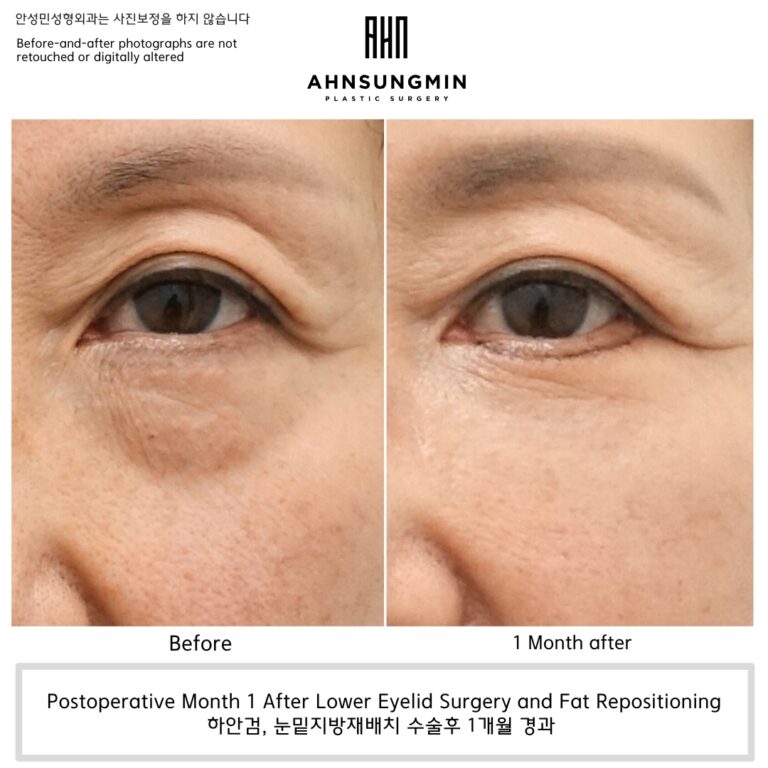
Postoperative Month 1 After Lower Eyelid Surgery and Fat Repositioning
The under-eye contour appears smoother and more balanced after surgery. However, natural smile lines and fine wrinkles around the lower eyelid remain visible.
This is often expected.
Lower eyelid surgery is intended to improve structural aging changes such as bulging fat, hollowing, and excess skin. It is not designed to eliminate every natural facial expression line.
The preservation of natural under-eye fullness and expression often contributes to a more balanced long-term result.
Improvement and Perfection Are Different Goals
One of the most important concepts in lower eyelid surgery is the difference between improvement and perfection.
Patients often notice meaningful improvement in under-eye contour, shadowing, and tired appearance.
At the same time, some wrinkles may remain.
This does not necessarily mean that the surgery was unsuccessful.
In many situations, preserving natural anatomy creates a more stable and natural-looking result than attempting to eliminate every visible line.
Recovery Also Continues Beyond the First Month
Patients should also remember that recovery is still ongoing at one month.
Residual swelling, tissue remodeling, and scar maturation continue for several months after surgery.
The lower eyelid often continues to soften and settle long after the early recovery period.
For this reason, early photographs should not be viewed as the final result.
Frequently Asked Questions
1. Why do I still have wrinkles after lower eyelid surgery?
Lower eyelid surgery improves structural aging changes such as bulging fat, hollowing, and excess skin. Fine expression lines may still remain because they are often related to natural facial movement.
2. Can lower eyelid surgery remove all under-eye wrinkles?
No. Surgery can improve certain wrinkles caused by excess skin or structural aging, but natural expression lines may still remain.
3. Is it normal to see wrinkles when smiling after surgery?
Yes. Dynamic wrinkles caused by smiling and facial expression often remain visible even after successful lower eyelid surgery.
4. Why didn’t my surgeon remove more skin?
Overly aggressive skin removal may increase the risk of lower eyelid retraction, unnatural tightness, and long-term complications. Preserving adequate skin is important for safety and stability.
5. Will my results continue to improve after one month?
Yes. Healing and tissue softening often continue for several months after surgery, and the lower eyelid may continue to improve as recovery progresses.
Insights
Many patients assume that removing more tissue automatically creates a better result. In reality, preserving healthy volume is often essential for maintaining natural under-eye contours.
Why Fat Preservation Matters in Lower Eyelid Surgery
Overly aggressive skin removal may increase the risk of lower eyelid retraction over time.
Why Lower Eyelid Retraction Often Appears Months After Surgery
Long-term stability often depends on preserving support structures rather than attempting to remove every visible wrinkle.
Understanding Lower Eyelid Surgery: Structure, Support, and Long-Term Stability
Recovery continues well beyond the first month, and early postoperative photographs should not be considered the final result.
Lower Eyelid Surgery Recovery Timeline: When Results Become Natural
Best Lower Blepharoplasty Surgeon in Korea
Learn how to choose the best lower blepharoplasty surgeon in Korea.
Request a Lower Eyelid Evaluation
Many patients expect lower eyelid surgery to eliminate every wrinkle around the eyes. In reality, successful surgery often involves improving structural aging changes while preserving natural expression and long-term eyelid stability.
If you are considering lower eyelid surgery or have questions about your recovery, a personalized evaluation may help determine which concerns can realistically be improved and which natural features should be preserved.
Seeing the Eye as a Whole, Not in Parts
A Clinic Dedicated to Eyelid Revision Surgery in Korea
Ahnsungmin Plastic Surgery
