Before and After.
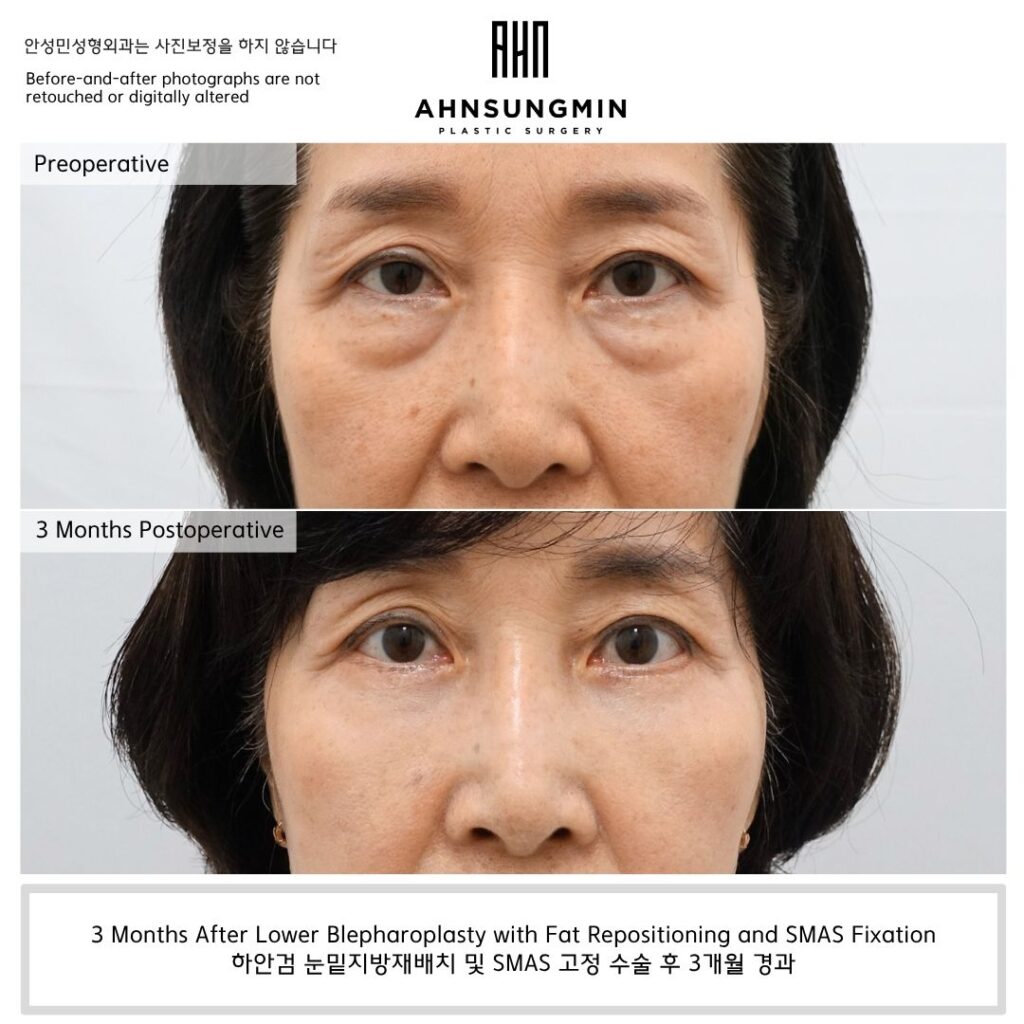
At 3 months after lower blepharoplasty in Korea with fat repositioning and SMAS fixation, most of the major swelling had improved significantly.
The lower eyelid contour appeared smoother and more continuous beneath the eyes while maintaining natural lower eyelid volume without excessive hollowing.
Rather than creating an aggressively flattened appearance, the goal of surgery was to preserve balanced lower eyelid support and achieve gradual softening over time.
This case also demonstrates how recovery after lower eyelid surgery continues progressively over several months.
Although the visible swelling had already improved substantially by 3 months, subtle tissue remodeling and contour stabilization were still continuing beneath the surface.
Recovery Timeline Progression.
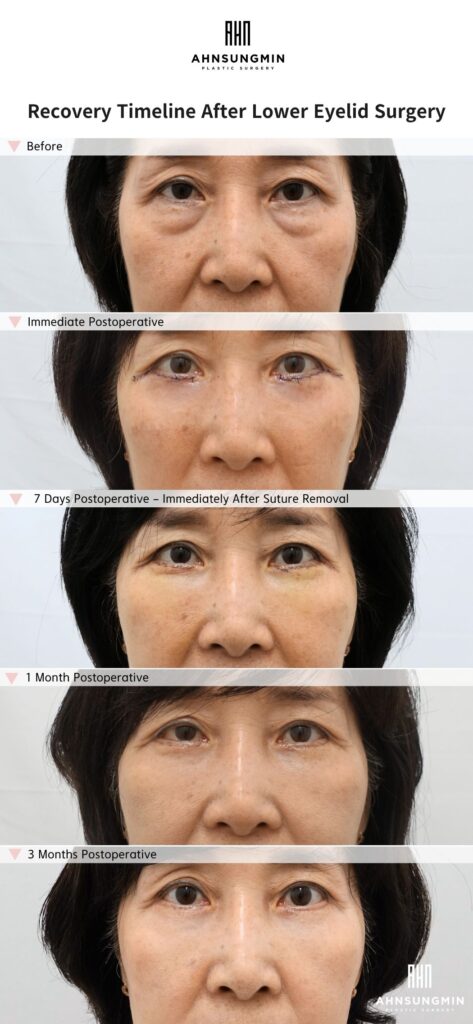
Immediately after surgery, temporary swelling and tissue tightness were visible around the lower eyelids, which is a normal part of the early healing phase.
By 7 days after surgery, most major bruising had already improved after suture removal, although mild swelling and stiffness remained.
At 1 month postoperative, the lower eyelid contour became softer and more natural as swelling continued to decrease gradually.
By 3 months postoperative, the under-eye area appeared smoother and more balanced while preserving natural lower eyelid fullness and facial expression.
Recovery after lower blepharoplasty continues gradually over time, and the final long-term contour often develops progressively over several additional months.
To better understand long-term healing after lower eyelid surgery, review our related article:
Lower Eyelid Surgery Recovery Timeline in Korea
Surgical Approach.
In this case, surgery focused not only on reducing lower eyelid bulging, but also on preserving natural volume transition and structural support beneath the eyes.
Fat repositioning and SMAS fixation were performed conservatively to avoid excessive hollowing or an overly aggressive appearance during recovery.
Long-term stability and natural facial balance were prioritized throughout the surgical planning process.
Related Insights.
Revision Lower Blepharoplasty in Korea
The Importance of Preserving the Aegyo-Sal in Lower Blepharoplasty
Best Lower Blepharoplasty Surgeon in Korea
Learn how to choose the best lower blepharoplasty surgeon in Korea.
Lower Eyelid Surgery Recovery FAQ.
How long does swelling last after lower eyelid surgery?
Major swelling usually improves significantly within the first several weeks after surgery, but subtle tissue swelling and contour stabilization may continue gradually for several months.
Is 3 months considered full recovery after lower blepharoplasty?
Although most visible swelling has improved by 3 months, deeper tissue remodeling, scar softening, and lower eyelid stabilization often continue beneath the surface for additional months.
Why was fat repositioning performed instead of aggressive fat removal?
Excessive fat removal may increase the risk of hollowing, sharp contour transition, stiffness, and accelerated aging appearance over time. Fat repositioning helps preserve smoother lower eyelid volume balance.
What is the purpose of SMAS fixation in lower eyelid surgery?
SMAS fixation helps support lower eyelid stability and improves structural balance during healing, which may contribute to smoother long-term contour transition beneath the eyes.
When do lower eyelid surgery results begin to look natural?
Most patients begin to notice a softer and more natural lower eyelid appearance gradually over the first several months as swelling improves and tissue stabilization progresses.
Request a Lower Eyelid Surgery Evaluation.
Lower eyelid surgery requires careful structural planning rather than aggressive fat removal alone.
Natural lower eyelid balance depends on volume preservation, tissue support, skin flexibility, and long-term contour stability.
At AHNSUNGMIN Plastic Surgery, lower blepharoplasty is performed with a focus on natural recovery, smooth lower eyelid transition, and long-term structural balance rather than excessive correction.
If you are considering lower eyelid surgery in Korea, you may request a personalized evaluation based on your current lower eyelid condition, skin quality, facial balance, and long-term recovery goals.
