Before and After
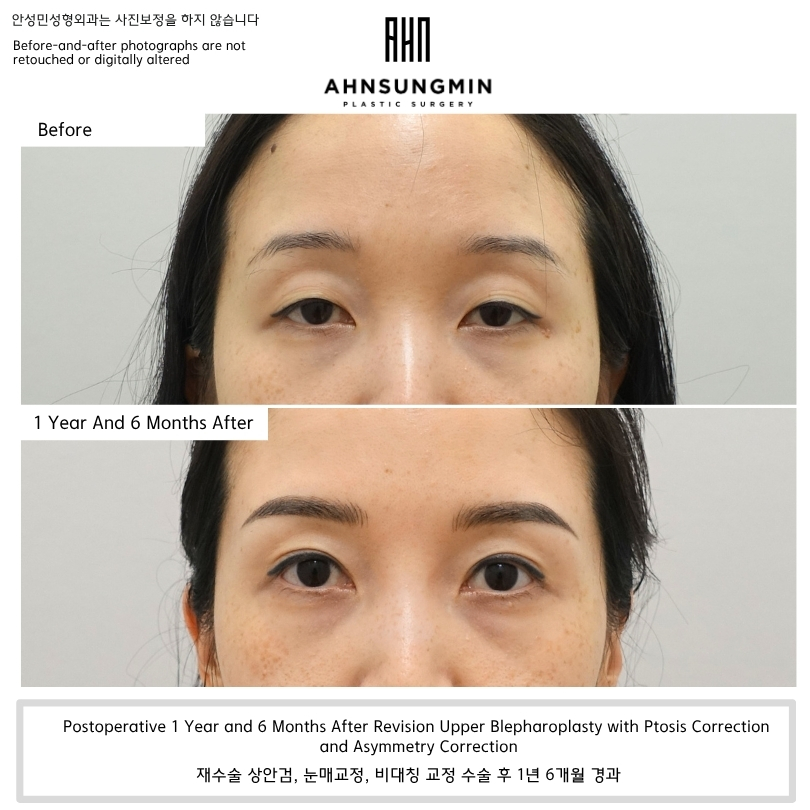
This patient presented after previous upper eyelid surgery with persistent heaviness, unclear eye opening, and an unstable double eyelid crease that had gradually loosened over time.
Although surgery had already been performed, the patient continued to rely heavily on forehead compensation in order to open the eyes.
The underlying imbalance in eyelid opening function had not been fully corrected.
As a result, the eyelids appeared tired and unclear, and the upper eyelid gradually lost structural stability as compensatory forces repeatedly affected the upper eyelid tissues.
At 1 year and 6 months after revision surgery, the patient is able to open the eyes more clearly without excessive forehead use, while maintaining a more stable and naturally balanced upper eyelid appearance.
Why the Eyelids Still Appeared Heavy After Previous Surgery
In some patients, the issue is not simply the crease itself.
When residual ptosis remains after surgery, patients continue using the forehead muscles to compensate for insufficient eye-opening strength.
Over time, this repeated compensation can create a heavy, tired, and unstable eyelid appearance.
The problem is not only aesthetic.
It is functional.
Why the Double Eyelid Crease Became Unstable
When eye-opening mechanics remain weak, repeated tension affects the upper eyelid with every blink and eye-opening movement.
Over time, the double eyelid crease may gradually loosen, become asymmetrical, or lose definition.
In these cases, simply recreating the crease without correcting function often fails to produce stable long-term improvement.
Why Ptosis Correction Was Necessary
In this case, the priority was not creating a deeper or more dramatic fold.
The focus was restoring stable eyelid opening mechanics by correcting the remaining ptosis.
Once the eyes could open more naturally without excessive forehead compensation, the upper eyelid appearance itself became lighter and more stable.
Once eyelid opening function stabilized, the overall upper eyelid balance was able to recover more naturally.
Functional Stability Changes the Entire Eye Impression
Many patients believe that unclear or heavy-looking eyes are caused only by the crease design.
However, in revision cases, the true issue is often persistent functional imbalance beneath the surface.
When eyelid opening stabilizes appropriately, the eyes often appear clearer, lighter, and more naturally defined without aggressive fold enlargement.
Surgical Approach
Revision upper blepharoplasty was performed together with ptosis correction and structural balancing of the upper eyelids.
Rather than focusing only on the crease itself, the surgery prioritized restoring stable eye opening, reducing forehead compensation, and improving long-term functional balance.
At 1 year and 6 months after surgery, the patient demonstrates clearer eye opening with less forehead dependence and a more stable and naturally balanced upper eyelid appearance.
Related Insights
→ Why Do My Eyes Still Feel Heavy After Double Eyelid Surgery.
→ Why Natural Eye Opening Matters More Than Crease Design.
→ Why We Focused on Functional Eyelid Opening Rather Than Making the Eyes Bigger.
→ Ptosis Correction Focused on Function, Not Size.
→ Ptosis Surgery Recovery Timeline: What to Expect From Day 1 to Month 3.
→ Best Eyelid Revision Surgery in Korea
Frequently Asked Questions
Why can the eyes still look heavy after previous eyelid surgery?
In some patients, residual ptosis remains after surgery. When eye-opening strength is still insufficient, compensatory forehead muscle use may continue, making the eyes appear heavy or tired.
Why can a double eyelid crease loosen over time?
If eyelid opening mechanics remain unstable, repeated tension during blinking and eye opening can gradually affect the crease structure and stability.
Why was ptosis correction necessary in this revision case?
The underlying ptosis had not been fully corrected previously. Improving eye-opening function was necessary to reduce forehead compensation and stabilize the upper eyelid appearance.
Can forehead compensation affect eyelid appearance?
Yes. Chronic forehead compensation may change eyelid tension patterns and contribute to heaviness, asymmetry, or unstable crease appearance over time.
What determines long-term stability after revision ptosis surgery?
Long-term stability depends not only on crease design, but on restoring balanced eyelid opening mechanics, reducing compensatory tension, and maintaining structural support.
Request a Revision Ptosis Evaluation
If you continue to experience heavy eyelids, unclear eye opening, forehead compensation, or unstable double eyelid folds after previous surgery, you may request a personalized evaluation based on eyelid function, residual ptosis, and long-term structural stability.
Seeing the Eye as a Whole, Not in Parts
A Clinic Dedicated to Eyelid Revision Surgery in Korea
Ahnsungmin Plastic Surgery
