Lower Eyelid Surgery Is Not About Erasing Volume.
Many patients believe that successful lower blepharoplasty should remove as much fullness beneath the eyes as possible.
In reality, that approach often produces the opposite of a natural result.
Aging does not simply create excess fat. It changes structural support, muscle balance, skin quality, and the relationship between the lower eyelid and the cheek.
Successful lower blepharoplasty is not about removing more tissue.
It is about knowing what should remain.
A youthful lower eyelid is not completely flat. It contains subtle contours that allow the eyes to look natural, relaxed, and expressive. One of those contours is the natural fullness beneath the eyelashes, commonly known in Korea as the aegyo-sal.
Removing an under-eye bag should not mean removing this natural anatomy.
Why Aegyo-Sal Should Not Be Removed.
The aegyo-sal is not simply excess tissue.
It contributes to the natural transition between the lower eyelid and the cheek while helping preserve facial expression and balance.
When it is removed aggressively, the lower eyelid may initially appear smooth. Over time, however, the eyes can begin to look flatter, less expressive, or older than intended.
Once this natural contour has been lost, recreating it is often far more difficult than preserving it during the original operation.
Preserving the aegyo-sal does not mean making it larger.
It means recognizing when a natural structure should be respected rather than removed.
Clinical Example
Postoperative Day 42 After Lower Blepharoplasty with Fat Repositioning and SMAS Suspension
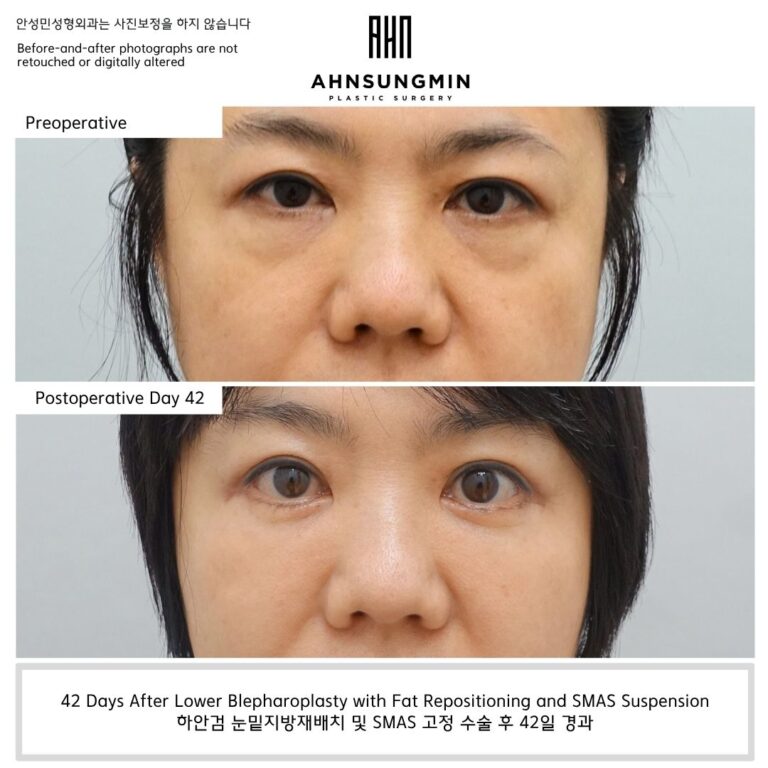
Before-and-after comparison three months after lower blepharoplasty with fat repositioning and SMAS suspension.
The under-eye bags have been reduced while preserving the patient’s natural aegyo-sal and lower eyelid contour. Rather than creating a completely flat appearance, the surgery restored a smoother transition between the lower eyelid and the cheek while maintaining natural volume and structural support.
What Changed After Surgery.
Instead of removing more fat, the existing orbital fat was carefully repositioned to improve the contour beneath the eyes.
Supportive structures were reinforced rather than sacrificed.
At postoperative day 42, healing is still progressing. Even at this stage, the lower eyelid appears smoother while preserving the natural aegyo-sal and maintaining a balanced transition between the lower eyelid and the cheek.
Rather than creating a completely flat appearance, the surgery preserved the natural contours that contribute to a youthful and expressive lower eyelid.
The objective was never to create a dramatic change.
It was to restore balance while preserving the anatomy that naturally belongs to the patient.
As healing continues, the contour is expected to become even more refined while maintaining long-term structural stability.
Long-Term Stability Matters More Than Immediate Smoothness.
Many patients judge lower eyelid surgery by how smooth the area appears immediately after surgery.
I believe the better question is how natural it will continue to look years later.
A lower eyelid that has been aggressively flattened may initially appear satisfactory, but as aging continues, hollowing and structural imbalance often become more noticeable.
Healthy tissue should be preserved whenever possible.
Fat should be repositioned when it can improve contour.
Support should be restored when the lower eyelid requires additional stability.
Successful lower blepharoplasty is not measured by how flat the lower eyelid becomes.
It is measured by whether the eyes still look like they belong to the patient.
Natural anatomy should remain recognizable after surgery.
That is why preserving the aegyo-sal is often just as important as reducing the under-eye bags themselves.
Concerned About Your Lower Eyelids?
Every lower blepharoplasty should be tailored to your anatomy. A personalized evaluation can help determine whether tissue preservation, fat repositioning, or another approach is most appropriate for achieving natural, long-term results.
Request a Lower Blepharoplasty Evaluation
Online consultation available for international patients.
Seeing the Eye as a Whole, Not in Parts
A Clinic Dedicated to Eyelid Revision Surgery in Korea
Ahnsungmin Plastic Surgery
