The Expectation of Symmetry Is Often Misunderstood.
Many patients come to consultation hoping that both lower eyelids will look exactly the same after surgery.
However, the human face is not built on perfect symmetry. Differences in muscle strength, fat distribution, and skeletal support exist on both sides, even in patients who appear balanced at first glance.
Lower eyelid surgery is not about forcing identical shapes.
It is about restoring structural balance while respecting natural asymmetry.
Not All Wrinkles Reflect the Same Cause.
Patients often assume that wrinkles under both eyes should be corrected equally.
In reality, the movement of the smiling muscles can differ from one side to the other. One side may pull more strongly, creating deeper folds that are not purely related to skin laxity.
Trying to “iron out” every wrinkle may ignore the functional differences of the muscles.
When muscle dynamics are not respected, the result can look tight on one side and unnatural on the other.
Structural Support Matters More Than Visual Matching.
When surgeons attempt to match both sides visually without understanding the underlying structure, excessive skin removal or overcorrection may occur.
This can increase downward tension and raise the risk of lower eyelid eversion or instability over time.
Aggressively pursuing perfect symmetry may also increase the risk of excessive tension, lower eyelid retraction, and long-term structural instability after surgery.
For this reason, successful lower eyelid surgery focuses on balanced movement and structural harmony rather than identical appearance alone.
Our goal is not mirror-like symmetry, but long-term stability.
Why Balanced Movement Is More Important Than Equal Lines.
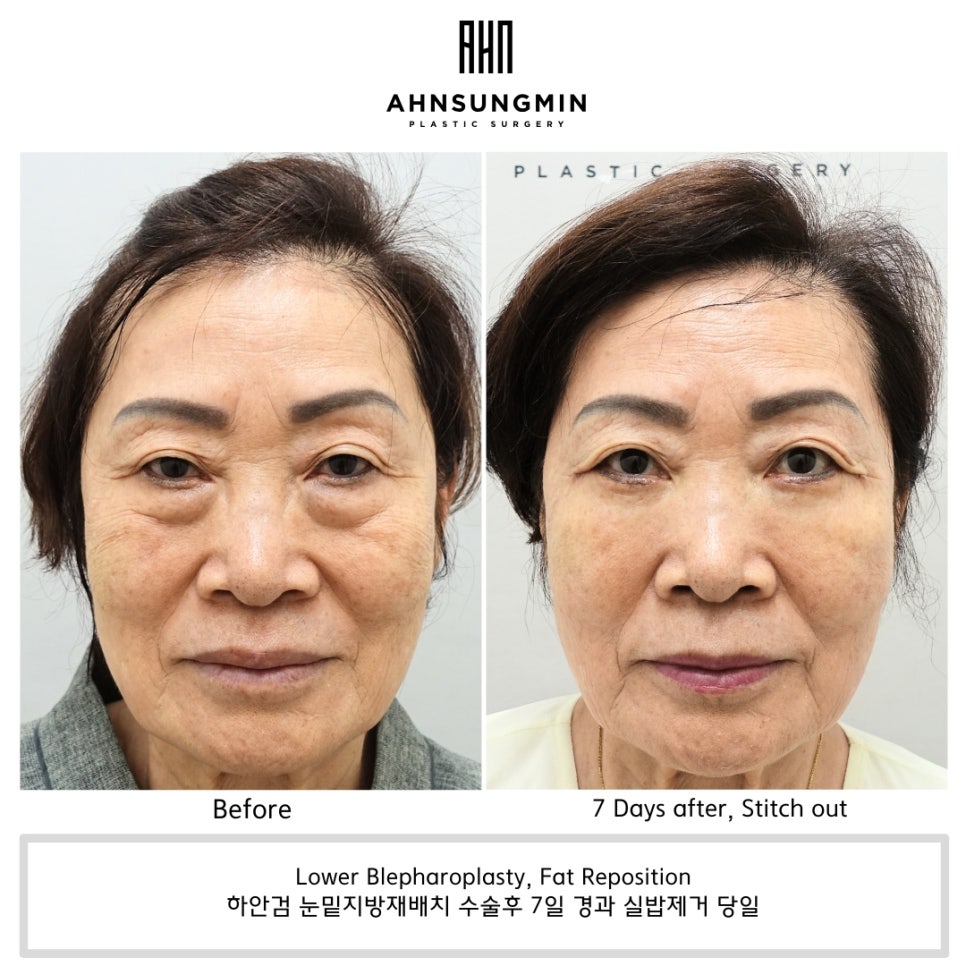
A natural lower eyelid should move harmoniously with facial expression.
If one side naturally smiles higher or has stronger muscle activity, forcing both sides to appear identical at rest may compromise how the eyes look during movement.
Balance does not mean sameness.
It means allowing each side to function within its own anatomical limits while maintaining overall harmony.
How We Approach Asymmetry at Ahnsungmin Plastic Surgery.
At Ahnsungmin Plastic Surgery, we evaluate:
- Differences in muscle activity between both sides
- Variations in fat position and support
- Skin elasticity and vertical eyelid length
- The direction of tension during smiling and blinking
Surgical planning follows structure—not symmetry alone.
Many patients concerned about asymmetry after surgery are actually experiencing natural differences in muscle activity, tissue healing, and facial movement rather than true surgical imbalance.
See our Lower Eyelid Surgery Recovery Timeline to understand how lower eyelid appearance continues to change during healing and stabilization.
Related Insight:
Why Lower Eyelid Surgery Ages Better When Tissue Is Preserved
LOWER BLEPHAROPLASTY SPECIALIST
Frequently Asked Questions About Lower Blepharoplasty Recovery
Can wrinkles remain after lower eyelid surgery?
Yes. Some fine wrinkles may remain intentionally to preserve natural lower eyelid movement and reduce the risk of excessive tension or eyelid retraction.
How long does swelling last after lower blepharoplasty?
Major swelling usually improves during the first few weeks, but subtle tissue stabilization and contour refinement may continue for several months.
Why is tissue preservation important in lower eyelid surgery?
Preserving skin and structural support helps maintain natural eyelid function, reduces tension, and improves long-term lower eyelid stability.
What is fat repositioning in lower eyelid surgery?
Fat repositioning redistributes existing under-eye fat to smooth hollow areas and improve contour without excessive fat removal.
Request a Lower Eyelid Evaluation
If one lower eyelid appears different from the other after surgery, the issue may not always reflect true asymmetry or surgical failure.
At Ahnsungmin Plastic Surgery, lower eyelid evaluation focuses on muscle activity, tissue support, structural balance, and long-term eyelid stability rather than visual symmetry alone.
Seeing the Eye as a Whole, Not in Parts
A Clinic Dedicated to Eyelid Revision Surgery in Korea
Ahnsungmin Plastic Surgery
