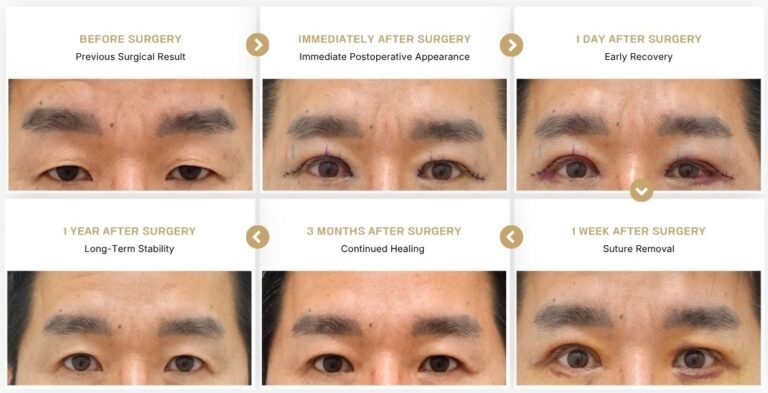
One Eye Looking Smaller After Ptosis Surgery Is a Common Concern
One of the most common concerns during ptosis surgery recovery is the feeling that one eye looks smaller than the other.
Patients often assume that this means the surgery was uneven or that the correction was unsuccessful.
In many cases, however, one eye looking smaller after ptosis surgery does not reflect the final result. It reflects the recovery process.
This difference is often temporary and must be understood in the context of swelling, muscle adaptation, and structural stabilization over time.
Swelling Does Not Resolve at the Same Speed on Both Sides
After ptosis surgery, swelling rarely decreases symmetrically.
One eyelid may retain more swelling, while the other side begins to settle earlier. When this happens, one eye may appear smaller even if the underlying correction was performed appropriately.
This is one of the reasons patients misinterpret early recovery.
During the ptosis surgery recovery period, appearance can shift from day to day. What looks imbalanced in the first few weeks may improve significantly as the tissue stabilizes.
Muscle Adaptation Also Affects Perceived Eye Size
Ptosis correction changes the function of the levator muscle, but both sides do not always adapt at the same speed.
Even when surgical adjustment is balanced, one side may begin to open more naturally earlier, while the other remains tighter or slower to respond.
This creates the impression that one eye is smaller after ptosis surgery.
What patients often perceive as asymmetry is not always a difference in the correction itself. It may be a difference in recovery speed.
The Crease and the Eye Opening Are Perceived Together
Patients do not judge eye size by opening alone.
They also interpret crease height, crease depth, and upper eyelid contour together.
If one crease appears deeper or higher, that side may look larger. If the other side appears swollen, heavier, or less defined, it may seem smaller.
This is why ptosis surgery asymmetry must be evaluated carefully. Visual imbalance is not always the same as structural imbalance.
Early Judgments Often Lead to Unnecessary Concern
One of the most common mistakes after ptosis surgery is making conclusions too early.
If one eye looks smaller during the early recovery period, patients may immediately think something has gone wrong.
But in many cases, observation is more appropriate than intervention.
As swelling decreases and the eyelid structure stabilizes, the difference often becomes less noticeable. This is why ptosis surgery results should not be judged in the first phase of recovery.
When the Difference Should Be Evaluated More Carefully
Not every difference is temporary.
If one eye continues to look smaller beyond the expected recovery timeline, or if the asymmetry becomes more pronounced over time, a more careful structural evaluation is necessary.
Possible causes may include pre-existing asymmetry, different muscle response, scar formation, or differences in tissue healing.
The key point is that this judgment should be made after stabilization, not during the early healing phase.
Internal References
→ Understand what to expect during ptosis surgery recovery
→ Read why ptosis surgery results should not be judged too early
→ Learn why perfect symmetry is not always possible in ptosis correction
→ See why uneven eyes after ptosis surgery are often part of recovery
→ Best Male Eyelid Surgeon in Korea
FAQ
Is it normal for one eye to look smaller after ptosis surgery?
Yes. During the early recovery period, one eye may appear smaller because swelling, muscle adaptation, and tissue healing rarely occur at the same rate on both sides. In many cases, this difference improves gradually as recovery progresses.
How long does it take for uneven eyes to improve after ptosis surgery?
Recovery varies from patient to patient, but eyelid symmetry often continues to improve over several weeks to several months. Final results should generally be evaluated only after the eyelids have stabilized rather than during the early postoperative period.
When should I be concerned if one eye still looks smaller after ptosis surgery?
If one eye continues to appear noticeably smaller after the expected recovery period, or if the difference becomes more pronounced over time, a thorough evaluation by your surgeon is recommended. Persistent asymmetry may be related to pre-existing differences, muscle response, scar formation, or other structural factors.
Surgical Approach
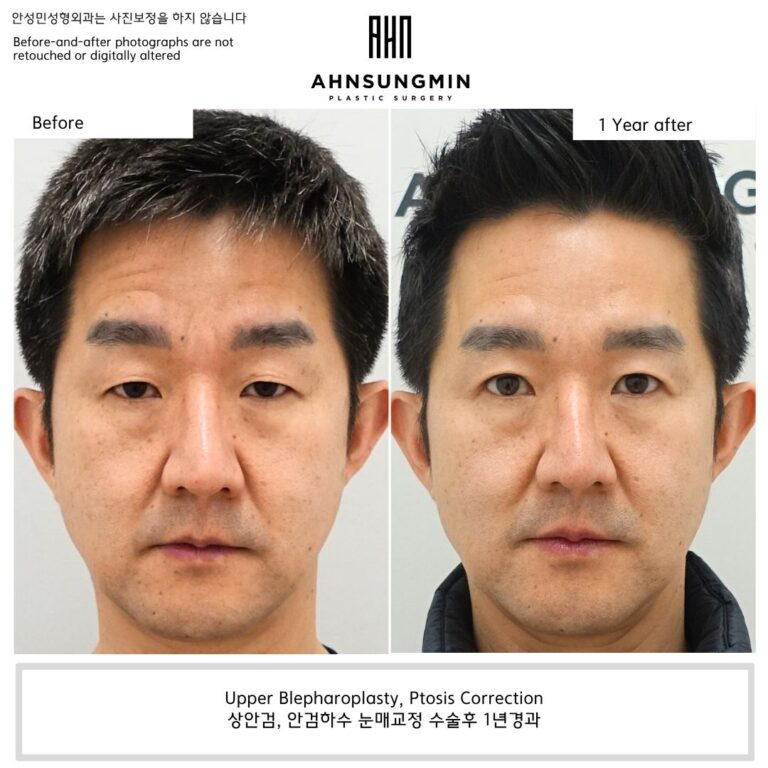
Ptosis surgery should be evaluated over time, not by early appearance alone. When one eye looks smaller after ptosis surgery, the question is not whether the eyes look identical immediately, but whether the eyelids are stabilizing in a balanced and sustainable way.
Seeing the Eye as a Whole, Not in Parts
A Clinic Dedicated to Eyelid Revision Surgery in Korea
Ahnsungmin Plastic Surgery
Request a Consultation for Ptosis Surgery Evaluation
