Early Results Are Not Final Results.
Many patients look in the mirror shortly after lower eyelid surgery and immediately try to judge the result.
This reaction is understandable. The swelling has started to settle, the sutures have been removed, and the patient expects to see the final contour.
But the lower eyelid does not heal that quickly.
At this stage, what patients see is not the final result. It is simply an early stage of recovery.
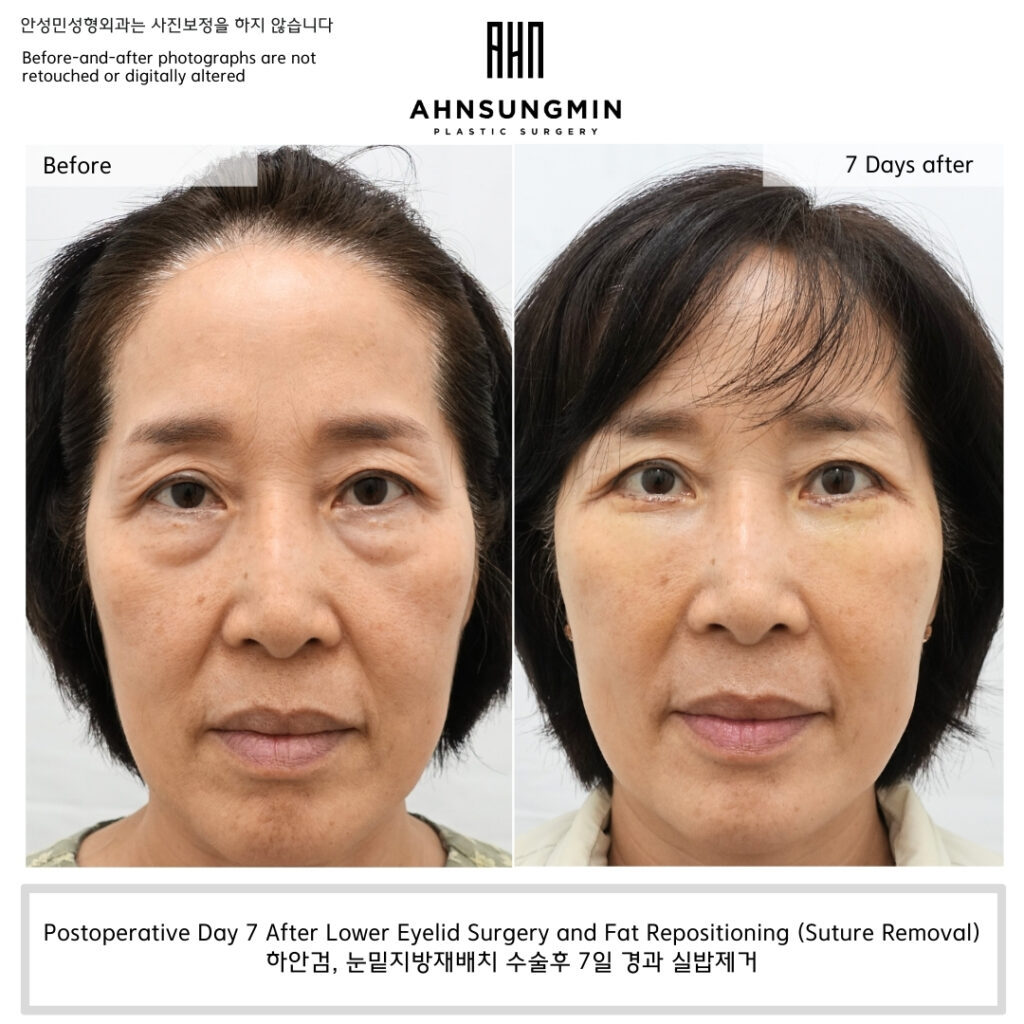
Before-and-after photographs are not retouched or digitally altered.
Swelling Changes the Shape of the Lower Eyelid.
Even when the surgery is technically successful, the lower eyelid may still appear uneven or slightly swollen in the early postoperative period.
This happens for several reasons.
First, the surgical area still contains postoperative swelling.
Second, the repositioned fat has not fully stabilized in its new location.
Third, the surrounding tissues are still adjusting to the structural changes.
Because of this, the contour seen at one week often looks different from the contour seen several months later. This is one reason why some lower eyelid changes become more visible over time.
Fat Repositioning Requires Time to Settle.
Lower eyelid fat repositioning is not simply a removal procedure.
It is a structural adjustment.
Fat that previously protruded forward is repositioned to smooth the transition between the lower eyelid and the cheek.
After surgery, the repositioned fat needs time to stabilize and integrate with the surrounding tissue.
During the early recovery period, mild irregularity or swelling can temporarily exaggerate the appearance of fullness.
This does not mean the surgery failed.
It simply means healing is still in progress. In many patients, lower eyelid recovery continues for several months after surgery.
Early Anxiety Is Common — But Often Unnecessary.
Many patients worry at this stage.
They may feel that the bulging has not improved enough or that the contour still looks unfamiliar.
But lower eyelid surgery is a procedure where patience is part of the treatment.
Real structural improvement appears gradually as swelling resolves and the tissues soften.
Judging the result too early can create unnecessary concern. In some patients, lower eyelid hollowing or contour changes become more noticeable later during healing.
Healing Is Part of the Surgical Process.
Lower eyelid surgery should not be evaluated in the first week.
Healing continues for months.
The contour becomes smoother as swelling subsides and the repositioned fat settles into its new structural position.
Understanding this timeline is important.
Because in lower eyelid surgery, the early appearance is rarely the final result.
Learn more about our approach to revision eyelid surgery in Korea.
Frequently Asked Questions
1. Is it normal for the lower eyelid to look swollen after surgery?
Yes. Swelling is a normal part of lower eyelid recovery and can temporarily affect the contour and shape of the eyelid during the early healing period.
2. Why can lower eyelid surgery results look different several months later?
Lower eyelid results may change over time as swelling decreases, scar tissue matures, and repositioned fat gradually stabilizes within the surrounding tissues.
3. Does uneven swelling mean lower eyelid surgery failed?
No. Mild asymmetry, irregularity, or swelling may appear temporarily during recovery even after technically successful surgery.
4. How long does lower eyelid fat repositioning take to settle?
Fat repositioning often continues to stabilize for several months after surgery as the tissues soften and healing progresses.
5. When should lower eyelid surgery results be evaluated?
Lower eyelid surgery results are usually evaluated several months after surgery rather than during the first few weeks of recovery.
Request a Lower Eyelid Recovery Evaluation
Early lower eyelid recovery can sometimes appear uneven or unfamiliar while swelling decreases and repositioned tissues gradually stabilize.
If you are concerned about prolonged swelling, persistent fullness, contour irregularity, asymmetry, or delayed healing after lower eyelid surgery, a detailed evaluation may help determine the current condition of the eyelid and supporting structures.
At Ahnsungmin Plastic Surgery, evaluation focuses on structural balance, tissue support, recovery progression, and long-term stability rather than aggressive early correction alone.
Request a Lower Eyelid Evaluation
Seeing the Eye as a Whole, Not in Parts
A Clinic Dedicated to Eyelid Revision Surgery in Korea
Ahnsungmin Plastic Surgery
