A Good Appearance Does Not Always Mean a Good Result
After ptosis correction, the eyelid may appear well elevated and symmetrical.
At first glance, the result can seem successful.
However, appearance alone does not define the quality of the outcome.
A result that looks good initially is not always a result that will remain stable.
Early Results Do Not Reflect Long-Term Behavior
n the early postoperative period, swelling and tissue tension can temporarily enhance the appearance.
The eyelid may appear higher, more defined, and more symmetrical than it will be over time.
As healing progresses, these temporary effects diminish,
and the true behavior of the eyelid becomes evident over time in ptosis correction.
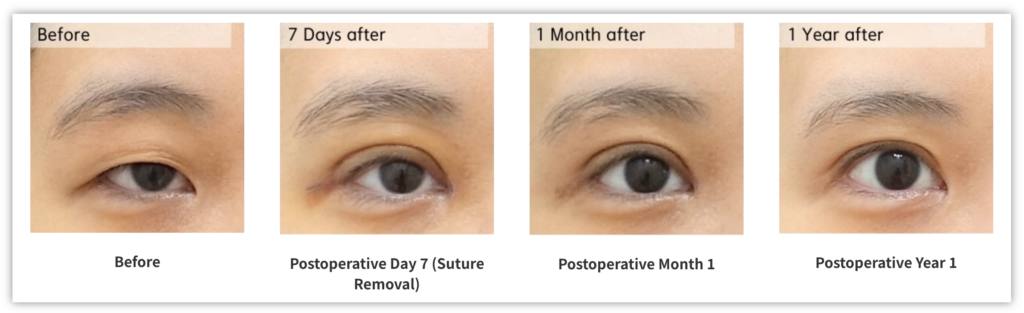
- Before
- Postoperative Day 7 (Suture Removal)
- Postoperative Month 1
- Postoperative Year 1
Tension Creates the Illusion of a Better Result
Excessive elevation or tightness can make the eyelid appear more open.
However, this is often the result of increased tension rather than functional balance.
Over time, tension can lead to:
• Instability
• Asymmetry
• Discomfort
• Gradual descent
What initially appears as a strong correction may not be sustainable over time in ptosis correction.
Stability Depends on Structural Balance
A stable result is not defined by how high the eyelid is,
but by how well the structures maintain balance during movement.
Muscle function, skin condition, and tissue support must work together.
Without this coordination, the result may degrade over time.
Overcorrection Does Not Improve Longevity
Attempting to achieve a more dramatic result does not improve long-term stability.
In many cases, overcorrection increases the risk of:
• Incomplete closure
• Irregular blinking
• Chronic irritation
• Early recurrence
A restrained correction often produces a more reliable outcome.
The Evaluation Must Extend Beyond the Mirror
A result should not be judged solely by how it looks in a static position.
We evaluate:
• Movement during blinking
• Consistency throughout the day
• Symmetry in dynamic function
• Long-term positional stability
A result that performs well over time is more important than one that appears impressive at a single moment.
The Goal Is a Result That Lasts
In ptosis correction, the objective is not to create the most noticeable change.
It is to create a result that remains stable over time.
A less dramatic but stable outcome is often the better result.
The Decision Is Based on Durability, Not Impact
The quality of ptosis correction is determined not by initial impact,
but by durability.
A result that maintains function and balance is ultimately more successful than one that appears ideal but cannot be sustained.
Our approach to ptosis correction is based on structure, function, and long-term stability. Learn more at Ahnsungmin Plastic Surgery.
👉 Ptosis Correction
the Eye as a Whole, Not in Parts
A Clinic Dedicated to Eyelid Revision Surgery in Korea
Ahnsungmin Plastic Surgery
