Lower eyelid aging is not caused by excess fat.
Many patients believe eye bags develop because there is simply “too much fat” beneath the eyes.
It seems reasonable to assume that removing the fat will solve the problem permanently.
However, aging rarely creates excess fat.
Instead, the ligaments, muscles, and connective tissues that support the lower eyelid gradually weaken. As structural support declines, the existing orbital fat begins to protrude forward.
The visible bulge is often a symptom of weakened support—not excessive volume.
Removing fat without restoring support may flatten the lower eyelid temporarily, but it does not correct the underlying cause.
Fat removal changes the structure—not the aging process.
Fat is not simply unwanted tissue.
It helps maintain the contour, support, and long-term stability of the lower eyelid.
When excessive fat is removed, the eyelid initially appears smoother. Over time, however, the remaining tissues continue to age while structural support has already been reduced.
The result may include:
- Hollowing beneath the eyes
- Contour irregularities
- Recurrent lower eyelid bulging
- Progressive lower eyelid instability
Aging continues.
The structure simply has less support to resist it.
Clinical Example
Revision Lower Blepharoplasty with Fat Repositioning and SMAS Fixation
7 Months Postoperative
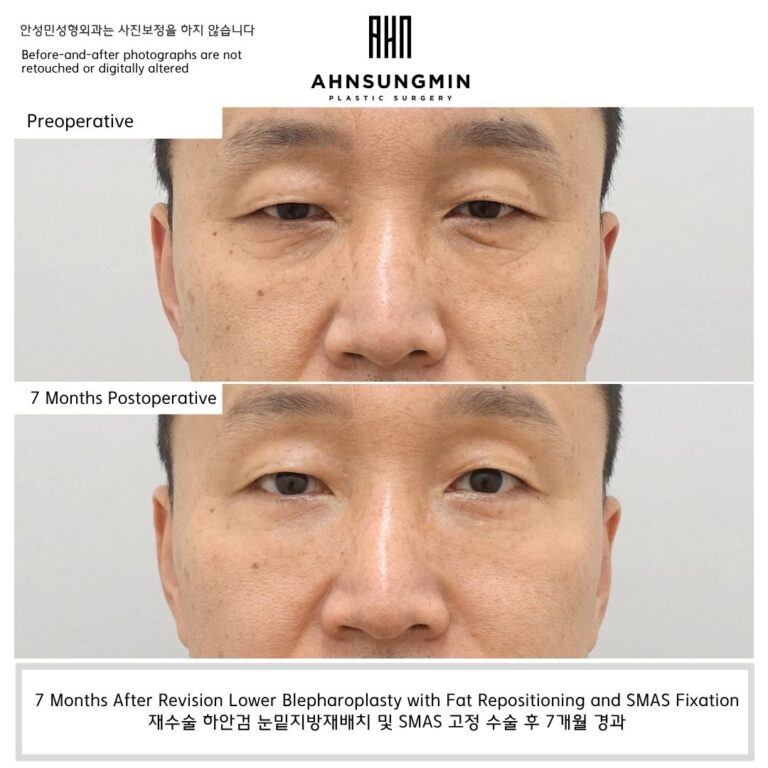
This patient previously underwent lower eyelid surgery but continued to experience contour irregularity and recurrent bulging.
Instead of removing additional fat, revision surgery focused on preserving tissue, repositioning orbital fat, and reinforcing structural support with SMAS fixation.
Seven months later, the lower eyelid demonstrates improved contour without an overcorrected or hollow appearance.
The goal was not simply to remove volume.
It was to restore structural balance.
Recurrence is often predictable.
Patients frequently ask,
“Why did my eye bags come back?”
In many cases, the original fat did not simply “grow back.”
Rather, the lower eyelid continued to age while structural support remained insufficient.
Weak supporting tissues allow neighboring fat compartments and soft tissue to shift over time.
What appears to be recurrence is often the natural consequence of an unstable lower eyelid rather than a failed operation.
Recurrence is not always unexpected.
It is frequently the result of structural imbalance.
Modern lower eyelid surgery focuses on preservation.
The philosophy of lower blepharoplasty has changed considerably.
Rather than aggressively removing fat, modern techniques aim to preserve existing tissue whenever possible.
Fat repositioning allows the surgeon to redistribute volume into hollow areas while maintaining the integrity of the lower eyelid.
The objective is not subtraction.
It is restoration.
Early improvement is not the same as long-term success.
Lower Blepharoplasty with Fat Repositioning and SMAS Fixation
43 Days Postoperative
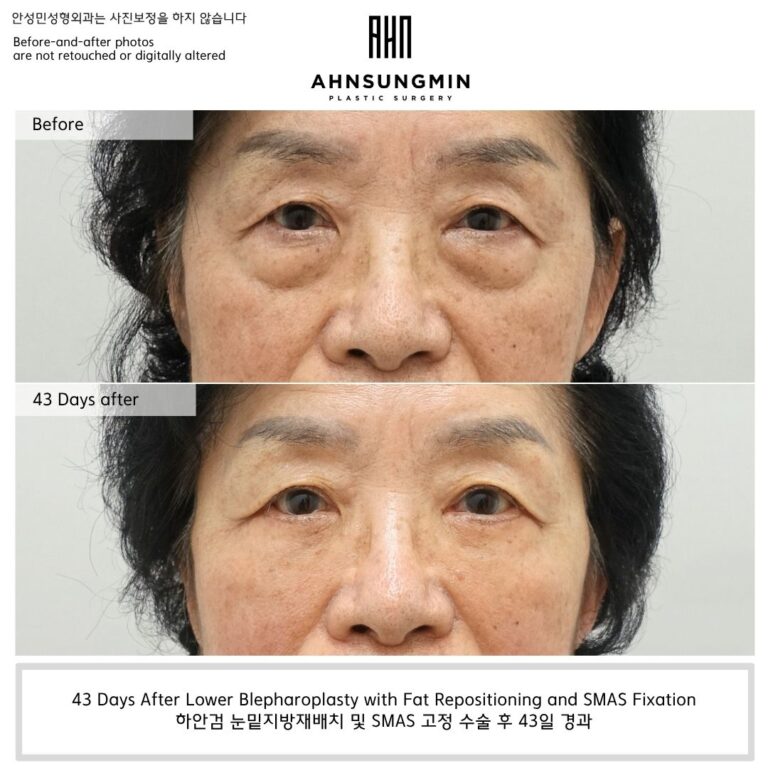
Although this patient is only 43 days after surgery, the lower eyelid already demonstrates smoother contour while preserving natural volume.
More importantly, no excessive tissue has been sacrificed in pursuit of immediate flatness.
Recovery continues over several months, but preserving support during the initial surgery greatly improves the likelihood of long-term stability.
The goal is not to create the flattest eyelid today.
It is to create the most stable eyelid years from now.
Revision becomes more difficult after excessive fat removal.
One of the greatest challenges in revision surgery is tissue deficiency.
Once orbital fat has been aggressively removed, recreating the original anatomy becomes extremely difficult.
Even with fat grafting or reconstructive procedures, restoring natural support is often limited.
The tissue preserved during the first operation frequently becomes the most valuable tissue during revision surgery.
This is why conservative surgical judgment remains one of the most important principles in lower eyelid surgery.
The best lower eyelid surgery often removes less.
Successful lower eyelid surgery is rarely defined by how much fat was removed.
Instead, it is measured by how naturally the lower eyelid continues to age over time.
Immediate cosmetic improvement should never compromise future stability.
Sometimes the most successful operation is the one that preserves more than it removes.
Related Insights
Why Lower Eyelid Surgery Is About Support, Not Removal
Why Lower Eyelid Bulging Returns After Surgery
How We Approach Recurrent Lower Eyelid Bulging
Frequently Asked Questions
1. Can eye bags return after lower eyelid surgery?
Yes. Eye bags can appear to return after surgery, especially if the underlying structural support was not adequately restored. In many cases, recurrence is related to aging, tissue descent, or insufficient support rather than fat simply “growing back.”
2. Is fat removal better than fat repositioning?
Not necessarily. Modern lower eyelid surgery often favors fat repositioning over aggressive fat removal because preserving existing fat helps maintain structural support and reduces the risk of hollowing and long-term contour irregularities.
3. Does removing too much fat increase the risk of recurrence?
Excessive fat removal can contribute to long-term problems. When too much supporting tissue is removed, the lower eyelid may gradually lose stability, making contour changes and apparent recurrence more likely as aging continues.
4. Can lower eyelid surgery be revised after excessive fat removal?
Yes, revision surgery is possible, but it is often more complex. Once orbital fat has been removed, restoring natural volume and support may require fat grafting, fat repositioning when possible, or additional reconstructive procedures.
5. What is the goal of modern lower blepharoplasty?
Modern lower blepharoplasty focuses on preserving structural support rather than removing as much fat as possible. The objective is to create a natural, stable lower eyelid that continues to age gracefully over time.
6.Does fat grow back after lower eyelid surgery?
No. Removed fat does not grow back. However, the lower eyelid continues to age. Changes in supporting tissues, remaining fat compartments, and skin laxity may create the appearance of recurrent eye bags, even though the original fat has not returned.
Concerned About Recurrent Lower Eyelid Bulging?
Recurrent lower eyelid bulging does not always mean the original fat has returned. Structural support, tissue aging, and previous surgical techniques all play an important role in long-term lower eyelid stability.
A personalized evaluation can help identify the underlying cause and determine whether observation, recovery, or revision surgery is the most appropriate next step.
Request a Revision Lower Blepharoplasty Evaluation
Online consultation available for international patients.
Seeing the Eye as a Whole, Not in Parts
A Clinic Dedicated to Eyelid Revision Surgery in Korea
Ahnsungmin Plastic Surgery
