Lower eyelid surgery is not about removing more skin.
One of the most common causes of failure in lower eyelid surgery is excessive skin excision.
Many patients believe that removing more skin creates a younger appearance. In reality, excessive skin removal often sacrifices the very structure that keeps the lower eyelid stable.
A smoother appearance immediately after surgery may come at the cost of long-term support.
What happens when too much skin is removed?
The lower eyelid depends on an appropriate amount of skin to maintain its normal position against the eye.
When excessive skin is removed, the eyelid loses its vertical reserve.
Instead of remaining supported, the eyelid begins to experience continuous downward traction.
As this tension increases, the lower eyelid gradually descends away from the globe.
This is a structural problem—not simply part of the healing process.
Early downward traction often appears before severe ectropion.
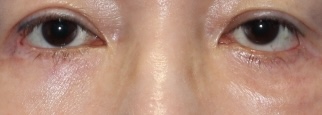
This image demonstrates an early stage of lower eyelid retraction after excessive skin excision.
Notice the increased scleral show beneath the iris and the downward displacement of the lower eyelid.
Patients often describe symptoms such as:
- Eyes that appear rounder than before
- Dryness and irritation
- Difficulty closing the eyes completely
- A constant feeling of tightness beneath the eyelid
These changes are frequently mistaken for postoperative swelling.
However, swelling resolves.
Skin shortage does not.
Skin shortage creates a problem that cannot simply “settle.”
Gravity acts on the lower eyelid every day.
Without sufficient skin length, there is no remaining tissue reserve to resist this downward pull.
Over time, eyelid malposition may become progressively worse.
This is why many revision cases begin with one seemingly small decision:
Removing just a little too much skin.
Preserving skin is often the safest surgical decision.
Modern lower blepharoplasty is not designed to maximize skin removal.
Its goal is to restore support while preserving the tissues necessary for long-term stability.
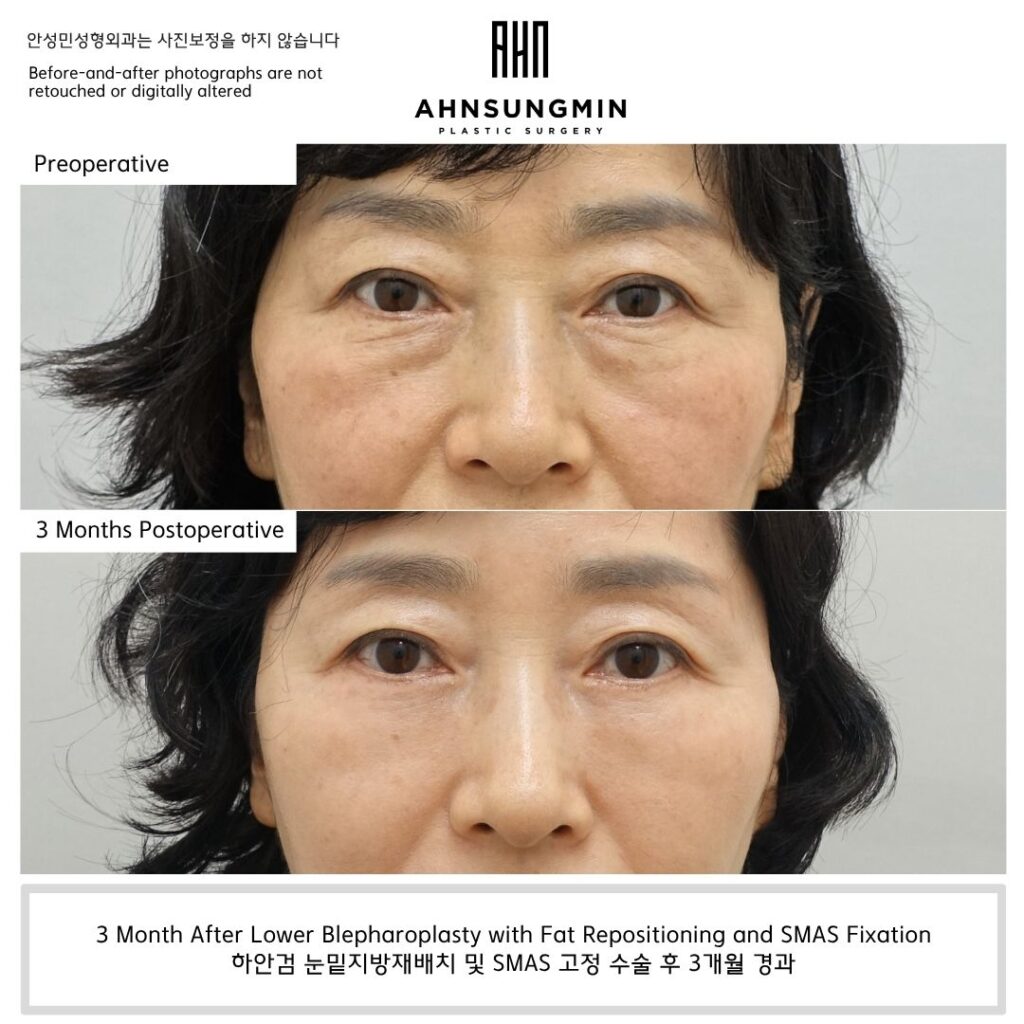
This patient underwent lower blepharoplasty with fat repositioning and SMAS fixation while preserving appropriate skin support.
Three months after surgery, the lower eyelids remain naturally positioned against the globe without downward traction.
The objective was not to create maximum tightness.
It was to maintain structural balance.
Revision becomes much more difficult once skin has been lost.
Unlike swelling, excessive skin removal cannot simply recover with time.
Every revision procedure increases scar formation and tissue adhesion.
Once skin becomes the limiting factor, reconstructive options become significantly more complex.
For this reason, experienced revision surgeons often consider skin preservation one of the most important decisions made during the initial surgery.
Lower eyelid surgery should preserve options—not eliminate them.
Removing less skin is not being conservative.
It is preserving the structural support that protects the eyelid for years to come.
Successful lower eyelid surgery is measured not by how tight the eyelid appears immediately after surgery—
but by how stable it remains years later.
Related Insights
Skin Shortage Is the Real Limitation in Lower Eyelid Revision Surgery
Why Lower Eyelid Surgery Is About Support, Not Removal
Why Fat Removal Leads to Recurrence in Lower Eyelid Surgery
Concerned About Lower Eyelid Tightness or Downward Pull After Surgery?
Persistent tightness, scleral show, or a downward-pulled lower eyelid may indicate more than routine postoperative swelling.
A careful structural evaluation can determine whether healing is progressing normally or whether skin shortage and lower eyelid retraction should be considered.
Request a Lower Eyelid Evaluation
Online consultation available for international patients.
Seeing the Eye as a Whole, Not in Parts
A Clinic Dedicated to Eyelid Revision Surgery in Korea
Ahnsungmin Plastic Surgery
