Patient Concern
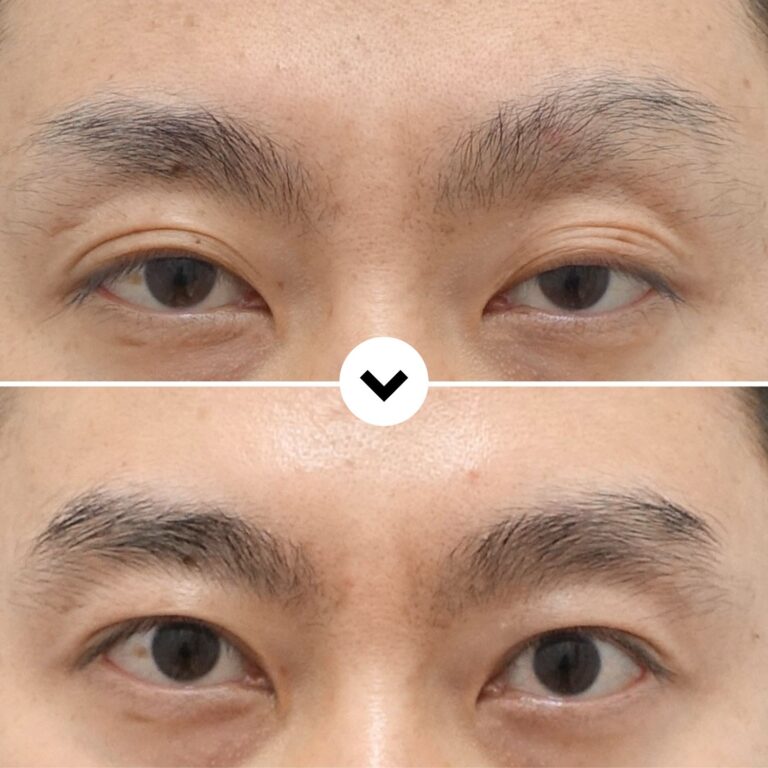
This patient visited our clinic seeking revision eyelid surgery after previous eyelid surgery because the eyes continued to appear tired, heavy, and only partially open.
Although a double eyelid crease had already been created, the patient remained dissatisfied with the overall appearance. The eyelids did not open fully, resulting in a persistent sleepy look and noticeable asymmetry.
Rather than requesting a higher or more prominent eyelid crease, the patient’s primary goal was to restore a brighter, more natural appearance by improving eyelid function.
Why Residual Ptosis Requires Functional Evaluation
Residual ptosis is one of the most common reasons patients remain dissatisfied after previous eyelid surgery.
Many patients assume that the double eyelid crease itself is the problem. In reality, the remaining weakness in eyelid opening often has a much greater influence on how the eyes appear.
When residual ptosis is overlooked, simply creating a higher fold or revising the crease rarely produces a meaningful improvement. Successful revision begins by identifying the underlying cause of the incomplete eyelid opening and determining whether functional correction is needed.
For this reason, revision surgery should always begin with careful structural and functional evaluation rather than focusing solely on cosmetic appearance.
Our Surgical Approach
For this patient, the objective was to restore eyelid function rather than create a larger or deeper crease.
The remaining levator muscle function, eyelid balance, and overall structural support were carefully evaluated before surgery. Based on these findings, the revision focused on improving eyelid opening while preserving a natural eyelid contour and maintaining facial harmony.
Rather than making the eyelids appear overcorrected, every surgical decision prioritized functional improvement, structural balance, and long-term stability.
Postoperative Month 6
Six months after revision surgery, the eyelids demonstrate improved opening, better symmetry, and a more natural appearance.
By this stage, postoperative swelling has largely resolved, allowing the functional improvement to become clearly visible. Instead of creating a more noticeable eyelid crease, the revision restored balanced eyelid function while preserving a soft and natural contour.
Although every patient heals differently, six months provides a far more meaningful time point for evaluating revision surgery than the early postoperative period. The result reflects not only cosmetic improvement but also improved structural balance and long-term functional stability.
Our Surgical Philosophy
Residual ptosis after previous eyelid surgery cannot be corrected simply by creating another eyelid crease.
Successful revision begins by understanding why the eyelids continue to appear heavy despite previous surgery. Careful functional evaluation, accurate diagnosis, and thoughtful surgical planning are essential for achieving stable long-term results.
When eyelid function is restored while preserving healthy tissue and structural balance, revision surgery can produce natural-looking improvements that remain stable over time.
Related Insights
Best Eyelid Revision Surgery in Korea: How to Choose the Right Specialist
Learn what distinguishes experienced revision specialists, from cause-based diagnosis and functional evaluation to long-term surgical planning and consistent postoperative care.
Why Residual Ptosis Can Remain After Eyelid Surgery
Explore why some patients continue to experience incomplete eyelid opening even after previous surgery and why functional assessment is essential before considering revision.
Why Long-Term Stability Matters More Than Immediate Results in Revision Surgery
Understand why revision surgery should be evaluated over months—not weeks—and how structural healing influences the final outcome.
Request a Revision Eyelid Surgery Evaluation
If your eyes still appear heavy, tired, or only partially open after previous eyelid surgery, a careful functional evaluation can help determine whether residual ptosis is contributing to your concerns.
Request a Revision Eyelid Surgery Evaluation
Online consultation available for international patients.
Seeing the Eye as a Whole, Not in Parts
A Clinic Dedicated to Eyelid Revision Surgery in Korea
Ahnsungmin Plastic Surgery
