Removing Eye Bags Should Not Mean Flattening the Lower Eyelid
Many patients believe that successful lower blepharoplasty should make the area beneath the eyes completely flat.
In practice, that is often where a natural result begins to disappear.
A youthful lower eyelid is not perfectly flat. It contains subtle curves and soft transitions that allow the eyes to remain expressive. The gentle fullness immediately beneath the eyelashes is commonly called the aegyo-sal in Korea.
The goal is not to make this area larger. It is to recognize when the patient’s natural contour should be preserved.
Removing an under-eye bag and removing the aegyo-sal are not the same thing.
The Real Decision Is What Should Remain
Lower blepharoplasty is often described in terms of what will be removed.
I believe the more important question is what should remain.
The lower eyelid contains skin, muscle, fat, and supporting structures that work together. Treating every visible fullness as excess tissue may produce a smoother appearance initially, but it can also remove features that made the eyes look natural.
Once the contour beneath the eyelashes has been flattened, recreating it may be much more difficult than preserving it during the original surgery.
For that reason, tissue should not be removed simply because it is present.
A Smooth Result Is Not Always a Natural Result
There is an important difference between reducing an under-eye bag and erasing every contour beneath the eye.
A completely flat lower eyelid may look tight, hollow, or disconnected from the cheek. The eyes may appear less expressive even when the bulging has improved.
This is why lower blepharoplasty cannot be planned by looking at the fat alone.
The surgeon must evaluate the relationship between the eyelid, the aegyo-sal, the tear trough, the orbital fat, and the upper cheek. A successful result depends on restoring smoother transitions without removing the anatomy that gives the lower eyelid its character.
Clinical Example
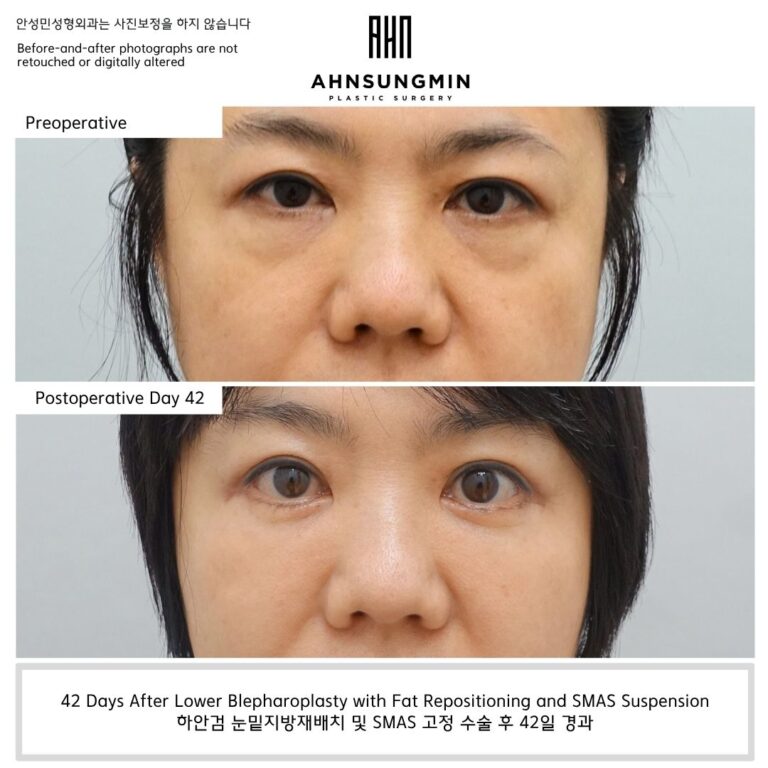
Postoperative Day 42 After Lower Blepharoplasty with Fat Repositioning and SMAS Suspension
In this patient, the under-eye bags were improved without eliminating the natural fullness beneath the eyelashes.
Fat repositioning was used to soften the uneven transition beneath the eyes, while SMAS suspension provided additional support. The objective was not to flatten the entire lower eyelid. It was to reduce the tired appearance while preserving the contour that belonged to the patient.
At postoperative day 42, some recovery is still continuing. However, the lower eyelid already appears smoother while maintaining a natural aegyo-sal and facial expression.
Preservation Often Requires More Judgment Than Removal
Removing tissue is technically possible in many cases.
Knowing when not to remove it requires more judgment.
This is especially important in patients with thin skin, limited fat, preexisting hollowing, or previous lower eyelid surgery. In these patients, aggressive removal may create a short-term improvement in bulging but increase the risk of a hollow or aged appearance later.
Fat repositioning may be appropriate when existing fat can be used to improve the transition below the eyelid. Structural support may also be necessary when laxity or downward pull is present.
The operation should be determined by the patient’s anatomy—not by a routine formula.
Aegyo-Sal Preservation Is Not the Same as Aegyo-Sal Augmentation
Preserving the natural aegyo-sal does not mean intentionally creating a larger roll beneath the eyelashes.
These are different decisions.
Some patients naturally have visible aegyo-sal. Others have very little. The goal of lower blepharoplasty is not to give every patient the same contour.
The goal is to avoid unnecessarily destroying a feature that is already part of the patient’s anatomy.
Natural surgery should preserve individual differences rather than replace them with one standardized result.
Long-Term Results Depend on Restraint
The early postoperative result is not the only result that matters.
Lower eyelid tissues continue to change with healing, aging, and gravity. A procedure that relies on aggressive removal may appear smooth at first but become hollow or structurally weak over time.
This is why restraint is part of surgical planning.
Healthy tissue should be preserved whenever possible. Fat should be repositioned only where it is needed. Support should be restored when the lower eyelid requires it.
The best operation is not the one that removes the most. It is the one that corrects the problem while leaving the natural eyelid recognizable.
The Lower Eyelid Should Still Look Like the Patient’s Own
Successful lower blepharoplasty is not measured by how flat the lower eyelid becomes.
It is measured by whether the eyes look less tired without appearing operated on.
The under-eye bag may need correction. The transition to the cheek may need support. But the soft contour beneath the eyelashes often deserves to remain.
Preserving the aegyo-sal is not a minor aesthetic detail.
In the right patient, it is part of preserving identity, expression, and a natural long-term result.
Related Insights
Lower Blepharoplasty Recovery Timeline
Understand how swelling changes and when natural lower eyelid contours become visible.
Lower Blepharoplasty with Fat Repositioning
Discover how fat repositioning helps preserve volume while improving under-eye bags.
Lower Eyelid Fat Repositioning in Korea
Choosing the Best Lower Eyelid Surgeon in Korea
Frequently Asked Questions
1. Does lower blepharoplasty remove the natural aegyo-sal?
Not necessarily. A well-planned lower blepharoplasty should improve under-eye bags without unnecessarily removing the natural fullness beneath the eyelashes. Preserving the natural aegyo-sal often helps maintain a more youthful and natural appearance.
2. Can the aegyo-sal disappear after lower eyelid surgery?
Yes. If excessive fat or supporting tissue is removed, the natural contour beneath the eyelashes may become flatter. Once this contour is lost, restoring it can be more difficult than preserving it during the initial surgery.
3. Is a completely flat lower eyelid the ideal result?
Not always. A youthful lower eyelid usually has subtle contours rather than a completely flat surface. The goal is to reduce eye bags while maintaining the natural transition between the lower eyelid and the cheek.
4. Why is fat repositioning important for preserving the aegyo-sal?
Fat repositioning redistributes existing orbital fat instead of simply removing it. When appropriate, this approach helps improve under-eye bags while preserving the natural lower eyelid contour and reducing the risk of an overly flat appearance.
5. How do you decide whether to preserve or remove tissue?
The decision depends on each patient’s anatomy, skin quality, fat distribution, lower eyelid support, and long-term goals. Rather than following a routine formula, treatment should be individualized to preserve natural anatomy whenever possible.
Concerned About Your Lower Eyelids?
Every lower blepharoplasty should be tailored to your anatomy. A personalized evaluation can help determine whether tissue preservation, fat repositioning, or another approach is most appropriate for achieving natural, long-term results.
Request a Lower Blepharoplasty Evaluation
Online consultation available for international patients.
