Many patients considering lower eyelid surgery are not looking for dramatic change.
In fact, one of the most common concerns is whether surgery will make them look different.
They are not necessarily trying to look younger.
They are not looking to change their eye shape.
And they certainly do not want people asking whether they had surgery.
What they want is much simpler.
They want to look less tired.
Less heavy.
Less distracted by the bulging or hollowing beneath the eyes.
Without looking like a different person.
The Goal Is Not to Create a New Face
One of the most common misconceptions about lower eyelid surgery is that dramatic change means a better result.
In reality, the best lower eyelid surgery often attracts very little attention.
Friends may notice that the patient looks more rested.
Family members may comment that the face appears brighter.
But few people can identify exactly what changed.
That is often a sign that the surgery respected the patient’s natural anatomy rather than trying to create a completely different appearance.
Before and After
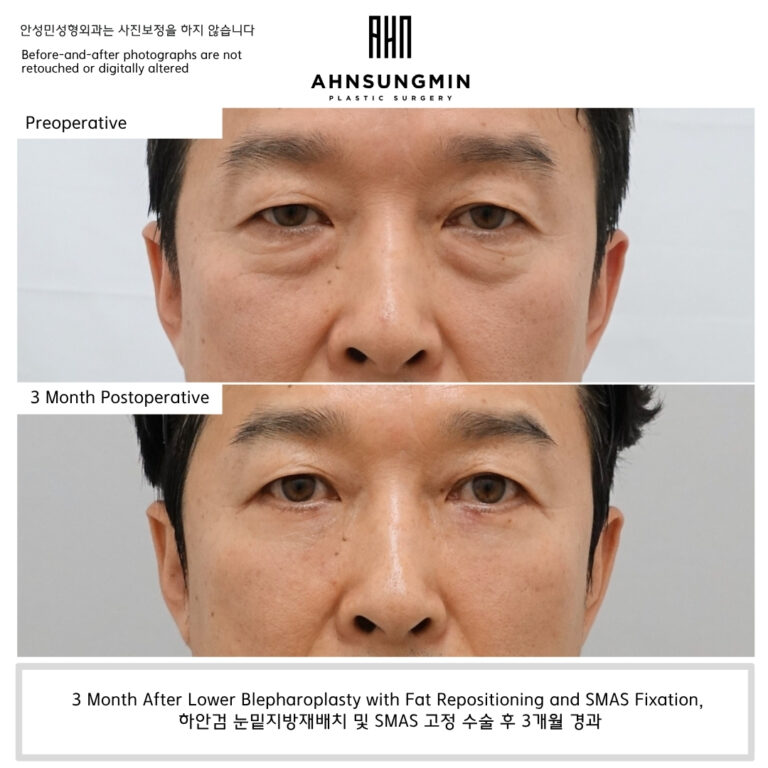
Postoperative Month 3 After Lower Blepharoplasty with Fat Repositioning and SMAS Fixation
Although the under-eye contour appears smoother and more balanced, the overall appearance of the face remains familiar.
The eyes do not look larger.
The expression does not appear artificial.
The goal was simply to reduce the distraction caused by under-eye bulging and contour irregularity while preserving the patient’s natural appearance.
Recovery Timeline
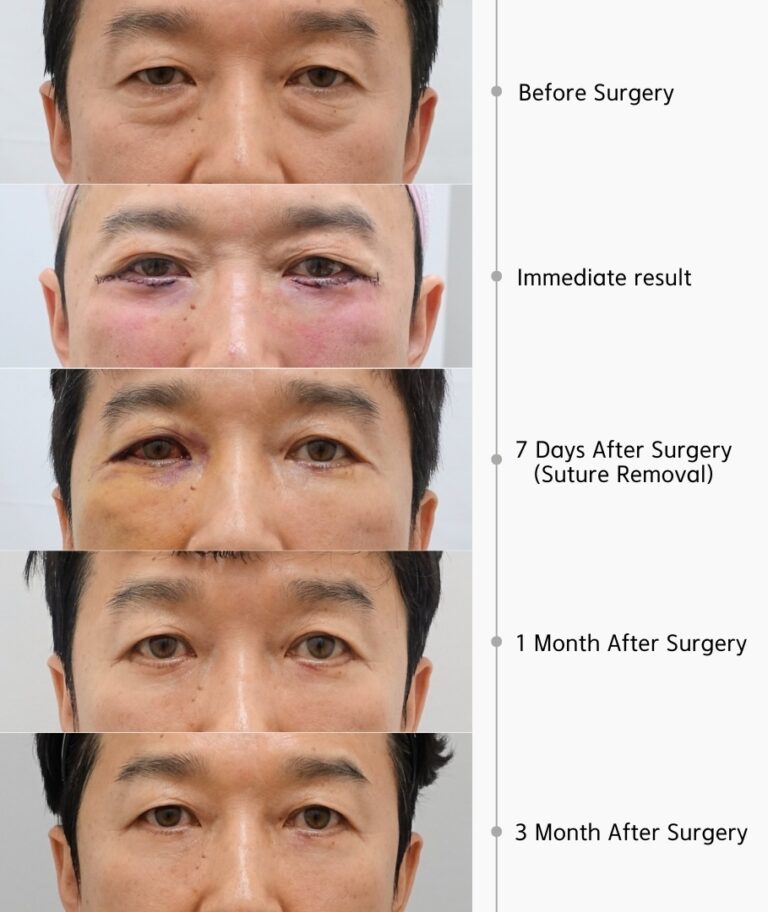
Recovery Timeline After Lower Blepharoplasty with Fat Repositioning and SMAS Fixation
Many patients worry when they see bruising and swelling during the first few days after surgery.
However, early recovery rarely reflects the final result.
In this patient, bruising was most noticeable during the immediate postoperative period and gradually improved during the first week.
By the time the sutures were removed, much of the initial swelling had already begun to settle.
At one month, the under-eye contour appeared significantly smoother, although healing and tissue remodeling were still ongoing.
By three months, the contour appeared more stable and natural as residual swelling continued to improve and the tissues settled further.
One of the most important things patients should understand is that lower eyelid surgery is a process rather than a single moment.
The appearance changes gradually as swelling resolves and tissues stabilize.
For this reason, the first few days after surgery should not be used to judge the final outcome.
Why Some Results Look Unnatural
Patients often worry about looking “overdone” after lower eyelid surgery.
In many cases, this concern comes from seeing results where excessive tissue was removed.
Aggressive fat removal, excessive tightening, or overcorrection can sometimes create an appearance that feels different from the patient’s natural facial character.
The under-eye area may look flatter.
The eyes may appear pulled.
The face may no longer move naturally.
These changes often attract attention for the wrong reasons.
Natural Results Require Restraint
Lower eyelid surgery is not simply about removing something.
It is often about preserving important structures while restoring balance.
Fat may be repositioned rather than aggressively removed.
Support structures may be reinforced rather than tightened excessively.
Volume may be preserved rather than eliminated.
The goal is to improve the contour while maintaining the features that make the face recognizable.
Looking Better Is Not the Same as Looking Different
Many patients are surprised by how subtle successful lower eyelid surgery can appear.
The improvement is often noticed more through overall facial balance than through any dramatic change in a specific feature.
The face still looks like the same person.
The eyes still look familiar.
The difference is that the under-eye area no longer draws unnecessary attention.
Postoperative Month 3
At three months, much of the early swelling has improved, but healing continues beyond this stage.
As tissues continue to soften and settle, the result often becomes even more natural over time.
Long-term stability remains more important than creating an immediate dramatic change.
Frequently Asked Questions
1. Should lower eyelid surgery make me look different?
Not necessarily. The goal is often to improve under-eye contour while preserving your natural appearance and facial character.
2. Why do some lower eyelid surgery results look unnatural?
Excessive fat removal, over-tightening, or aggressive correction may sometimes create an appearance that no longer looks natural.
3. Can people tell if I had lower eyelid surgery?
Many successful results appear subtle. Friends and family may notice that you look more rested without knowing exactly why.
4. Is fat always removed during lower eyelid surgery?
Not always. In many patients, fat repositioning and volume preservation are important parts of achieving a natural result.
5. When do lower eyelid surgery results start to look natural?
Recovery varies, but most patients continue to see improvement as swelling resolves and tissues soften over several months.
Insights
Natural-looking lower eyelid surgery often depends on preserving volume rather than removing too much tissue.
Why Lower Eyelid Hollowing Happens Over Time
Recovery continues beyond the first few weeks, and early photographs rarely represent the final result.
Lower Eyelid Surgery Recovery Timeline: When Results Become Natural
Long-term support plays an important role in maintaining stable lower eyelid position over time.
Understanding Lower Eyelid Surgery: Structure, Support, and Long-Term Stability
Preserving natural facial expression is often more important than removing every visible wrinkle.
Why Are Some Wrinkles Still Visible After Lower Eyelid Surgery?
Request a Lower Eyelid Surgery Evaluation
Many patients are not looking to look different. They simply want the under-eye area to appear less tired while preserving their natural appearance.
A personalized evaluation may help determine whether lower eyelid surgery can improve under-eye contour while maintaining the facial features that make you look like yourself.
