Before and After.
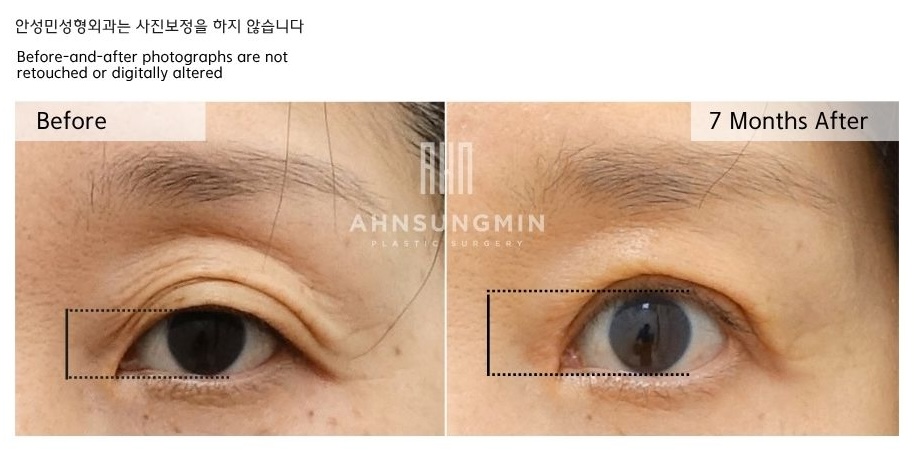
Before / 7 Months After Revision Surgery for Multiple Eyelid Folds
Some patients visit our clinic not because the eyelid fold is too small, but because the fold has become unstable over time.
Instead of one clear crease, several parallel lines begin to appear above the original fold. In some cases, the eyelid starts forming triple folds or layered creases that change throughout the day depending on swelling, eye opening strength, or fatigue.
This type of problem is often more structural than aesthetic.
In many revision cases, the issue is not simply “where the fold is,” but how the fold is being supported internally.
Why Multiple Folds Develop.
Multiple eyelid folds often appear when the original fixation weakens or when scar adhesion forms unevenly after previous surgery.
As the internal support becomes unstable, the eyelid may begin creating secondary lines above the original crease during eye opening. Patients often describe this as:
- “My fold keeps splitting.”
- “Several lines appear when I open my eyes.”
- “The crease changes every day.”
- “One side keeps folding differently.”
In some patients, functional eye opening weakness also contributes to this instability. When the forehead or surrounding muscles compensate repeatedly during eye opening, additional creases may gradually form over time.
This is why some multiple-fold cases cannot be corrected simply by creating a new line.
The underlying structural imbalance must first be understood.
Why We Did Not Create a Larger Fold.
In this case, the goal was not to make the eyelids look larger or deeper.
Creating a higher or stronger fold in already unstable tissue can sometimes worsen the appearance of layered creases. Excessive fixation may also increase tension and stiffness in the upper eyelid.
Instead, the revision focused on:
- simplifying the fold structure
- releasing unstable adhesion
- improving fold stability
- restoring a more natural upper eyelid contour
The objective was long-term stability rather than dramatic change.
Structural Approach to Revision.
Revision surgery for multiple folds often requires careful judgment because the tissue has already been altered by previous procedures.
In patients with repeated crease formation, scar tissue, fixation imbalance, and skin behavior during eye opening must all be evaluated together.
For this reason, revision surgery is not simply about removing old lines.
The surgery must reduce the conditions that continuously recreate unstable folds.
In many cases, restraint becomes more important than aggressive correction.
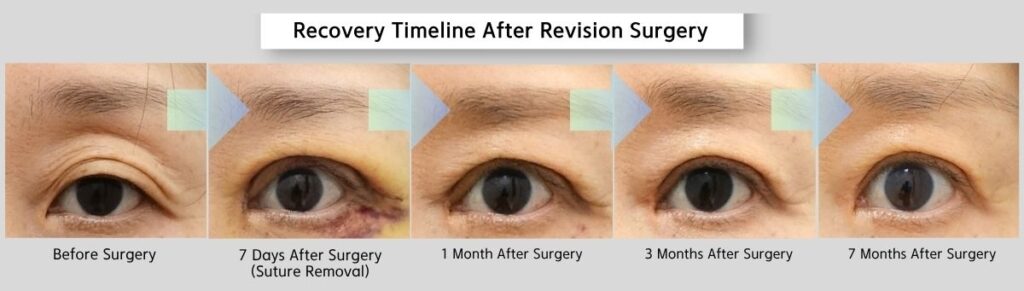
Recovery Timeline After Revision Surgery.
Results at 7 Months.
At 7 months after revision surgery, the multiple layered folds appear significantly reduced, and the upper eyelid crease looks more stable during eye opening.
The goal was not perfection or excessive sharpness.
The goal was to restore a fold that behaves more naturally and consistently over time.
Patients experiencing multiple eyelid folds often also struggle with related issues such as unstable high folds, functional eye opening imbalance, scar adhesion, and prolonged recovery after previous surgery. In some cases, understanding the structural cause of repeated crease formation becomes more important than simply creating a new fold. Related insights may also help explain why some revision cases require ptosis correction, why swelling and fold instability can continue for months during recovery, and how long-term stabilization is approached in complex revision eyelid surgery cases in Korea.
Frequently Asked Questions.
Why do multiple eyelid folds develop after previous surgery?
Multiple eyelid folds often develop when the original crease fixation becomes unstable or when scar adhesion forms unevenly after surgery. Functional eye opening imbalance and repeated compensation can also contribute to layered crease formation over time.
Can triple eyelid folds be corrected with revision surgery?
In many cases, revision surgery can improve unstable or layered eyelid folds by simplifying the crease structure and restoring more stable internal support. However, the surgical approach depends on scar tissue condition, fixation balance, and the remaining eyelid anatomy.
Why not simply create a stronger or higher fold?
In revision cases involving unstable tissue, aggressive fixation or higher folds can sometimes worsen stiffness, asymmetry, or repeated crease formation. Long-term stability is often more important than creating a larger fold.
Is ptosis related to multiple eyelid folds?
In some patients, weakened eye opening function or compensatory forehead muscle use contributes to unstable crease formation. This is why certain multiple-fold revision cases may also require functional ptosis correction.
How long does recovery take after revision eyelid surgery?
Recovery after revision eyelid surgery is usually longer than primary surgery because scar tissue and altered anatomy require more stabilization time. Swelling and crease settling may continue improving for several months after surgery.
Request a Revision Eyelid Surgery Evaluation.
Multiple eyelid folds and unstable crease formation are often caused by structural imbalance rather than simply the position of the fold itself. In many revision cases, careful analysis of scar adhesion, fixation stability, eye opening function, and long-term tissue behavior becomes more important than creating a larger or stronger crease.
If you are experiencing layered eyelid folds, triple folds, unstable crease changes, or asymmetry after previous eyelid surgery, a detailed structural evaluation may help determine whether revision surgery is appropriate.
Ahnsungmin Plastic Surgery in Korea specializes in revision eyelid surgery focused on structural balance, functional stability, and long-term natural outcomes.
→ Request a Revision Eyelid Evaluation
Seeing the Eye as a Whole, Not in Parts
A Clinic Dedicated to Eyelid Revision Surgery in Korea
Ahnsungmin Plastic Surgerynbsp;
